
The Enterprise Video Operating Model
shootsta.
The Enterprise Video Operating Model
By Shootsta · Published July 3, 2026 · Updated October 2026
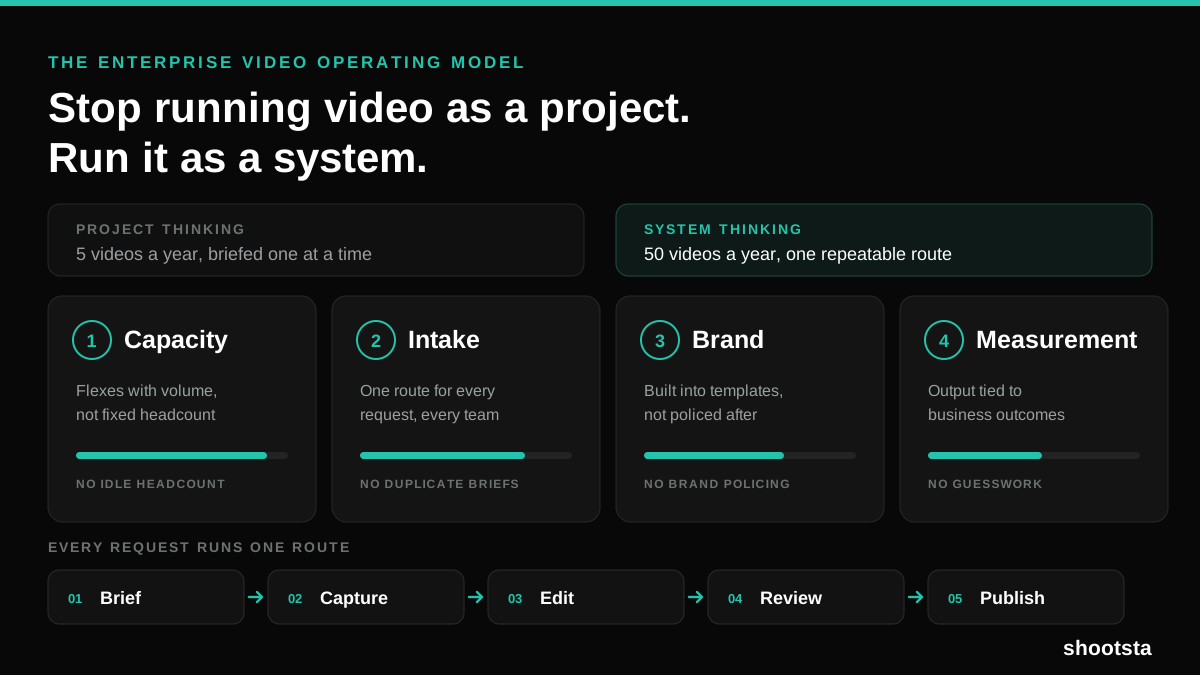
Five videos a year is a project. Fifty is a system. The enterprise video operating model is that system, built on four pillars: capacity that flexes with volume, one intake route, brand built into the workflow, and measurement tied to business outcomes. Here is how to tell which stage you are at and how to build the model in 90 days.
The enterprise video operating model is the way a company produces video as an always-on system rather than a run of one-off projects. It rests on four pillars: capacity that flexes with volume instead of fixed headcount, one intake route every request runs through, brand standards built into the workflow instead of policed at the end, and measurement that ties output to business outcomes. Five videos a year is a project. Fifty is a system, and that difference is what lets you scale output without runaway cost or brand drift.
You probably do not have a video problem. You have a model problem. Video gets planned the way a project gets planned: a brief, a quote, a timeline, a delivery. That holds up fine at a handful of pieces a year. It falls over the week three departments each want video and the calendar is already full, which is where a lot of large teams now find themselves.
The teams that got past it did something different. They stopped treating each piece as its own project and started running video as a system in the background of the business. That shift has a name, and it is worth defining with care, because it changes how you resource, budget and report on everything downstream.
What is the enterprise video operating model?
The enterprise video operating model is a repeatable system for producing on-brand video at volume, built so capacity flexes with demand and quality holds without manual policing. It is the operational answer to the enterprise video production bottleneck, where demand for video outruns your team's ability to make it. Instead of scaling by adding people or briefing a new agency each time, the model scales by running one route that any request can flow through.
Think of how finance or IT already works in your business. Nobody stands up a new finance function for each invoice. There is a system, and volume runs through it. The operating model applies the same logic to content: one intake, one workflow, one brand standard, one set of numbers that proves it is working.
Every piece starts from nothing. New brief, new quote, new scramble for a slot in someone's week. It works until the requests multiply.
The same route handles ten pieces or a hundred. Volume goes up, the process holds, and the cost stays something you can forecast.
Why does project thinking break at scale?
Project thinking breaks because the overhead per video never goes down. Each piece gets a fresh brief, a fresh cost estimate, and a fresh hunt for time on someone's calendar. At five videos a year that overhead is invisible. At one a week it becomes the job, and your team spends more of the week coordinating video than making it.
The cost model breaks the same way. Per-project pricing means the invoice climbs in lockstep with output, so more video always means more spend and no volume relief. Fixed in-house headcount has the opposite flaw: you carry capacity that sits idle between launches, then get swamped when three campaigns land in the same week. Neither shape suits steady, always-on volume, which is what a modern content calendar demands.
What does one intake route look like?
One intake route means every video request from every function enters the same front door, on the same brief, and comes out the same way. Sales does not brief its own freelancer while HR emails an agency and product quietly buys an editing subscription. The route below is the spine of the model, and it is usually the first thing worth fixing, because agreeing one brief costs nothing and it immediately shows you your true volume.
What are the four pillars of the model?
The four pillars of the enterprise video operating model are on-demand capacity, one intake route, brand built into the workflow, and measurement tied to business outcomes. Miss one and the system leaks: output stalls, brand drifts, or the program cannot prove its worth the moment budgets tighten.
Pillar one: capacity that flexes with volume
The first pillar swaps fixed headcount for capacity you can dial. Launch weeks, events, and seasonal pushes create spikes no realistic in-house team can staff for without sitting idle the rest of the quarter. On-demand capacity absorbs the peak and shrinks back after, so you pay for the work you ship. This is the pillar that lets a small internal team take on far more than its headcount suggests.
Pillar two: one intake route
The second pillar gives every request the same front door. A single route with a standard brief kills duplicate work, stops requests falling through the cracks, and gives you one clear view of everything in flight. It is the least glamorous pillar, and it is usually the one that speeds things up the most.
Pillar three: brand built into the workflow
The third pillar makes on-brand the default rather than a final inspection. When intros, lower thirds, fonts, and your brand palette are locked into templates and shared assets, every editor starts from the right place. Brand consistency stops being a manual check across a stack of vendors and becomes a property of the workflow. As output multiplies, this is the pillar that protects what you have built. We go deeper on it in keeping brand consistency as video scales.
Pillar four: measurement
The fourth pillar ties output to outcomes. A program that cannot show what its video did will always be first on the list when budgets tighten. Measurement means tracking volume, turnaround, and cost per finished piece, then connecting that output to the campaigns and results it supported. It is how video stops being an expense line you defend and starts being a function that earns more budget.
How do you know which stage you are at?
If video in your business is coordinated but still briefed one piece at a time, you are at stage two. The four stages below describe how a video program usually matures. Find the row that sounds like your last quarter, and the gap to the next row is your work.
- How many videos did the business publish last quarter, across every team?
- What did the average finished piece cost you, all in?
- How long from approved brief to first edit?
- Who signs off on brand, and at what point in the process?
- Which business result did last quarter's video support?
How do you build the model in 90 days?
You build it in three moves. Fix intake, then fix capacity, then wire in brand and measurement. Do them in that order. Intake is the cheapest move and it exposes your real volume, which is the number every later decision depends on.
- Publish one brief form and one owner for it
- Count every request that came in last quarter, from every team
- Log turnaround and cost on each piece, even roughly
- Split the work into what your team should own and what should flex
- Put the flexible half with one partner rather than four
- Run a launch week through the new route and time it end to end
- Move intros, lower thirds, fonts, and palette into shared templates
- Agree the five numbers you will report every quarter
- Take the first report to your CFO before they ask for it
This article explains the four pillars. The playbook is the part you work through with your team, printed or on screen.
- A 20-point scorecard that grades your current model pillar by pillar
- The one-page intake brief you can put in front of every team on Monday
- A 90-day rollout plan split into what to fix first, second, and last
- The five numbers to put in front of your CFO, with how to source each one
How does this help you prove video ROI to leadership?
A system produces numbers that a run of projects never can. When every request goes one route, you can report exactly how many pieces shipped, how fast, and at what cost each. You can line that up against the campaign calendar and show video kept pace with demand rather than holding it back. That is the language an economic buyer responds to.
It fixes the cost conversation too. Volume-based cost lets you forecast a full year of video spend instead of reacting to invoices one project at a time. When finance can see cost per finished piece falling as volume rises, video stops reading as an expense. We lay out the numbers side in the business case for enterprise video.
What does the model look like in practice?
DUAL, a specialty insurer, runs this model. Rather than hire a production team or brief a new agency for every piece, they built a repeatable system that ships on-brand video at volume without adding headcount. Requests run one route, brand is baked into the templates, and capacity flexes with their calendar. The result is more output, faster turnaround, and one consistent brand across all of it.
That is the operating model working as designed: a system the business can rely on rather than a bottleneck it works around. How you build it, in-house, agency, or platform, is its own decision, which we weigh up in in-house, agency, or platform for video and the business case for a video production platform.
Frequently asked questions
What is the difference between a video operating model and a video operating system?
They describe the same idea at two altitudes. The enterprise video operating model is the strategic framework: the four pillars and the shift from project to system thinking. The video operating system is the day-to-day operational version, the specific intake, workflow, and governance steps that make the model run. Read the model to decide direction, then read the operating system to build it.
We already have an in-house video team. Does this replace them?
No, and a model that tried to would fail. Your in-house team knows the brand, the stakeholders, and the story better than any outsider will. What they cannot do is absorb a launch week, a global campaign, and a quarterly all-hands in the same fortnight without something slipping. The operating model gives them elastic capacity underneath, so they hold creative direction while the volume work flexes around them. We cover the split in how a video partner extends your in-house team.
Do we need to make fifty videos a year for this to be worth it?
No. The number is an illustration rather than a cut-off point. The model earns its keep the moment demand outgrows a project-by-project approach, which for many teams is well under fifty pieces a year. If requests are piling up, review is slow, or brand is drifting across vendors, you already have a model problem worth fixing.
How do we start moving from projects to a system?
Begin with intake, because it is the fastest win and the base for everything else. Route every video request through one standard brief and one owner, then layer in flexible capacity, brand templates, and simple measurement. Research on operating-model change points the same way: getting one front door in place is usually the step that makes the rest possible.
How long does it take to stand one up?
Assume a quarter to get the shape right and two more to make it routine. Intake can be live inside a month because it is a form, an owner, and an agreement. Flexible capacity takes as long as your procurement process takes. Brand templates and reporting land last, once you have enough volume flowing through the route to be worth templating.
Sources and further reading
The patterns above line up with how researchers describe rising video demand and how operating models scale a function without scaling headcount. For wider context:
- Wistia State of Video report, where research shows video volume per business climbing year over year.
- HubSpot marketing statistics, where studies find video is now a core format across the buyer journey.
- McKinsey on operating models, on how a function run as a system scales output without a matching rise in cost.
On Shootsta's side, see how a CMO should think about enterprise video and the DUAL case study.
Where to go next
This is the framework post in a series for marketing leaders. For the problem the model solves, read the enterprise video production bottleneck. For the operational how-to, read the video operating system. For the leadership view, read how a CMO should think about enterprise video.
To see how far your current setup sits from this model, run it through the CMO video scorecard. It grades coverage, brand, turnaround, cost per video and measurement out of 25.
To map your own program against the four pillars, book a free consultation.
The Enterprise Video Operating Model
This is the worksheet version of the article. Score your current model, then build the new one in 90 days.
- A 20-point scorecard that grades your model pillar by pillar
- The one-page intake brief to put in front of every team
- A 90-day rollout plan, split into what to fix first, second, and last
- The five numbers to take to your CFO, and where each one comes from
No cost, no meeting. Straight to your inbox.
Read the latest at shootsta.com/blog/enterprise-video-operating-model
You might also like

How to Plan Video Team Capacity Around Leave
Your only editor just booked two weeks off, and you already know which projects will slip. Chad Lakin explains how to plan video team capacity so the work keeps moving when someone is away.
Corporate Video Editing Standards: Full Guide
A two-page editing standard does more for consistency than a forty-page brand book. Here is what it should cover, who owns each part, and how to enforce it with an in-house editor or an outside partner.
Quality Control in Outsourced Video Editing
When editing leaves the building, quality has to be checked by a system rather than by whoever happens to look. Here is the system: acceptance criteria, two QA gates, counted revision rounds and a quarterly audit.
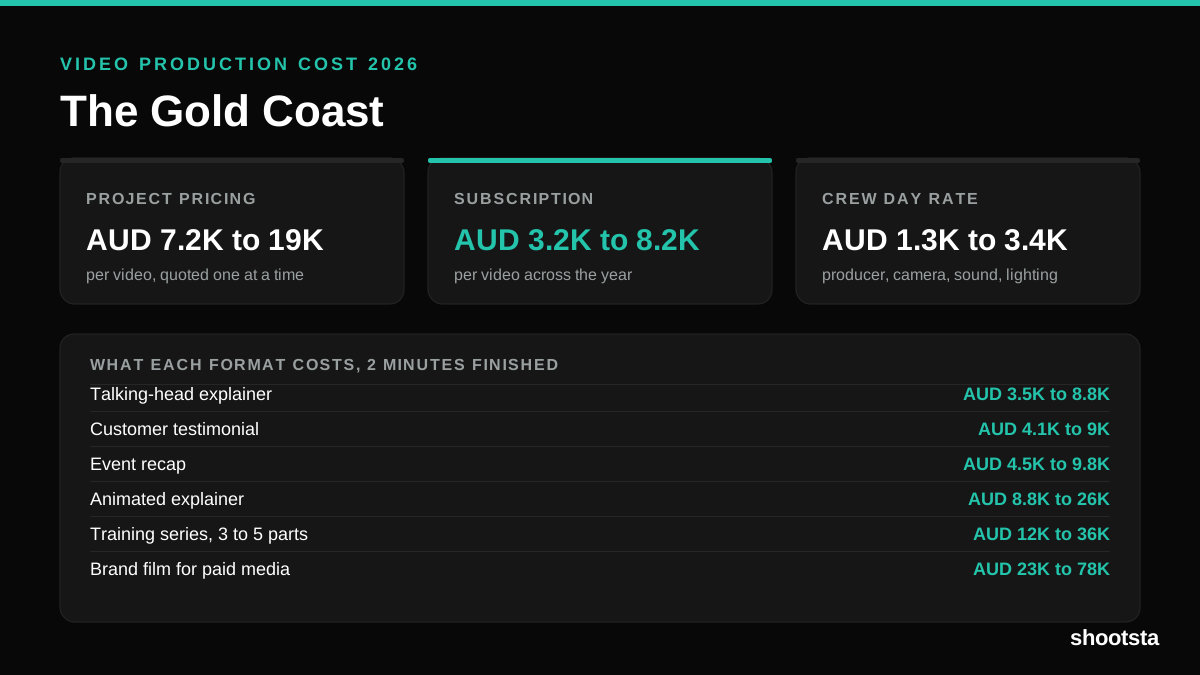
Video Production Cost on the Gold Coast 2026
Video production in the Gold Coast costs AUD 3,200 to AUD 8,200 per finished video on a subscription model, and AUD 7,200 to AUD 18,500 for one-off project work. Here is what you are paying for, and how the three pricing models compare.
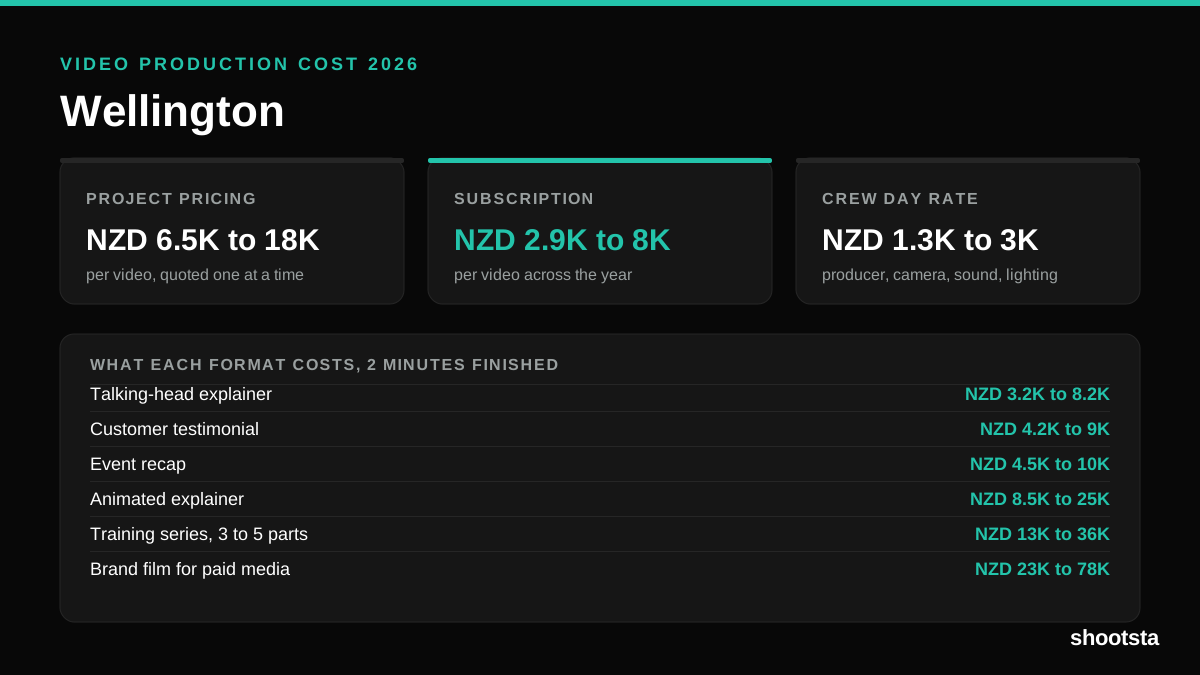
Video Production Cost in Wellington (2026)
Video production in Wellington costs NZD 2,900 to NZD 8,000 per finished video on a subscription model, and NZD 6,500 to NZD 18,000 for one-off project work. Here is what you are paying for, and how the three pricing models compare.
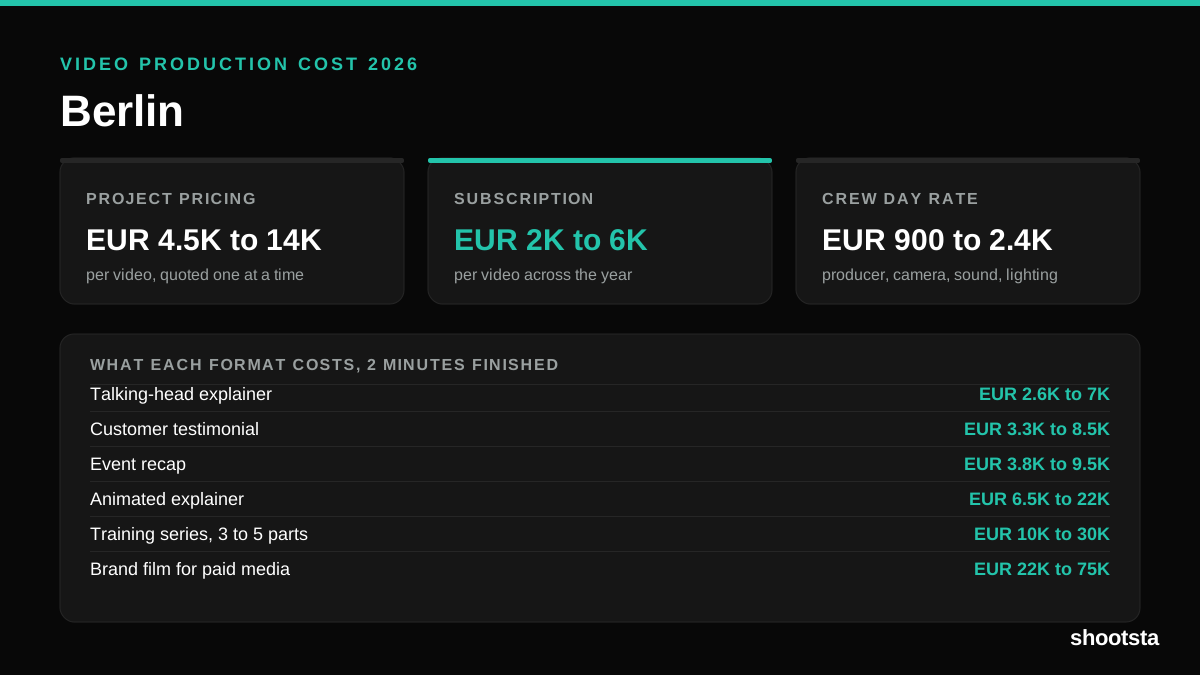
Video Production Cost in Berlin (2026)
Video production in Berlin costs EUR 2,000 to EUR 6,000 per finished video on a subscription model, and EUR 4,500 to EUR 13,500 for one-off project work. Here is what you are paying for, and how the three pricing models compare.