
10 Checks for Corporate Video Editing Services
shootsta.
10 Checks for Corporate Video Editing Services
By Shootsta · Published August 20, 2026 · Updated October 2026
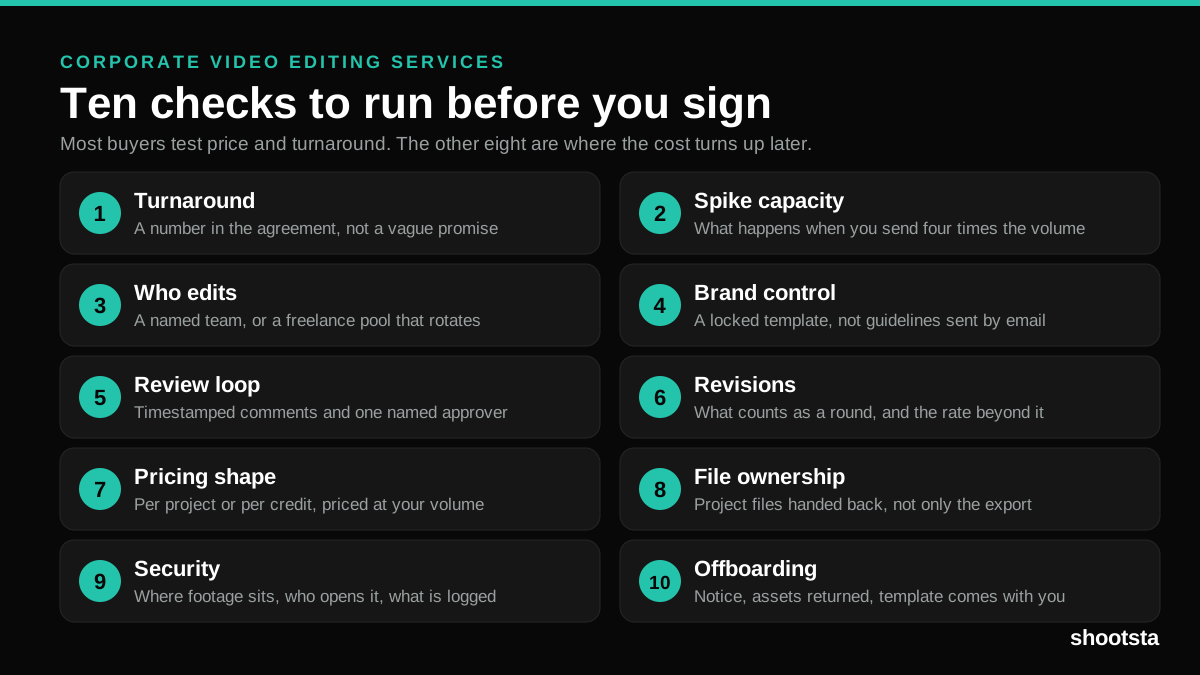
Most buyers compare corporate video editing services on price and turnaround, then get caught by the other eight things. Here are the ten checks to run before you sign, and the answers that tell you a partner can hold up at volume.
Short answer. Corporate video editing services are outsourced teams that turn footage your business already has into finished, on-brand video. When you compare them, test ten things: turnaround stated as a commitment, capacity in your spike months, who edits and where they sit, how brand rules are enforced, the review loop, how revisions are counted, the shape of the pricing, who owns the footage and project files, how your footage is secured, and what happens when you leave. It is easy to test only price and turnaround, but the other eight are where extra cost tends to turn up later.
Picking between corporate video editing services looks simple from the outside. Each provider shows a good showreel and says the turnaround is fast. The quotes land within a few thousand of each other, so the decision gets made on price.
Then the first busy month arrives. The edits come back off-brand, the review loop drags on for extra rounds and the invoice carries line items nobody quoted for. At that point it is clear the showreel was the wrong thing to test.
This is the checklist we would run on corporate video editing services in your position, built from what goes wrong after the contract is signed rather than what looks good in a pitch. For each of the ten questions, you get the answer that should reassure you and the answer that should worry you.
What to look for in corporate video editing services
Here is the whole checklist in one table. Take it into your next call with any of the corporate video editing services on your shortlist and mark each row as you go.
| What to check | A good answer sounds like this | A warning sign sounds like this |
|---|---|---|
| 1. Turnaround | A stated number of business hours for a first cut, with a defined response when it slips. | "Usually a few days, depending on the queue." |
| 2. Spike capacity | A bench of editors and a queue that flexes to four or five times normal volume. | "We would need plenty of notice for that." |
| 3. Who edits | A named pod that handles your work every time, in a stated location. | "We match each job to an available editor." |
| 4. Brand control | A locked template or workspace holding your fonts, titles, grade and end frames. | "We follow whatever brand rules you send us." |
| 5. Review loop | Timestamped comments in one place, with one named approver. | "Just email the changes through and we will action them." |
| 6. Revisions | A defined round, a stated number included, and a published rate beyond that. | "Unlimited revisions" with no definition of a round. |
| 7. Pricing shape | A model priced at your annual volume, with every add-on named up front. | A single day rate, with the rest quoted later. |
| 8. Ownership | Finished video and project files handed over, with the terms in writing. | "You own the final export." Silence on project files. |
| 9. Security | Named storage, access controls, logging and a current certification. | "Files go in a shared drive folder." |
| 10. Offboarding | A stated notice period, with assets and templates returned. | Vagueness, or a change of subject. |
The rest of this guide works through each row: what the check is for, why it costs money when you skip it, and how to score the answer you get. Every provider will pass some of these. What marks out corporate video editing services built for a program from ones built for a project is how many they pass at once.
What are corporate video editing services?
Corporate video editing services are outsourced editing teams that take footage your business already has and turn it into finished video. That covers cutting, grading, sound, motion graphics, captions and versioning for different channels.
Corporate video editing services sit downstream of filming. You capture the raw material, either with your own team, a phone, a webcam or a crew, and the editing partner assembles it. That split is what makes the model cheaper than a full production agency: you are not paying for a crew day every time someone needs a two minute video.
How do the three delivery models for corporate video editing services compare?
Corporate video editing services come in three shapes, and the shape decides how well the ten checks can be answered.
| Freelance editor | Production agency | Managed subscription | |
|---|---|---|---|
| Pricing shape | Hourly or per project. | Per project, with production overhead. | Fixed monthly fee for a set volume. |
| Cost at 40 videos a year | Low unit cost, high admin cost. | Highest total cost. | Lowest cost per finished video. |
| Turnaround | Depends on one person's calendar. | Days to weeks, scheduled around shoots. | Committed, often 48 hours for a first cut. |
| Spike capacity | None. One person has one calendar. | Available, at a premium. | Built in, since capacity is pooled. |
| Brand consistency | Strong while the same person stays. | Strong, and priced accordingly. | Strong when templates are locked. |
| Best for | Under 10 videos a year. | Flagship brand films. | Recurring volume across teams. |
Most enterprises end up running two of these at once. An agency handles the annual brand film, and an editing partner handles the other 40 videos. Our comparison of a freelance video editor against a subscription works through where each one breaks, and in-house versus outsourced video production costs covers the build-or-buy numbers.
The ten checks for corporate video editing services in detail
Is the turnaround a commitment or a hope?
Ask what the standard turnaround is for a first cut, then ask what happens when it slips. A real answer names a number of business hours and says what the provider does if it misses. A soft answer says "usually a few days" and leaves the rest to goodwill.
Turnaround is the check that decides whether video can answer anything urgent, and it is the one most corporate video editing services soften. A results announcement, a crisis message or a product fix all have a shelf life measured in days. Our own standard is a 48-hour first cut, and it holds because editors work across time zones rather than in one office, with people in Sydney, London, Singapore and San Diego. Many corporate video editing services will not put a number in writing unless you push for it, so push for it. Read what a good video turnaround time looks like for the benchmarks to hold a provider to.
What happens in your busiest month?
Video demand rises and falls through the year. Sales kickoff, town halls, event season and end-of-year launches concentrate the work into three or four months, a pattern visible in the volume trends reported in the Wistia State of Video report and the Vidyard business video benchmarks. That is when corporate video editing services either prove themselves or fall over.
Ask the direct question: if we send four times our normal volume in March, what happens? You want to hear about a bench of editors and a queue that flexes, and the answer "we would need notice" should worry you. A provider built only for your average month will quietly push your spike work into the following month, which is the month you did not need it.
Who edits your video, and where do they sit?
Some corporate video editing services keep an in-house team, while others route work to a marketplace of freelancers who change every month. The second option is cheaper, and you can see it in the work, because nobody builds up knowledge of your brand.
Ask whether you get a named editor or an assigned pod, and whether the same people handle your work each time. Ask where they are based, because that decides whether an overnight turnaround is real or requires someone to work through the night. Distributed teams are how a first cut lands before your morning, a follow-the-sun service design that the Chartered Institute of Procurement and Supply treats as standard practice.
How is brand enforced, not just described?
Every provider will say they follow your brand rules, and all corporate video editing services mean it when they say it. The question is what enforces them when a new editor picks up your job at 2am.
A strong answer describes a locked template or workspace: your fonts, your lower thirds, your intro and outro, your grade, all pre-loaded so the editor cannot drift. A weak answer describes a PDF that gets emailed to freelancers. Guidelines are a reference document, and a reference document tends to lose when a deadline is close.
Brand consistency comes from a template that makes the right choice the only choice, because an editor on deadline will not remember every rule.
We wrote up the mechanics in seven steps to brand consistency across outsourced video editing. When you talk to a provider, ask to see the workspace itself as well as the rule book.
What does the review loop look like?
Review is usually slower than the edit itself, which is why the best corporate video editing services will ask about your approval chain before they quote. A two minute video may take an editor half a day, yet getting it approved can take weeks. The delay comes from serial sign-off, where each reviewer waits for the one before.
Ask where feedback goes. Timestamped comments on the video beat an email thread, because the editor knows exactly what to change and where. Tools like Frame.io made that the default expectation for post-production review, and any provider still collecting notes by email is adding days for no reason. Ask how many stakeholders the provider expects, and whether they will push back when the review list keeps growing. Good corporate video editing services will tell you when your review structure is the thing slowing delivery down. Our guide to speeding up corporate video review workflows covers what good looks like here.
How are revisions counted?
Revisions are the line item that surprises people, and the one where corporate video editing services differ most. Some providers include two rounds. Others offer changes with no cap, then define a round so loosely that each fix becomes a new project.
Get the definition in writing. It should say what counts as a revision, what counts as a new edit and what the rate is beyond the included rounds. Then ask what their average is across clients. If they do not know, they are not measuring it, and a provider that does not measure revision rounds cannot tell you whether your brief or their editing is the problem.
What shape is the pricing?
Many corporate video editing services quote in one shape and will offer the other if you ask for it. Per-project pricing works when you make six videos a year. It stops working at volume, because every video restarts the quoting, scoping and invoicing cycle. Credit or subscription pricing works the other way around: the setup happens once, and each video after that is a request rather than a buying exercise.
Whichever you pick, get the full picture. Ask about rush fees, extra language versions, additional cutdowns, and what happens to unused capacity. Our pricing page sets out how credits work at Shootsta, including credits that roll over inside your contract period. The Forrester research library and MIT Sloan Management Review both make the same general point about buying services: the headline rate rarely predicts the total.
Who owns the footage and the project files?
You should own the finished video, and that part is rarely in dispute. The terms for project files are where it tends to get vague.
Without the project file, a text change in eighteen months means rebuilding the edit from scratch. Ask whether source files are handed over on request, at what cost, and in what format. Ask the same about the footage archive, and how long they keep it. If your videos use licensed music or stock, ask which rights you hold and whether they survive the contract, because copyright in a commissioned work does not always sit where people assume. The basics are set out by the US Copyright Office, the World Intellectual Property Organization and IP Australia.
How is your footage handled and secured?
Corporate video often contains unreleased product, financial results or staff who have not consented to public use. That makes footage handling a security question rather than a logistics one.
Ask where files are stored, who inside the provider can access them, whether access is logged, and what certifications they hold. ISO 27001 and a SOC 2 report are the two most commonly requested. Ask how a takedown request works if something needs pulling. If your footage includes people in the EU, the UK or Australia, the rules are set by the EU data protection framework, the UK Information Commissioner's Office and the Australian Privacy Principles. The NIST Cybersecurity Framework is a useful checklist if your security team wants one. Corporate video editing services vary widely here, so ask every provider on your shortlist the same questions.
What happens when you leave?
This question rarely comes up during a sales process with corporate video editing services, and it is the one buyers later wish they had asked. Offboarding tells you how confident a provider is in the value of staying.
Ask for the notice period, whether you get your assets and project files back, and in what format. Ask whether the brand template you built together comes with you. A provider that answers this cleanly is not planning to hold your library hostage.
Interactive checker
Does your video production contract have the right protections?
Toggle the clauses your current (or draft) contract already contains. The checker scores procurement readiness and flags the highest-priority gaps to close before signing.
Clauses present in your contract
Procurement readiness
0%
High-risk contract
Clauses in place
0 / 7
of the seven baselines
High-priority gaps
2
2 must-add
Clauses to push for before signing
Full IP transfer to customer (footage, files, finished video, templates) - unconditionalHigh
Without this, the vendor can hold raw footage hostage at renewal time, which makes it the most important clause on the list.
Clear exit terms agreed before you sign (notice period and how you get your files out)High
You should know how the agreement ends and what happens to your footage and files before you commit to a term.
No non-compete preventing the vendor from serving competitors
Often demanded, rarely justified. Non-competes limit vendor scale and add cost without giving buyer real protection.
Mutual indemnity for IP infringement with proportionate caps
Either side can introduce IP risk. Mutual indemnity reflects that. Caps should be in proportion to the annual fee.
Per-project NDAs and security controls such as SSO and role-based access
Regulated industries and most enterprise procurement teams require these before they will sign.
Capped overages or predictable burst pricing, no surprise per-incident charges
Removes invoice variability that finance teams find difficult to forecast. QBR-based recalibration is the modern standard.
Mediation-first dispute resolution with governing law in customer's region
Mediation before arbitration keeps disputes cheap to resolve. Governing law matters for cross-border enforcement.
What a good contract looks like
A confident production partner will agree to all seven baselines. If a vendor pushes back hard on IP transfer, exit clause or non-compete, ask why. The answer usually reveals whether the vendor is protecting their business model or yours.
See Shootsta's standard contract termsThis checker covers the seven clauses most often cited in enterprise procurement reviews. Your legal team will have additional jurisdiction-specific items; this is the baseline, not the complete checklist, and this is general guidance rather than legal advice.
How do you score corporate video editing services against the checklist?
Ten checks, scored 0 to 2 each, for a total out of 20. Score 2 when the answer is specific and in writing, 1 when it is verbal or partial, and 0 when the provider changes the subject.
- 17 to 20. The provider is built to run a program, so move to a paid pilot.
- 12 to 16. Workable, with gaps worth negotiating before signing. The gaps are usually revisions, ownership or offboarding.
- 7 to 11. The service was built for one-off projects and is being sold as a program. It is fine for a single video and risky for forty.
- Under 7. You would be paying for a showreel rather than a service.
Score every provider on the same call structure so the numbers compare. Run the rubric on all the corporate video editing services you are considering in the same week, while the answers are fresh. In our experience the spread between shortlisted providers is wider on checks 6 through 10 than on price, which is the opposite of how shortlists usually get built.
What does the finished work look like?
A showreel proves that a provider can cut one great video. What you want to see is consistency across a real program.
When you are shortlisting corporate video editing services, ask for three videos from one client made months apart. Holding up over time is the harder test, and it is the one that predicts what your library will look like next year.
How much should corporate video editing services cost?
Corporate video editing services price two ways, and the gap between them widens with volume. Per-project editing for a standard corporate video runs from a few hundred dollars for a simple cut to several thousand for graphics-heavy work. Agencies sit at the top of that range because editing is bundled with production overhead.
Subscription and credit models change the numbers. You pay a fixed monthly fee covering a set number of edits, which brings the effective cost per video down as volume rises. Across our client base that lands at 50-60% lower per-video cost vs. agencies.
The number worth comparing is the cost per approved video across a year, including the hours your own team spends briefing and reviewing, rather than the headline quote.
Include your own internal time in that calculation. Say a video costs $600 to edit and also takes 9 hours of a marketing manager's week; its real cost is well above $600. Our breakdown of in-house versus outsourced video production costs works through it in detail, and the HubSpot State of Marketing report gives useful context on where video budgets are going.
What else should be in the brief to corporate video editing services?
Four requirements get left out of briefs to corporate video editing services and then cost money to add later.
- Captions and transcripts. Large companies usually require them for internal video. The standards are set out in the W3C captions guidance and WCAG 2.2, with obligations under the Americans with Disabilities Act for many US employers. Ask whether captions are included or billed.
- Aspect ratios and cutdowns. One edit rarely ships to one place. Confirm what a 16:9, 9:16 and 1:1 set costs, and check the platform specs in the IAB guidelines and LinkedIn marketing resources.
- Delivery formats and metadata. If video is going on your website, it needs a thumbnail, a transcript and VideoObject markup to be eligible for a video result, per Google's video SEO documentation. If it is going to YouTube, the YouTube caption specifications apply.
- Technical standards. Frame rates, picture format and audio levels matter when video plays in a boardroom or on a broadcast feed. The Society of Motion Picture and Television Engineers holds the reference standards.
What are the warning signs?
Five answers from corporate video editing services should slow you down.
- A quote with no questions. A provider who prices your work without asking about volume, brand assets or review structure has priced the easy version of the job.
- Turnaround with no commitment attached. "Fast" is a marketing word until it is a number in a contract.
- No named editors. If the answer is vague about who does the work, the answer is a rotating pool.
- Brand handled by document. When brand rules are emailed to editors, the videos start to drift within the first few edits.
- Silence on offboarding. A provider that will not describe how you leave is describing how hard leaving will be.
None of these are dealbreakers on their own. Two or more together usually means the service was built for one-off projects and is being sold as a program. That is the most common failure mode among corporate video editing services pitched to enterprise teams.
Frequently asked questions
What should you look for in corporate video editing services?
Ten things: turnaround stated as a commitment, capacity in your spike months, who edits your work and where they sit, how brand rules are enforced rather than described, the review loop, how revisions are counted, the shape of the pricing at your annual volume, who owns the footage and project files, how your footage is stored and secured, and what happens when you leave. Score each answer 0 to 2 and compare providers out of 20.
How do you evaluate a corporate video editing company?
Run the same ten questions past every provider on the same call structure, and ask for three videos made for one client months apart. A showreel shows peak output, while a run of work for one client over time shows what you are likely to receive. Then convert every quote to cost per approved video across a year before you compare numbers.
What is the difference between corporate video editing services and an agency?
An agency usually sells the whole production: concept, crew, shoot and edit. Corporate video editing services take footage you already have and finish it. If your team can capture footage in-house, editing services remove the largest recurring cost without giving up quality. Many enterprises run both, using an agency for flagship brand work and an editing partner for the rest.
We already have an in-house video team. Why would we outsource editing?
Editing is the part of the job that scales worst. Your in-house team knows the business, the stakeholders and the brand, and none of that can be outsourced. What they run out of is hours in the timeline, usually in the same three or four months every year. An editing partner absorbs volume and overflow so your team stays on the work only they can do: strategy, story and the relationships that get things approved. The split is set out in how a video partner extends your in-house team. If your team is one person, what happens when your whole video team is one person covers the same ground.
Can corporate video editing services handle multiple departments?
Yes, and this is where they earn their value. Marketing, internal comms, sales and learning teams all need video, but none of them need a full-time editor. Pooling that demand into one partner gives every team access to editing without any of them carrying headcount. Ask how the provider separates requests by team, and whether each team gets its own brand template inside the same brand system.
How long does it take to onboard a video editing partner?
Plan on a few weeks for a typical enterprise team. Corporate video editing services front-load the work: supplying brand assets, building the templates, agreeing the review structure and running one or two test videos. A complete onboarding is what makes the first busy month work, so treat a provider who wants to skip it as a warning sign.
What should be in the contract?
Five terms carry most of the risk in a contract with corporate video editing services. The first two are the turnaround commitment, with what happens if it is missed, and the included revision rounds, with the rate beyond them. The next two cover ownership of finished video and project files, and data handling and retention for your footage. The last is the notice period and what you take with you, and the rest can be agreed later.
How do you compare quotes that are structured differently?
Put every quote on the same basis: cost per approved video over a year. Corporate video editing services shape their quotes in different ways on purpose. Take your expected annual volume, add the revision rounds you realistically use, include any language versions and cutdowns, then divide. A per-project quote that looks cheap for one video often loses badly at 40 videos a year.
Do corporate video editing services work for regulated industries?
Yes, but the check that matters changes. Plenty of corporate video editing services work inside regulated environments. In financial services, pharma and the public sector, the constraint is the review chain rather than the edit. Ask whether the provider has worked inside a compliance or medical review process before, and how they version files so an approved cut cannot be confused with a draft. Our guides to planning financial services video around legal review and producing video for healthcare and pharma cover the workflow.
How many videos do you need before corporate video editing services are worth it?
Once you pass about 10 videos a year, corporate video editing services usually start to cost less than the alternatives. Below that, a freelance editor or an agency project is simpler. Above it, the cost of running every video as separate projects starts to exceed the editing cost, and a managed model wins on both time and money.
Sources and further reading
The criteria above match how content, communications and procurement teams describe buying corporate video editing services at volume. For wider context on each check:
- Volume and turnaround benchmarks: Wistia State of Video report, Vidyard business video benchmarks, HubSpot video marketing research.
- Workflow and review: Frame.io on timestamped review, Lean Enterprise Institute on value stream mapping.
- Content operations: Content Marketing Institute research, MIT Sloan Management Review, Forrester research, Chartered Institute of Procurement and Supply.
- Security and privacy: ISO 27001, AICPA on SOC 2, NIST Cybersecurity Framework, EU data protection, UK ICO, Australian Privacy Principles.
- Ownership and licensing: US Copyright Office, WIPO, IP Australia.
- Accessibility and delivery: W3C accessible media, WCAG 2.2, ADA, YouTube captions, Google video SEO, schema.org VideoObject, IAB guidelines, SMPTE.
On Shootsta's side, see enterprise video editing services, the best video editing services for enterprise teams, the eight questions to ask before signing a video editing subscription, and how to fix enterprise video editing bottlenecks.
About Shootsta
Shootsta provides corporate video editing services worldwide. Shootsta is a global video production service that helps enterprises create on-brand videos at scale and operationalize video production across every business touch-point. We have produced 70,000+ videos for 920+ brands since 2014, with a 48-hour turnaround standard and 4.9 / 5 customer satisfaction. Editors work from offices in Sydney, London, Singapore, and San Diego. Shootsta produces video for LinkedIn, Qantas, CBRE, Schneider Electric, AstraZeneca, PwC, Stryker, and ASML, among 920+ brands globally.
Where to go next
If you are still working out whether to outsource at all, start with in-house versus outsourced video production costs. If you have already decided and you are shortlisting, read what slows scalable corporate video editing so you know which answers to press on. For the delivery side, see how to speed up corporate video review workflows.
To pressure-test corporate video editing services against your own volume and brand rules, book a free consultation.
To see what a provider's QA pass should cover before a cut reaches you, read the complete guide to video editing QA. Quality control across the hand-off, including who owns which gate and what the contract should say, is covered in quality control in outsourced video editing.
For the Australian market specifically, see video editing services in Australia.
Take this article with you
Read the latest at shootsta.com/blog/corporate-video-editing-services-checklist
You might also like
How to Plan Video Team Capacity Around Leave
Your only editor just booked two weeks off, and you already know which projects will slip. Chad Lakin explains how to plan video team capacity so the work keeps moving when someone is away.
Corporate Video Editing Standards: Full Guide
A two-page editing standard does more for consistency than a forty-page brand book. Here is what it should cover, who owns each part, and how to enforce it with an in-house editor or an outside partner.
Quality Control in Outsourced Video Editing
When editing leaves the building, quality has to be checked by a system rather than by whoever happens to look. Here is the system: acceptance criteria, two QA gates, counted revision rounds and a quarterly audit.
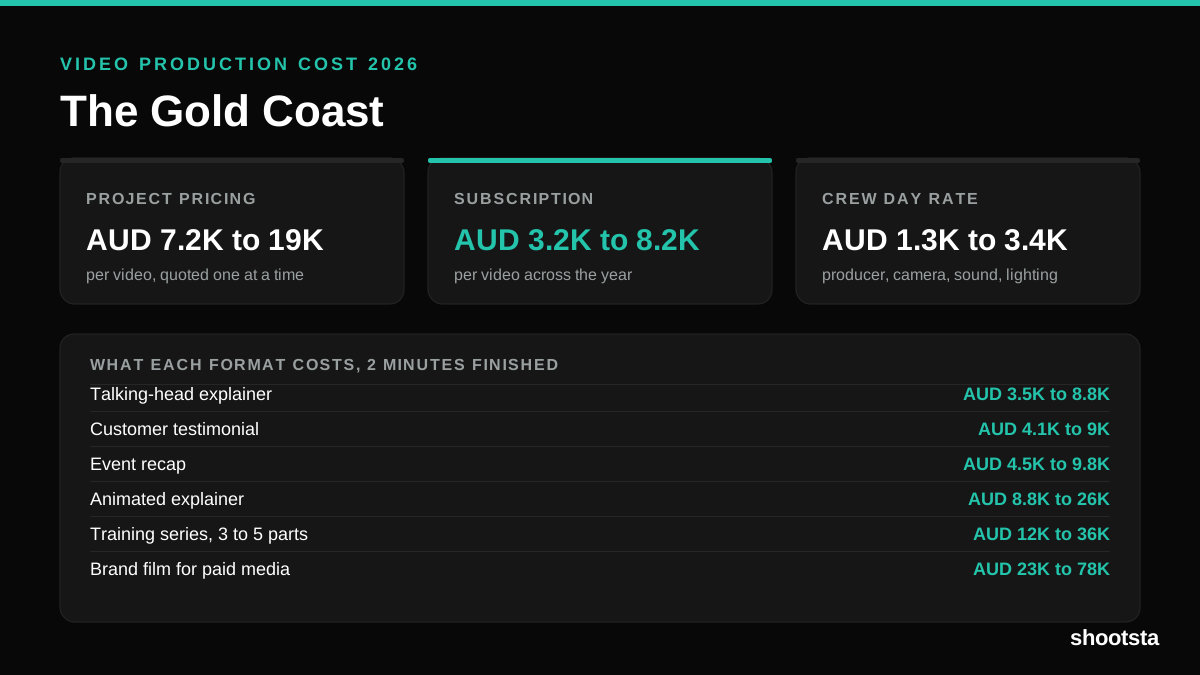
Video Production Cost on the Gold Coast 2026
Video production in the Gold Coast costs AUD 3,200 to AUD 8,200 per finished video on a subscription model, and AUD 7,200 to AUD 18,500 for one-off project work. Here is what you are paying for, and how the three pricing models compare.
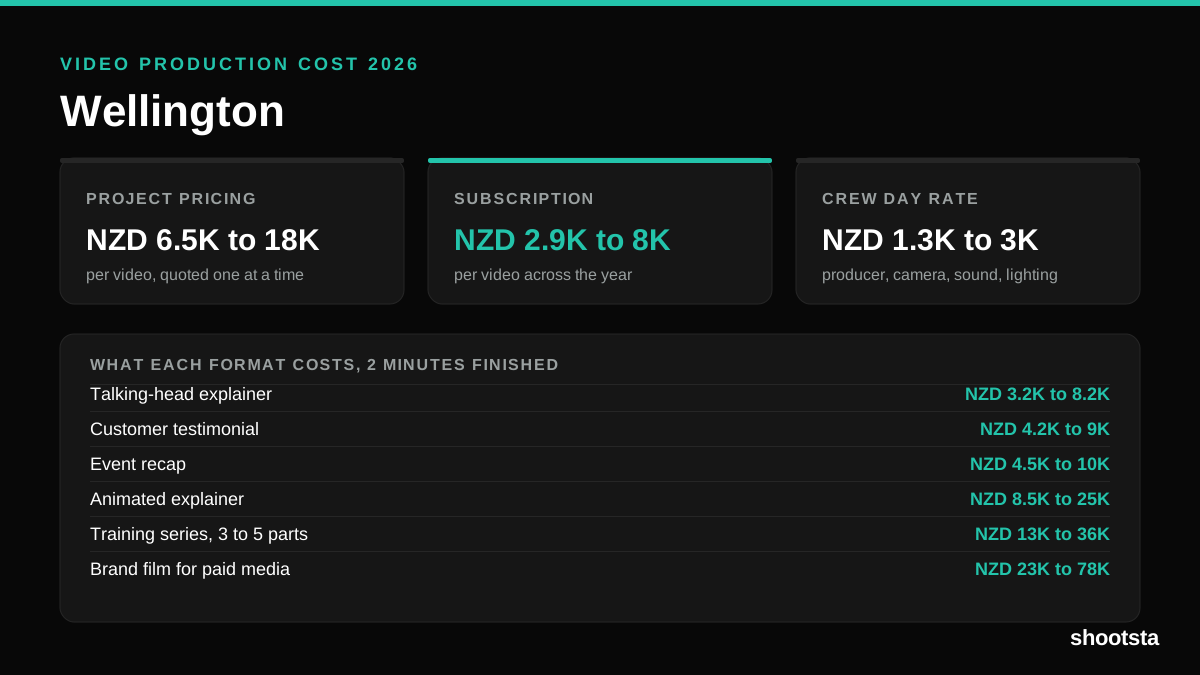
Video Production Cost in Wellington (2026)
Video production in Wellington costs NZD 2,900 to NZD 8,000 per finished video on a subscription model, and NZD 6,500 to NZD 18,000 for one-off project work. Here is what you are paying for, and how the three pricing models compare.
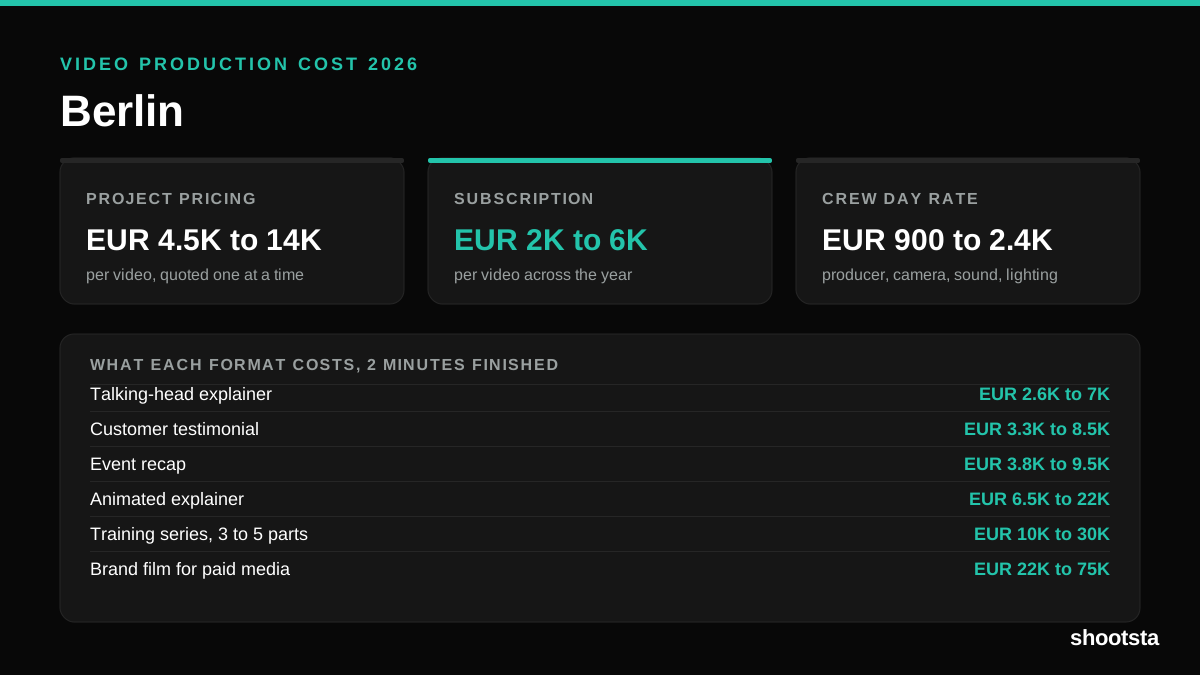
Video Production Cost in Berlin (2026)
Video production in Berlin costs EUR 2,000 to EUR 6,000 per finished video on a subscription model, and EUR 4,500 to EUR 13,500 for one-off project work. Here is what you are paying for, and how the three pricing models compare.