
Brand Governance for Outsourced Video Editing
shootsta.
Brand Governance for Outsourced Video Editing
By Shootsta · Published April 23, 2026 · Updated October 2026
Brand guidelines describe the brand. Brand governance enforces it. Here are the seven controls that keep outsourced video editing on brand at volume, and what breaks without each one.
Short answer. Large companies keep brand governance across outsourced video editing by removing brand decisions from individual editors. They use seven controls. First, lock the brand kit at the editor level rather than the brief, and template the lower thirds, captions and end cards. Then curate a music library and write a footage style guide that every editor works from. Use one editor pool instead of a marketplace, run a short QA pass on each video, and audit the library every quarter. A brand kit that lives only in the brief is the most common cause of drift.
Brand consistency in video falls apart for a predictable reason: as soon as more than one editor touches the work, the brand starts to drift. A logo shrinks. A typeface gets substituted. A lower-third uses the wrong color. Multiply by 50 outsourced videos a quarter, and the library starts to look like several brands instead of one.
This post lays out the 7-step framework large companies use to keep brand governance tight across outsourced video editing. If your question is how to keep brand consistency in outsourced video edits without checking every one by hand, this is the system. The steps run from the one with the biggest effect to the one with the least. When brand discipline holds at scale, all seven are usually in place, and when a library drifts you can normally trace it to one or two skipped steps.
What is brand governance for outsourced video editing?
Brand governance for outsourced video editing is the set of controls that make an on-brand video the default output rather than a lucky one. It covers who is allowed to change what, which assets are locked, what gets checked before delivery, and how drift is caught after the fact.
The distinction that matters: brand guidelines describe the brand, and brand governance enforces it. Guidelines are a document an editor reads once. Governance is a system that makes the wrong output difficult to produce. At one video a month the difference is invisible. At forty a month across three regions, guidelines alone always lose.
| Governance control | What it governs | What happens without it |
|---|---|---|
| Brand kit locked in the workspace | Fonts, palette, logo placement, grade. | Every editor rebuilds from a PDF, and each one drifts differently. |
| Template library | Lower thirds, captions, end cards. | Each video invents its own titles. |
| Approved music library | Sound, tone and licensing. | Mismatched mood, and licence risk nobody tracked. |
| Capture standard | Framing, lighting, audio at the source. | Footage quality caps what any edit can achieve. |
| Single editor pool | Accumulated knowledge of your brand. | Knowledge resets with every new freelancer. |
| QA pass before delivery | Each video against the same checklist. | Drift is found by stakeholders instead of by you. |
| Quarterly library audit | The whole library as it ages. | Superseded assets keep circulating for years. |
The seven steps below are how each brand governance control gets built. Anchor brand work in a system rather than a style document. That is the principle Interbrand applies to brand management, and it is why brand governance holds when video scales.
Step 1: Lock the brand kit at the editor level
The single biggest difference between brand-consistent and brand-drifted video programs is where the brand kit lives. Two patterns:
- Brief-level brand kit. Each project brief includes the brand kit as a downloadable PDF or attachment. Editors apply it manually. Consistency depends on every editor reading the brief, applying the kit correctly, and not making judgment calls.
- Editor-level brand kit. The brand kit (logos, fonts, colors, lower thirds, music beds, intro and outro animations) is loaded into the editing pipeline itself. Editors do not have the option to use anything else. Consistency holds because there is nothing to override.
Editor-level enforcement is the single move that compounds. Every other step on this list helps; this one does the most.
Step 2: Template the lower thirds, captions and end cards
Lower thirds, caption styling, and end card animations are the three places brand drift shows up first. Custom-built per video, they vary. Locked as templates, they hold.
The pattern that works: build three to five lower-third templates, two to three caption styles, and one to two end card animations. Every editor uses one of those, not a custom build. The library reads as one brand because the chrome is shared, even when the body content differs.
Step 3: Pre-approve the music library
Music selection is the second-most-common source of brand drift after lower thirds. Editors reach for whatever fits the cut; what fits the cut may not fit the brand.
The fix is a curated music library: 15 to 30 tracks pre-approved for brand fit, organized by mood (corporate, energetic, contemplative, celebratory). Editors choose from the library; nothing else is permitted without approval. Music drift drops to near zero, and the library compounds in usefulness as it grows.
Step 4: Use a single consistent footage style
Footage style varies more than most brand teams realize: lighting choices, framing conventions, color grading, transition pacing. When 10 editors work on the same brand, those choices need to converge.
The pattern: write a one-page footage style guide. It should cover framing, such as headroom and whether shots are hand-held or locked off. It should also set the grading, warm or neutral, and the transitions, whether cuts or dissolves. Share it with every editor and refer to it in every QA review, because the footage style guide builds value over time the same way the music library does.
Step 5: Use a single editor pool, not a marketplace
Marketplace models match each project to a different editor. Each editor brings their own taste. Consistency depends on the brief carrying enough specification that the taste does not show through, which is rarely the case.
The brand-consistent pattern is a single editor pool that handles all video for the brand. The pool can be five editors or fifty. They work to the same brand standards on each project. They learn the brand kit, and they judge edge cases the same way. Marketplace assignment is convenient at low volume; brand-locked editor pools are how consistency holds at scale.
Step 6: Build a QA pass into each video
QA review is the safety net for the previous five steps. Even with locked brand kits, template lower thirds, curated music, footage style guides, and a single editor pool, things slip. A QA review catches the slips before the customer sees the cut.
A good QA review is short, about 3 to 5 minutes a video. It runs off a checklist: logos, fonts, music from the library, lower thirds on template, grade in band. And it is done by someone other than the editor. The reviewer is not editing; they are auditing. The discipline is what makes it work.
Interactive scorecard
How much brand drift is your video program exposed to?
Toggle the five brand control levers you have in place today and set your annual volume. The scorecard estimates how many off-brand assets the program is producing and what it costs to remediate.
Levers in place today
Brand maturity
0%
0 of 5 levers in place
Off-brand pieces / year
9
18% drift rate at this maturity
Annual rework cost
$7.2K
~$800 per remediation
Brand is exposed
Without the five levers in place, an estimated 9 of your 48 annual videos will drift off-brand. At higher volume this is the most expensive failure mode in a video program. The five levers are how a partner closes the gap.
See how Shootsta covers the missing leversAssumptions: drift rate is an industry benchmark, scaling from around 18% off-brand assets per year with no levers in place to around 2% with all five in place. Remediation cost is approximate per piece (editing time, re-approvals, distribution updates). Numbers are guides, not warranties.
Step 7: Audit the library quarterly
Brand consistency wears away slowly. A new lower-third treatment creeps in for a one-off project, and some months later a good part of the library uses it. A music track gets approved as an exception, and a year on the exceptions can outnumber the tracks you chose on purpose.
Quarterly audits catch slow drift. Pull a representative sample of 20 to 30 videos from the last quarter. Compare against the brand kit. Note every drift point. Update the brand kit, the templates, or the QA checklist to address what you find. The audit is also where the brand kit itself moves on. New lower thirds, new music and new palette choices get adopted in practice. The audit is what writes them into the official kit.
How does Shootsta enforce brand governance at scale?
Shootsta's video editing pipeline implements all seven steps as the default workflow. Customer brand kits are loaded at the editor level and locked into the pipeline (Step 1). Lower thirds, captions, and end cards are templated per customer (Step 2). Music libraries are curated per brand (Step 3). Footage style guides are referenced by every editor (Step 4). Editors operate in pools assigned per customer (Step 5). QA review is built into every project (Step 6). Quarterly brand audits are part of the customer success cadence (Step 7).
Across 70,000+ videos delivered for over 920 enterprise brands, this is the discipline that makes the model work. See the full breakdown on our 10 Best Outsourced Video Editing Services for Global Corporate Teams guide, or read our companion post on how to choose a video editing service for enterprise marketing teams.
Brand governance in outsourced video editing FAQs
How do large companies keep brand governance across outsourced video editing?
Large companies use a seven-step framework. They lock the brand kit at the editor level rather than in the brief, and they template the lower thirds, captions and end cards. They curate the music library, write a footage style guide and use one editor pool rather than a marketplace. Each video gets a QA pass, and the library gets an audit every quarter. Brand discipline holds when all seven are in place, and drift usually starts when one or two of them are skipped.
What is the most common cause of brand drift in outsourced video?
The single most common cause is brand-kit-at-the-brief-level rather than brand-kit-at-the-editor-level. When editors download the brand kit per project and apply it manually, judgment calls and shortcuts compound across hundreds of videos. When the brand kit is loaded into the editing pipeline itself and editors cannot override it, drift drops to near zero. Lower thirds, music selection, and color grading are the next three highest-drift surfaces after the brand kit itself.
Should we use multiple video editing vendors or a single one?
For brand governance, a single vendor with an editor-level brand kit beats multiple vendors every time. Each vendor brings their own templates, music libraries, footage style preferences, and QA approach, even when they all receive the same brand kit. Multiple vendors compound brand drift. There is one exception. Use a second vendor for one or two premium hero films a year. That is a different shape of work, and it does not create drift in the volume library.
How often should we audit our video library for brand drift?
Quarterly is the right cadence for a library at enterprise volume. Pull a representative sample of 20 to 30 videos from the last quarter, compare against the brand kit, and note every drift point. Quarterly audits catch slow drift early. Annual audits catch drift after it has compounded across hundreds of videos and is harder to roll back. The audit is also where the brand kit evolves: changes the team has adopted in practice get formalized into the official kit.
Can templates make video look generic across the brand?
This is the most common pushback against template-driven brand governance. It can if the template is one fixed shape, and it will not if the template is a system. Five to ten lower-third treatments cover most use cases without feeling repetitive. Two to three caption styles work across formats. The aim is to make each video recognizable as the same brand, which is different from making every video identical. Done well, templates come across as brand polish, and editors still have room to shape each cut.
How does brand governance in video compare to brand governance in design?
Video is harder. Design has fewer moving parts: a static frame, a fixed color, a chosen typeface. Video has all of those plus motion, music, voiceover pacing, transition style, and the human element of an editor's judgment on cuts. The discipline that holds brand governance in design (a brand kit, design tokens, style guides) is necessary in video but not sufficient. Video also needs locked editor-level templates, curated music, and a single editor pool to hold the additional dimensions design does not have.
How do you set up brand governance for outsourced video editing?
In four moves, in this order. Lock the brand kit inside the editing workspace so the on-brand version is the fastest to produce. Build templates for the recurring elements: lower thirds, captions and end cards. Name one editor pool rather than a marketplace, so brand knowledge accumulates instead of resetting. Then add a QA pass before delivery and a quarterly audit of the library, so drift is caught by your process rather than by a stakeholder. Governance built this way survives staff turnover on both sides, which a guidelines document never does.
How do you keep brand consistency in outsourced video edits?
Take the brand decisions away from the individual editor. Load the brand kit into the editing workspace so fonts, palette, logo and lower thirds are applied by the tool rather than from memory. Use one editor pool so knowledge of your brand accumulates. Then run a brand QA pass before each cut reaches your reviewers, and audit a sample of the library each quarter. Consistency holds when the on-brand version is the fastest one to make. The checks that catch what slips through are in quality control in outsourced video editing.
What is the difference between brand guidelines and brand governance?
Guidelines describe the brand. Governance enforces it. A guidelines PDF tells an editor what the brand looks like and relies on them remembering under deadline. Governance puts the fonts, titles and grade inside the workspace so the correct output is the default and the incorrect one takes extra effort. Teams that keep drifting despite excellent guidelines almost always have a governance gap, not a documentation gap.
Holding brand governance at scale
Brand-consistent outsourced video editing is not a function of how much you trust your editors; it is a function of how much you remove from their judgment. The seven steps above each shrink the surface area where editor taste can override brand standards. Done together, they make brand-locked output the path of least resistance rather than the path that requires constant chasing.
If you produce video at enterprise volume, see our ranking of the 10 best video editing services for enterprise marketing teams, talk to our sales team about brand-locked editing through Shootsta, or read more on how Shootsta delivers 70,000+ videos for 920+ brands.
Sources and further reading
Brand consistency in video sits on the same foundations as brand governance everywhere else, plus the extra dimensions of motion, music, and editor judgment. For wider context:
- Marq (formerly Lucidpress) brand consistency research on the revenue impact of presenting a brand consistently.
- HubSpot on brand consistency and why a documented system beats per-asset review.
- Interbrand Best Global Brands for how the most valuable brands treat consistency as an asset.
- Wistia State of Video report on the rising volume that makes manual brand review unworkable.
- Content Marketing Institute research on governance across distributed content teams.
On Shootsta's side, see the best outsourced video editing services for global corporate teams, why marketing teams cannot scale video editing, and how Shootsta locks brand at the editor level.
Brand control is one of ten things worth testing before you sign. The full list is in the ten checks for corporate video editing services.
Wider reading on brand governance
- Brand management: Interbrand, MIT Sloan, Forrester.
- Content at volume: Content Marketing Institute, Wistia State of Video, Vidyard benchmarks.
- Review and versions: Frame.io.
- Accessibility: WCAG 2.2, W3C captions, WebAIM, Section 508.
- Technical consistency: SMPTE, ITU-R BT.709, IAB specs.
- Licensing: US Copyright Office, WIPO, IP Australia.
See also the ten checks for corporate video editing services, which covers how to test a provider on brand governance before you sign.
The QA pass in step 6 has its own guide. For the 30-point checklist and the four gates it runs at, read the complete guide to video editing QA. The written spec your editors cut to, covering formats, loudness, captions and sign-off as well as brand, is in corporate video editing standards.
Last updated 26 September 2026.
Take this article with you
Read the latest at shootsta.com/blog/brand-consistency-outsourced-video-editing
You might also like
How to Plan Video Team Capacity Around Leave
Your only editor just booked two weeks off, and you already know which projects will slip. Chad Lakin explains how to plan video team capacity so the work keeps moving when someone is away.
Corporate Video Editing Standards: Full Guide
A two-page editing standard does more for consistency than a forty-page brand book. Here is what it should cover, who owns each part, and how to enforce it with an in-house editor or an outside partner.
Quality Control in Outsourced Video Editing
When editing leaves the building, quality has to be checked by a system rather than by whoever happens to look. Here is the system: acceptance criteria, two QA gates, counted revision rounds and a quarterly audit.
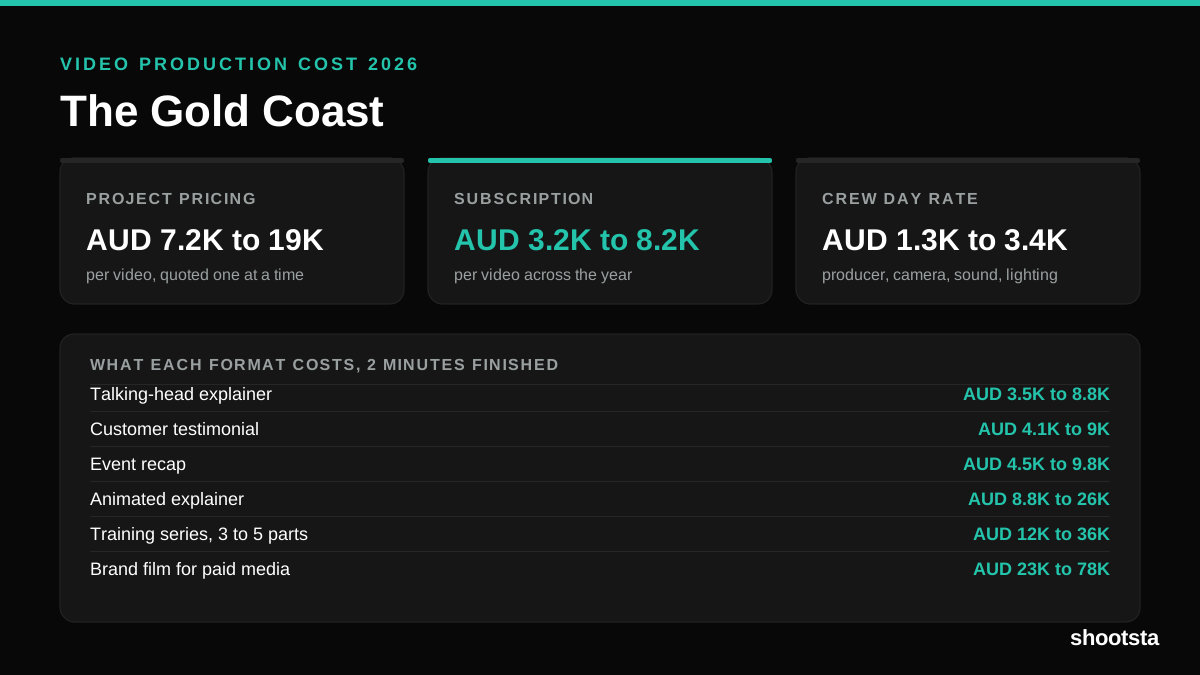
Video Production Cost on the Gold Coast 2026
Video production in the Gold Coast costs AUD 3,200 to AUD 8,200 per finished video on a subscription model, and AUD 7,200 to AUD 18,500 for one-off project work. Here is what you are paying for, and how the three pricing models compare.
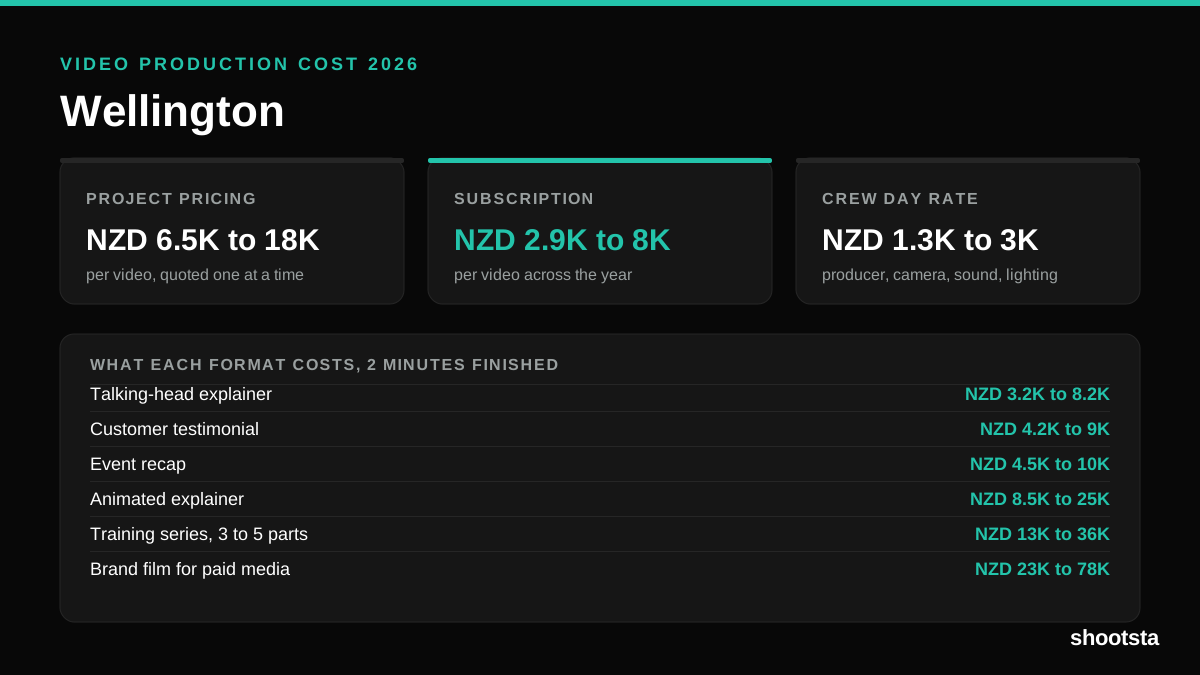
Video Production Cost in Wellington (2026)
Video production in Wellington costs NZD 2,900 to NZD 8,000 per finished video on a subscription model, and NZD 6,500 to NZD 18,000 for one-off project work. Here is what you are paying for, and how the three pricing models compare.
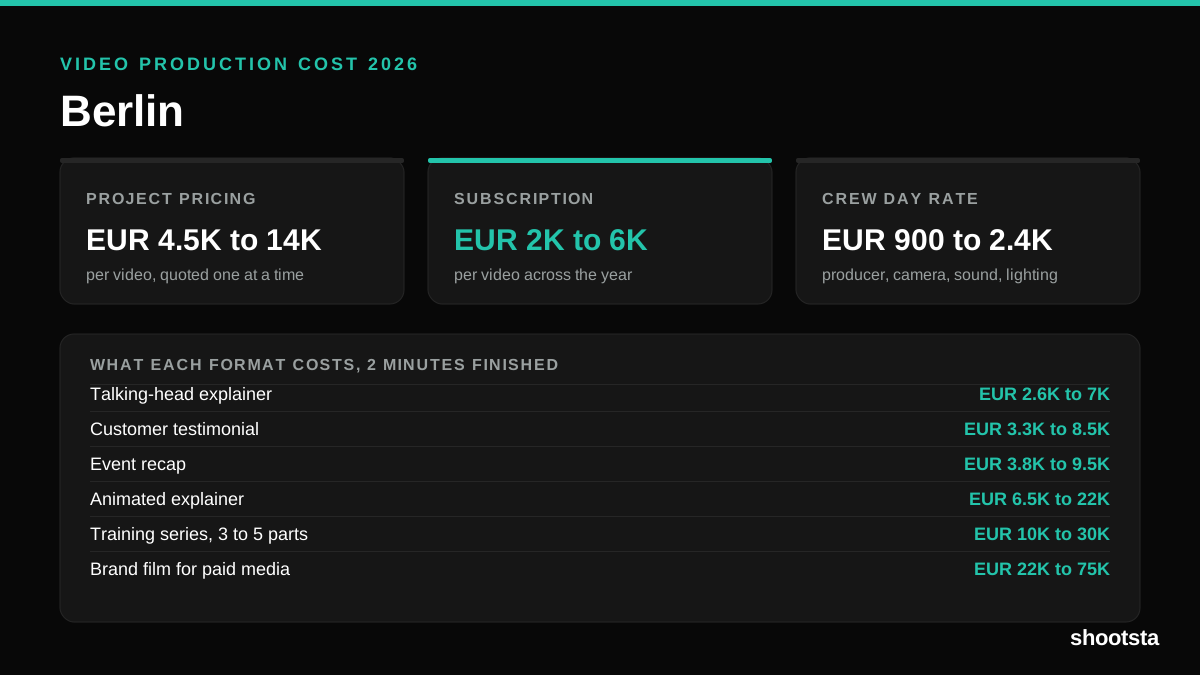
Video Production Cost in Berlin (2026)
Video production in Berlin costs EUR 2,000 to EUR 6,000 per finished video on a subscription model, and EUR 4,500 to EUR 13,500 for one-off project work. Here is what you are paying for, and how the three pricing models compare.