
The Real Risks of Outsourcing Video Production
shootsta.
The Real Risks of Outsourcing Video Production
By Shootsta · Published October 30, 2026 · Updated November 2026
Brand drift, slow approvals, hidden costs, footage security and supplier lock-in, with the questions that expose each risk before you sign.
The real risks of outsourcing video production are brand drift, slow approvals, hidden costs, loose handling of your footage and too much reliance on one supplier. Each one can be managed if you settle the brand rules, the review process and the contract terms before the first video starts. This guide covers what tends to go wrong, how to spot it early and what to ask a provider before you sign.
If you run marketing, internal comms or L&D, you have probably felt the pull to outsource already. The requests keep coming, and your team cannot cut every campaign video, leadership update and training module on time. Outsourcing fixes that capacity problem, but only when you go in knowing where it can break.
What are the main risks of outsourcing video production?
Most problems with outsourced video fall into five groups. Your brand can drift when editors guess at your rules, and approvals can stall when feedback arrives in pieces. Costs can climb when extras are priced separately, and your footage can end up with people who should not see it. Finally, you can end up depending on a supplier you cannot easily leave.
None of these is a reason to keep every edit in-house. They are reasons to pick a partner carefully and to agree how the work runs before it starts. The sections below take each risk in turn, with the question that exposes it.
Will an outside editor get our brand wrong?
Brand drift is the risk teams worry about most, and it usually starts with a vague brief. When each editor reads your guidelines in their own way, fonts change size and logos animate differently. After a few months, your videos no longer look like they came from the same company.
The fix is a video brand template that is set up once and applied to every edit. It should cover your logo, fonts, palette, captions, lower thirds and end cards for every format you publish. Ask any provider who builds that template, who keeps it current and whether every editor on your account uses it. Our guide to brand consistency in outsourced video editing goes through the full checklist.
Will outsourcing slow down our approvals?
Outsourcing can make approvals slower if your reviewers send notes by email, at different times, in different words. The editor then works through each message in turn, and a two-day job turns into two weeks. This is the most common reason a capable partner still feels slow.
Agree on rounds of feedback before you start. One person should collect every reviewer's notes, remove the clashes and send one list per round. A shared video review workflow keeps the comments on the video itself, so nobody has to match an email to a timestamp.
Where do the hidden costs of outsourcing come from?
Hidden costs rarely sit in the headline price. They show up in the extras, such as rush turnaround, extra language versions, more feedback rounds than the contract allows and new quotes for every small change. Per-project pricing adds a fresh approval cycle to each video, which costs your team time even when the invoice looks fine.
Before you sign, ask the provider to list what a standard project includes and what costs extra. Find out how rush work is priced and how many rounds of feedback come with each video. If the provider uses video production credits, ask which services the credits cover and what happens to any you do not use. Our explainer on how rush video production works shows where urgent requests usually come from.
How safe is our footage with an outside partner?
Your raw footage can be sensitive. It might include an unreleased product, a restructure announcement or staff who agreed to appear in an internal video only. Once it leaves your systems, you need to know who can see it and how long it is kept.
Ask how files are sent and stored, who on the provider's side can open them and whether they will sign an NDA. Check that the platform lets you control access by role, and ask how long footage is kept after a project closes. If your IT or legal team has a vendor checklist, send it early so it does not hold up the first project.
What if we become dependent on one supplier?
Every outsourcing deal creates some dependence, and that is not a problem in itself. The risk is a deal you cannot leave cleanly because your files, templates and finished videos sit in a system you no longer control. That risk grows as your library grows.
Ask who owns the finished videos and the project files, and how you would export your library if you moved on. Check the contract term and what happens at renewal, and read the terms before the first invoice. A good partner answers these questions plainly, because they expect you to stay for the work and not for the lock-in.
Does outsourcing mean replacing our in-house team?
It does not have to. Many teams keep their in-house video people for shoots, executive messages and the projects only they can run, and use a partner for the editing that would otherwise queue up. The in-house team keeps control of the brand and the story, and the partner adds capacity around them.
This model also lowers several of the risks above. Your own people still own the brief and the final sign-off, so brand drift and approval delays are easier to catch. Read how a video partner extends your in-house team for the details, or compare the options on our page about in-house vs outsourced video production.
What should you ask a video partner before you sign?
These questions bring most outsourcing risks into view during the sales process, while it is still easy to walk away. Ask them in writing and keep the answers with the contract.
- Who sets up our brand template, and does every editor on our account use it?
- How many rounds of feedback come with each video, and how do reviewers leave comments?
- How fast does the first version arrive, and when does the clock start?
- What does a standard project include, and what costs extra?
- How is rush turnaround priced?
- Who can see our footage, will you sign an NDA, and how long do you keep files?
- Who owns the finished videos, and how would we export our library?
- Who is our day-to-day contact?
Our list of questions to ask a video editing subscription goes further on pricing and plan terms.
How does Shootsta handle these risks?
Brand template setup is part of every Shootsta plan, and Shootsta editors apply your template to every video. Every project includes five rounds of feedback, and the first version comes back in around 48 hours. Editors work across 5+ regions with 24/7 coverage, so a video can be edited while your own team is offline.
Plans are annual subscriptions on prepaid credits, and credits must be used within your contract period. Editing, animation and creative services all run on credits, while shoots are priced separately and rush turnaround is quoted separately. Every plan also includes dedicated account support, so you have one contact to ask when something looks wrong. Shootsta works alongside your in-house team and agency and does not replace them.
Frequently asked questions
Is outsourcing video production risky?
Outsourcing video production carries some risk, mainly around brand consistency, approvals, cost and the security of your footage. Most of that risk comes from a loose brief or a vague contract, not from outsourcing itself. A locked brand template, agreed feedback rounds and clear pricing remove most of it.
How do you protect your brand when you outsource video?
Set up a video brand template once and make sure every editor on your account uses it. Keep the final sign-off with someone on your own team. Review the first few videos closely, because that is when any drift is easiest to fix.
Should we outsource all of our video production?
Few teams need to outsource everything. A common pattern is to keep shoots, executive messages and creative direction in-house and outsource the editing, animation and work in other regions. That keeps control close and adds capacity where the queue builds up.
Take this article with you
Read the latest at shootsta.com/blog/risks-of-outsourcing-video-production
You might also like
Why Brand Video Goes Stale and How to Fix It
Why Brand Video Goes Stale and How to Fix It
How to find out-of-date videos, decide whether to re-edit or re-shoot, and keep your video library current with owners, review dates and brand templates.
Why Urgent Video Requests Go Sideways
Most urgent videos go sideways because nobody planned for urgent work to happen. Chad Lakin explains how comms teams build the process first, so a fast turnaround becomes routine.
How to Plan Video Team Capacity Around Leave
Your only editor just booked two weeks off, and you already know which projects will slip. Chad Lakin explains how to plan video team capacity so the work keeps moving when someone is away.
Corporate Video Editing Standards: Full Guide
A two-page editing standard does more for consistency than a forty-page brand book. Here is what it should cover, who owns each part, and how to enforce it with an in-house editor or an outside partner.
Quality Control in Outsourced Video Editing
When editing leaves the building, quality has to be checked by a system rather than by whoever happens to look. Here is the system: acceptance criteria, two QA gates, counted revision rounds and a quarterly audit.
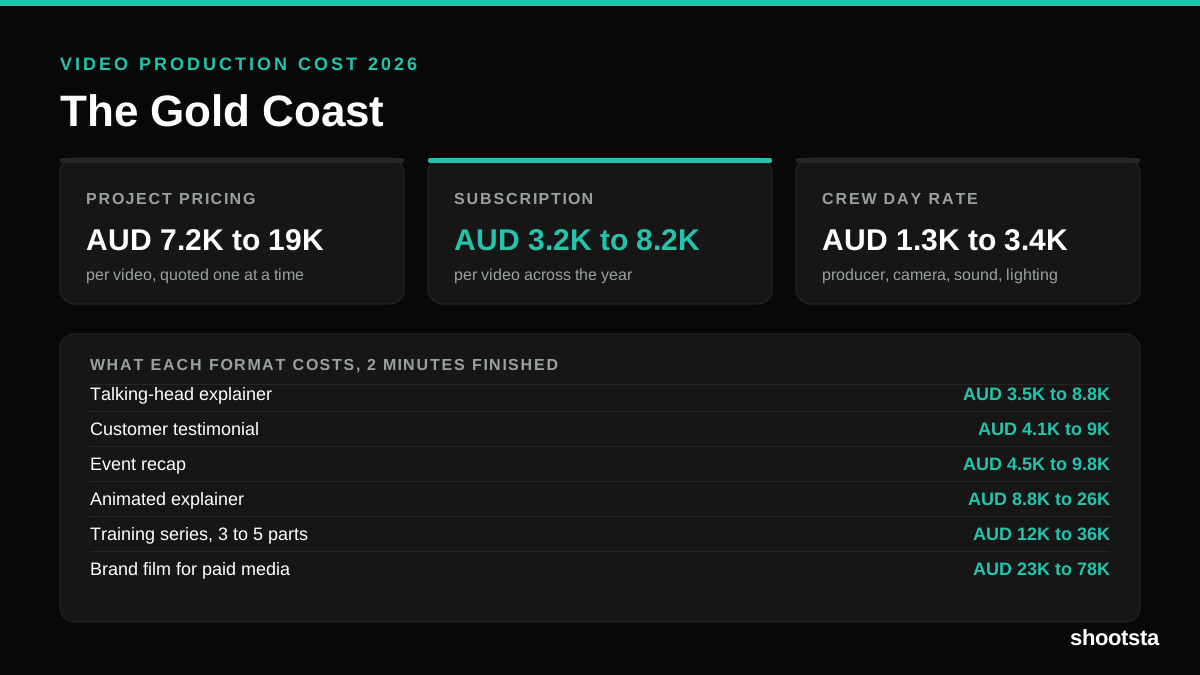
Video Production Cost on the Gold Coast 2026
Video production in the Gold Coast costs AUD 3,200 to AUD 8,200 per finished video on a subscription model, and AUD 7,200 to AUD 18,500 for one-off project work. Here is what you are paying for, and how the three pricing models compare.