
Stop Treating Every Video the Same
shootsta.
Stop Treating Every Video the Same
By Shootsta · Published August 5, 2026 · Updated October 2026
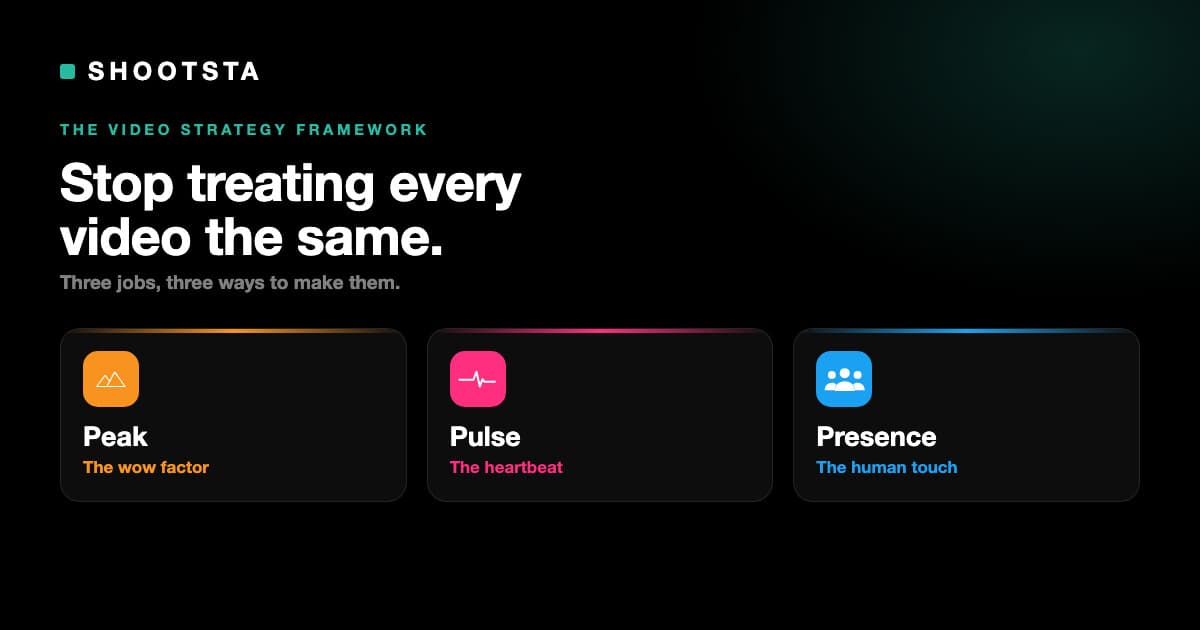
Treating every video the same is one of the most expensive mistakes enterprise teams make. Chad Lakin breaks down the three jobs video does, and how to put the right resources behind each one.
One of the most expensive mistakes enterprise teams make is treating every video the same, even though each one has a different job. If you produce it all the same way, you overspend on work that only needed to be quick. You also flatten the work that should have stopped people in their tracks.
In this clip, Chad Lakin, Senior Vice President of Growth at Shootsta, walks through the Peak, Pulse, Presence framework, and why it has caught on as a way for enterprise teams to think about scaling video.
Watch the clip above, then read on to see how the three fit together and where to spend on each.
What are Peak, Pulse and Presence?
The framework sorts your video by the job it does rather than the format it takes. Name the job first, and the right budget, speed and level of polish tend to fall out on their own.
Peak: big brand moments
Peak is the high-craft work: the brand films and campaigns that create visibility and set how the market sees you. Product launches, your best customer stories and the keynote all sit here, and this is the work worth going big on. It is also a small slice of everything you make, which is why it can carry the biggest budget per video.
Pulse: consistent communication
Pulse is the steady rhythm that keeps you credible between the big moments. It covers thought leadership, customer stories, event highlights and executive updates. None of it needs to be a hero film. It needs to keep coming week after week, at a standard that does the brand credit.
Presence: everyday trust
Presence is the human stuff: leaders, employees and customers talking to camera in their own words. It includes sales videos, internal comms, FAQ and how-to clips and the quick culture snippet. It earns trust over time because it feels real rather than produced. Polish it too hard and you kill the thing that made it work.
Why does the framework matter for your budget?
Getting it wrong costs you quietly, in two directions. Spend a Peak budget on Pulse content and you have burned hero-film money and weeks of timeline on something that only needed to be consistent and on time. Produce Presence content like a Peak campaign and it stops feeling real, because the polish is the exact thing that makes it read as staged.
Once you can name the role each video plays, putting the right resources in the right place gets a lot easier. It is the same shift behind treating video as a capability rather than a campaign, and the reason no single production model absorbs enterprise video volume. Each job needs its own production model.
How do you resource each one?
Naming the three is only useful if it changes what you do next. Here is where each one belongs.
Peak. Peak work is low in volume and high in craft. This is where your agency earns its fee, or where Shootsta Premier handles the premium one-offs. Put the big budget here, and mostly here.
Pulse. Pulse runs at higher volume, and it depends on speed and predictable cost. This is the job for a managed partner and a platform: brief today, first edit back in about 48 hours, so it ships while it still matters, usually at 50 to 60% below agency. That is the model behind an enterprise video editing service, and the turnaround is broken down in how a video partner ships in 48 hours.
Presence. Presence has the highest volume of the three, and it works best when your own people make it. Give leaders, sales and employees the kit, the templates and the guardrails to create on brand without a producer in the room for every clip. The trick is keeping brand consistency as video scales, so more creators does not turn into messier output.
If you overspend on Peak and starve the rest, that is where the backlog and the wasted money pile up. Running all three at a cost and speed you can sustain is what the enterprise video operating model is for.
Frequently asked questions
What is the Peak, Pulse, Presence framework?
It is a way to sort enterprise video by the job it does. Peak is the high-impact brand moments that create visibility, Pulse is the regular communication that builds consistency, and Presence is the authentic, everyday content from real people that earns trust over time. Name the job for a video and you know how much budget, speed and polish it needs.
Which of the three do most organizations underinvest in?
It is usually Presence and Pulse. Teams often pour budget into the occasional Peak campaign and starve the steady content that keeps them credible in between. Pulse and Presence are the parts that compound, so under-funding them is the most common and most expensive mistake.
We already have an in-house team and an agency. Where does a partner fit?
Each covers a different job. Your agency and your in-house craft shine on Peak, where the stakes justify the time, and your team owns the brand judgment and the relationships. A managed partner takes the Pulse and Presence volume that would otherwise swamp them, so nothing stalls in the edit queue. More on that split in how a video partner extends your in-house team.
How fast can Pulse and Presence content be produced?
About 48 hours for a first edit once the footage and brief are in. That turnaround is what makes a steady Pulse cadence and high-volume Presence content realistic, rather than a nice idea that never ships.
Where to go next
For the full system that runs all three, read the enterprise video operating model. For why one production approach can't carry every job, read why one model can't scale enterprise video. And when the whole load lands on one hire, read what happens when your whole video team is one person.
Start by naming which of the three your team underinvests in, because that is usually the first step to fixing where the budget goes.
Take this article with you
Read the latest at shootsta.com/blog/stop-treating-every-video-the-same
You might also like

How to Plan Video Team Capacity Around Leave
Your only editor just booked two weeks off, and you already know which projects will slip. Chad Lakin explains how to plan video team capacity so the work keeps moving when someone is away.
Corporate Video Editing Standards: Full Guide
A two-page editing standard does more for consistency than a forty-page brand book. Here is what it should cover, who owns each part, and how to enforce it with an in-house editor or an outside partner.
Quality Control in Outsourced Video Editing
When editing leaves the building, quality has to be checked by a system rather than by whoever happens to look. Here is the system: acceptance criteria, two QA gates, counted revision rounds and a quarterly audit.
Video Production Cost on the Gold Coast 2026
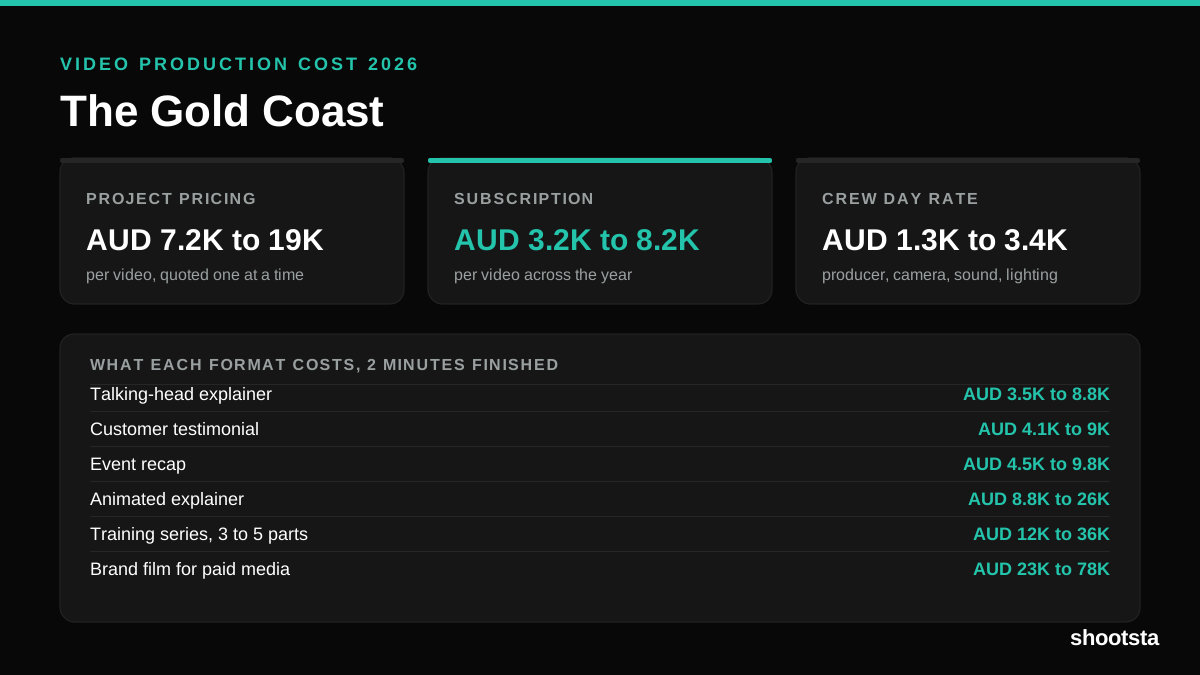
Video production in the Gold Coast costs AUD 3,200 to AUD 8,200 per finished video on a subscription model, and AUD 7,200 to AUD 18,500 for one-off project work. Here is what you are paying for, and how the three pricing models compare.
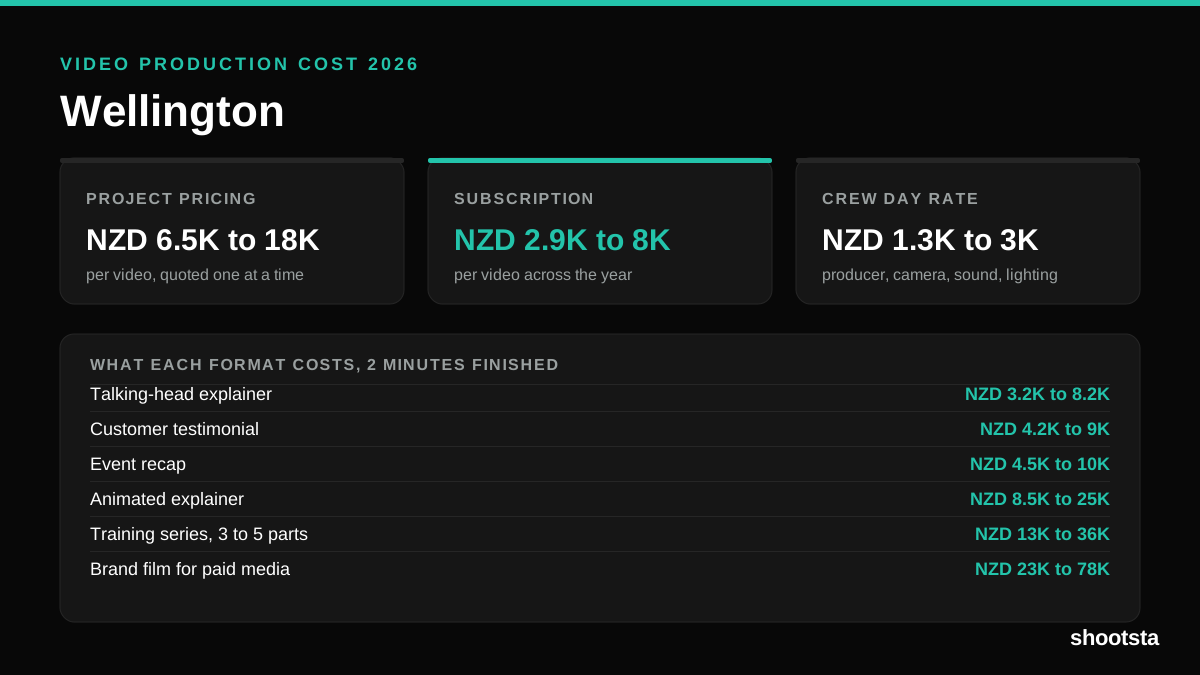
Video Production Cost in Wellington (2026)
Video production in Wellington costs NZD 2,900 to NZD 8,000 per finished video on a subscription model, and NZD 6,500 to NZD 18,000 for one-off project work. Here is what you are paying for, and how the three pricing models compare.
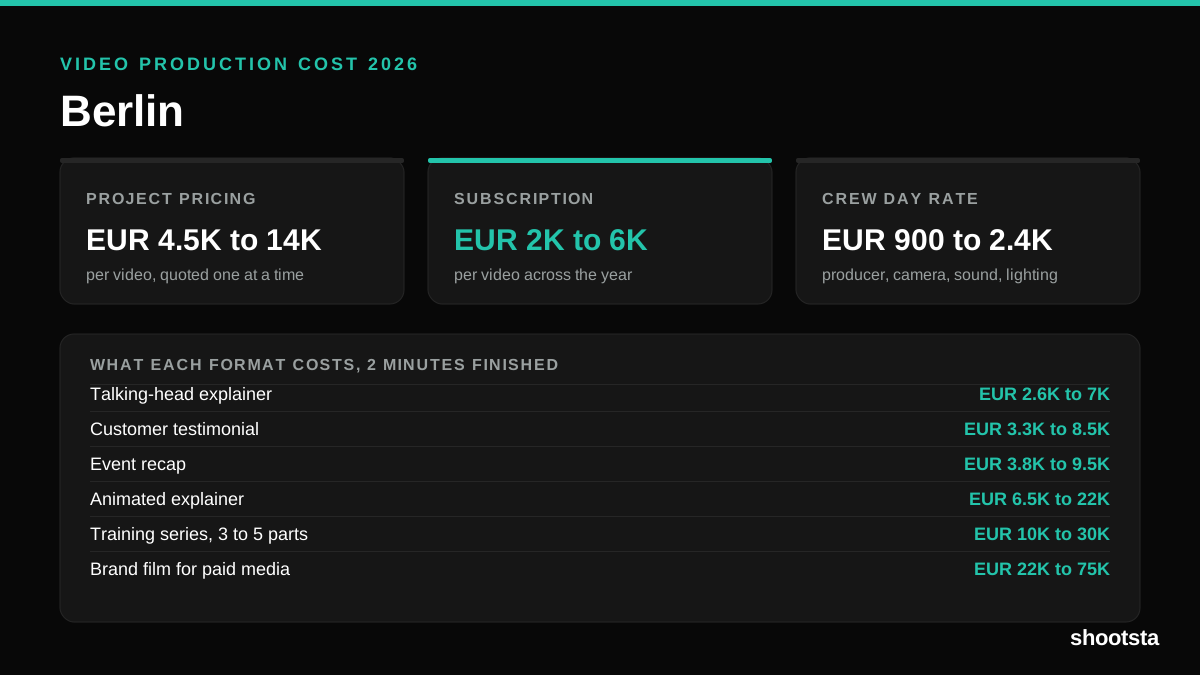
Video Production Cost in Berlin (2026)
Video production in Berlin costs EUR 2,000 to EUR 6,000 per finished video on a subscription model, and EUR 4,500 to EUR 13,500 for one-off project work. Here is what you are paying for, and how the three pricing models compare.