
Enrollment Marketing Video for Small Colleges
shootsta.
Enrollment Marketing Video for Small Colleges
By Shootsta · Published May 26, 2026 · Updated October 2026
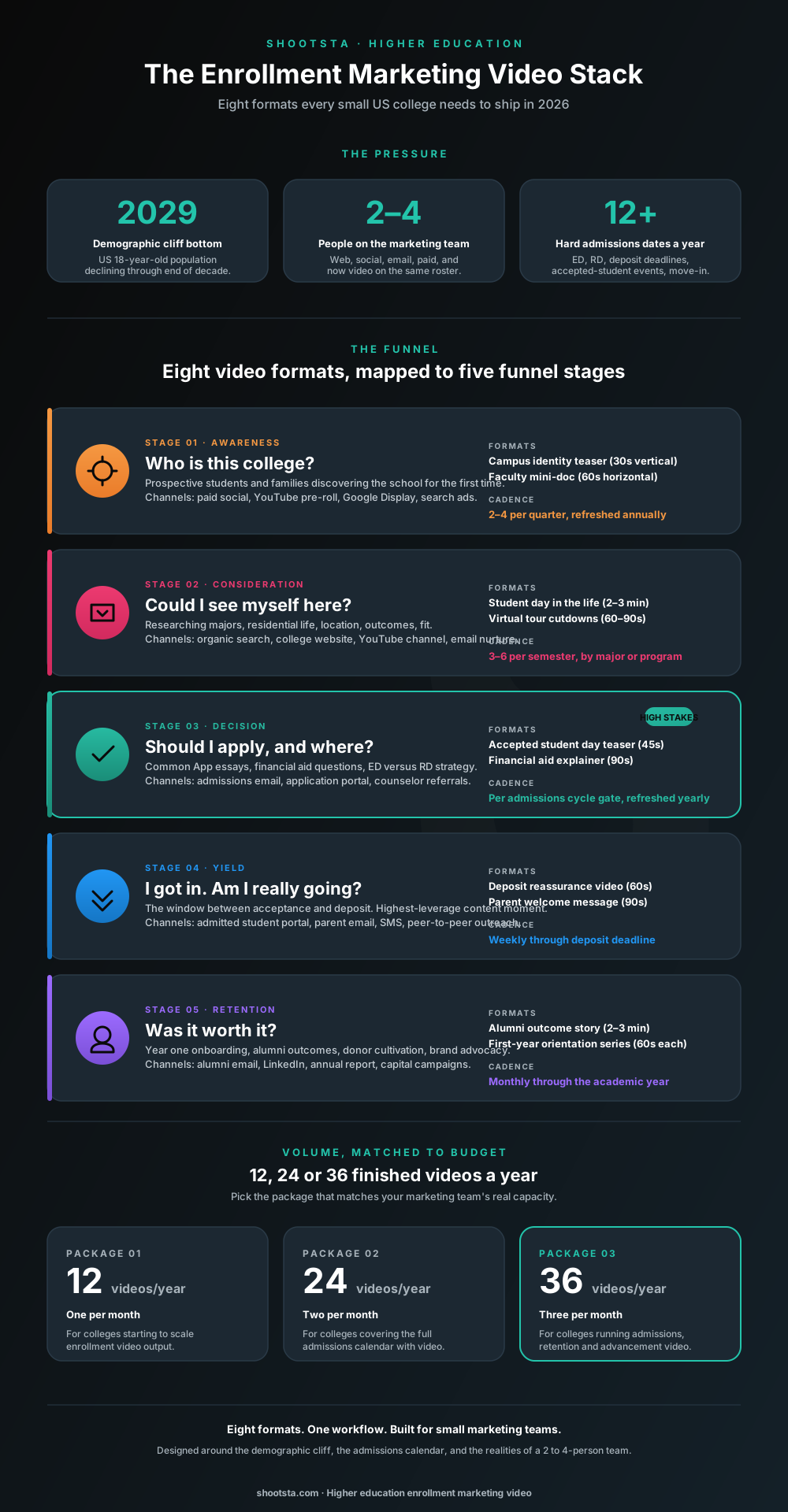
Eight video formats every small US college should be shipping in 2026, mapped to the five stages of enrollment marketing: awareness, consideration, decision, yield and retention. Built for two-to-four-person marketing teams.
The US higher education market is harder in 2026 than it has been in a generation. The 18-year-old population peaked in 2025 and will keep declining through the end of the decade. Smaller private colleges feel it first. A marketing team of two to four people now has to defend yield, lift application volume, support advancement, cover orientation, and produce more video than the school has ever made, all without adding headcount.
Most colleges respond by hiring a videographer. That move usually fails. A single full-time hire loaded with benefits and equipment costs $75,000 to $90,000 a year and is sized for steady-state volume. The admissions calendar is not steady-state. It runs on twelve hard dates a year, and each one needs video that ships within days.
This piece is the inventory. It lists the eight video formats every small US college should be producing in 2026, mapped to the five enrollment marketing funnel stages, with the production specs and cadence that make them shippable on a lean team. Read it as a checklist. If you are not producing six of the eight today, that is your roadmap.
Quick answer. Enrollment marketing video is the set of formats a college uses to move a prospective student through five funnel stages: Awareness, Consideration, Decision, Yield and Retention. In 2026, the working baseline for a small US private college is eight formats producing 24 to 36 finished videos per year, supported by a partner production model rather than a single in-house videographer hire.
What is enrollment marketing video?
Enrollment marketing video is the use of short and medium-form video to move a prospective student from first awareness through deposit, then through orientation and retention. It is distinct from advancement video (alumni-facing) and brand video (institution-facing). The audience is a 16 to 18-year-old prospective student and the parent who often steers the financial decision. You measure it in deposits rather than impressions.
Small US private colleges in 2026 sit inside a structural demographic shift. The 18-year-old population peaked in 2025 (NCES projections) and declines through 2031. The colleges that grow yield through that decline will be the ones who run enrollment marketing video as a system rather than a series of one-off productions.
The enrollment marketing video stack at a glance
The eight formats below cover the five funnel stages. The table is the executive summary. Each format is broken out in detail below it.
| Format | Stage | Runtime | Primary channel | Cadence |
|---|---|---|---|---|
| Campus identity teaser | Awareness | 30s vertical | Paid social, YouTube pre-roll | Annual refresh |
| Faculty mini-doc | Awareness | 60 to 90s | YouTube, program pages | 1 per major, 3-year cycle |
| Day in the life | Consideration | 2 to 3 min | YouTube, embedded | 3 to 6 per year |
| Virtual tour cutdowns | Consideration | 60 to 90s | Landing pages | One shoot, 8 cuts |
| Accepted student day teaser | Decision | 45s | Admissions email, SMS | 10 days before each event |
| Financial aid explainer | Decision | 90s animated | Aid pages, FAFSA flows | Annual refresh in August |
| Deposit reassurance video | Yield | 60s | Admitted student portal | Weekly through May 1 |
| Parent welcome message | Yield | 90s | Post-deposit email | Sent day of deposit |
What are the five stages of enrollment marketing video?
Most college marketing teams plan video around individual campaigns. The better lens is the funnel: every video has a stage, an audience, and a specific job to do. Five stages cover the lifecycle from a 16-year-old first hearing the college's name to an alumnus making a planned gift twenty years later.
- Awareness. Who is this college, in 30 seconds, to someone who has never heard of it.
- Consideration. Can a prospective student see themselves here, and how does the school differ from the next twenty options on their list.
- Decision. What an application, a financial aid package and an Early Decision strategy look like at this institution.
- Yield. The window between acceptance and deposit, which is where video does the most for you in the whole funnel.
- Retention. Year one onboarding, alumni outcomes, donor cultivation, the long arc that turns a student into an advocate.
Each stage has its own audience, its own channels, and its own video formats. Below are the eight that move the most numbers for small US colleges.
What are the eight enrollment marketing video formats?
1. Campus identity teaser (Awareness)
A 30-second vertical cut that answers one question: what does this college feel like. Aerial of the campus, three or four cuts of students moving between buildings, one direct-to-camera line from a well-known faculty member or the President. It carries very little information and sets a mood instead. Plan for it to be watched on mute with captions.
It runs on paid social, YouTube pre-roll and the Google Display network. Refresh it every year, because the visual half-life of an identity teaser is about twelve months before it starts feeling dated.
2. Faculty mini-doc (Awareness)
A 60 to 90-second portrait of a single faculty member doing something specific. Think of a chemistry professor in the middle of a lab, a music director walking from rehearsal to a private lesson, or a coach in the locker room before a game. The format works because it concretizes what is otherwise abstract (academic quality, faculty access) into one human image.
Make one per major and refresh it every three years. A small college with 25 majors builds a library of 25 evergreen pieces over a rolling cycle.
3. Student day in the life (Consideration)
A 2 to 3-minute walkthrough of a real student's day, shot in a fly-on-the-wall style. The camera follows them from wake-up and breakfast through class, lab, lunch with friends, rehearsal, the dorm room and an off-campus job. There is no narration, so captions and lower thirds carry the story. The student drives the story and the camera follows.
This tends to be the most-watched format on a college's YouTube channel. Plan three to six per academic year, split by major and by residential life category. A history major's day looks different from a biology major's, and prospective students notice.
4. Virtual tour cutdowns (Consideration)
Your college probably has a virtual tour already. Full tours often run 8 to 15 minutes, and few viewers watch them end to end. The cutdowns are 60 to 90-second clips broken out by location: residence hall, dining hall, athletic complex, library, signature academic building. Embed them on the relevant landing pages, where they answer specific questions in the prospective student's research.
You produce them from the same shoot day as the full tour. They add about 6 to 8 hours of edit time rather than a second production cycle.
5. Accepted student day teaser (Decision)
A 45-second hype reel that goes out 10 days before the accepted student event, and its job is to drive RSVPs. Cut last year's footage with drone shots, music and captions, and close on a card with the date and the RSVP link.
Send it through admissions email, post it on the admitted student portal and drop it into a parent SMS. The lift in RSVP volume from sending this versus not sending it can be substantial at small colleges where admitted-student attendance correlates with deposit conversion.
6. Financial aid explainer (Decision)
A 90-second animated or whiteboard video that walks through how aid packaging works at this college. It covers cost of attendance, the parts of the aid package, the difference between a merit award and a need-based award, and the appeals process. Keep it plain and skip the brand gloss.
Once it exists, it is often the most-watched video on a college's financial aid pages. Refresh it every August when the next year's figures land. The bridge pattern from our animated explainers for financial services piece applies almost directly here, because the audience problem is the same: dense rules, anxious audience, decision under deadline.
7. Deposit reassurance video (Yield)
A 60-second video from a current student, addressed to admitted students who are still deciding. Keep it specific. The student names a fear they had at this point last year (homesickness, money, friends, classes) and says what happened next. It works as a message from a peer rather than a testimonial.
Release one per week through the deposit deadline, each with a different student and a different angle. The cumulative effect on yield can shift the deposit rate by points, which at a small private college translates to meaningful tuition revenue.
8. Parent welcome message (Yield)
A 90-second video from the President, the Dean of Students, or the Director of Family Programs, addressed directly to parents of admitted students. It accepts that the whole family makes the decision, and it covers what the first six weeks look like and the support that exists for both students and parents.
Send it the same day the deposit lands. It is one of the easiest videos to produce and one of the highest-retention-impact pieces in the whole stack.
Retention bonus: alumni outcome story and orientation series
Beyond yield, two formats anchor the long arc. The alumni outcome story (2 to 3 minutes, one per quarter) shows a graduate five or ten years out, in their actual workplace, walking through how their college experience connects to their current life. The first-year orientation series (60 seconds each, six to eight pieces) covers the practical questions every first-year student asks in the first two weeks (where to eat, how to add a class, how to access mental health support, how to find a job on campus).
The alumni outcome story gives your advancement team something to send donors. The orientation series cuts the volume of repeat questions hitting the Dean of Students office and lifts first-year retention by giving students a video answer to the questions they would otherwise email about at midnight.
How does a small marketing team produce all eight formats?
Hiring a videographer is the obvious answer, and the math does not support it. A loaded full-time hire is $75,000 to $90,000 a year. The production volume the eight formats require is uneven: bursts in October for ED launches, March for accepted student day, April through May for yield, August for orientation. A full-time hire is paid the same in June as in March, and most of the time is over-resourced or under-resourced.
The model that does work is a small in-house team (a Director of Strategic Content plus a Writer/Editor) supported by a production partner that absorbs the shoot, edit and asset volume. The in-house team owns brand, story, the relationships with deans and faculty, the editorial calendar. The partner owns the production capacity. That means 12, 24 or 36 finished videos a year, depending on the package the college picks. The same force multiplier pattern we wrote up for Singapore video teams applies almost line for line to a small US college.
What does a typical small college spend on enrollment video?
Three common patterns we see at small US private colleges:
- Status quo. An average small college spends $40,000 to $70,000 a year on freelance video, hires a freelance crew for the President's welcome and the Commencement reel, and produces 6 to 8 videos a year. The admissions calendar gets covered in slides rather than video.
- Hire model. The marketing team adds a full-time videographer at $75,000 to $90,000 loaded. Output doubles to 12 to 15 videos a year, then plateaus, because a single producer cannot cover the entire admissions calendar without burning out.
- Force multiplier model. The team stays at its current size and subscribes to a production partner package. Output reaches 24 to 36 finished videos a year, including coverage of every major admissions gate. Total cost lands inside the same band as the hire model, with substantially more output and no permanent headcount risk.
| Model | Annual cost | Output | Calendar coverage |
|---|---|---|---|
| Freelance status quo | $40K to $70K | 6 to 8 videos | Hero moments only |
| In-house videographer hire | $75K to $90K loaded | 12 to 15 videos | Half the admissions gates |
| Force multiplier package | $75K to $90K | 24 to 36 videos | Full calendar |
The full breakdown of the three models, including the loaded-cost math for the in-house hire, is in our lean college video production piece.
What is the cheapest enrollment marketing video to start with?
Start with the financial aid explainer. Once it exists, it is often the most-watched video on a college's aid pages. The production cost is bounded (one animation pass, refreshed annually when figures update), and the video answers the question that drives the highest volume of inbound parent and student questions in the entire funnel. If the marketing team can produce only one new format this year, this is the one.
The second cheapest is the deposit reassurance video. One half-day shoot, six to eight 60-second pieces, queued weekly through May 1. The cost per deposit driven by this format is lower than any paid channel a small college runs.
Which enrollment marketing video format moves yield the most?
The deposit reassurance video, by a wide margin. It is the only format that speaks directly to an admitted student who has not yet deposited, addresses a specific named anxiety (financial, social, academic, geographic), and ships during the window where the decision is being made. Yield-stage video is the cheapest deposit channel a small college has access to in 2026, ahead of paid social, direct mail, and travel-and-events.
What is summer melt and how does enrollment video reduce it?
Summer melt is the share of deposited students who fail to enroll in the fall. The rate is typically 1 to 4 percent at residential private colleges and as high as 10 to 20 percent at large public and community colleges, according to research from the Strategic Data Project at Harvard's Center for Education Policy Research. The pattern is consistent: deposited students who lose contact with the institution between May and August melt at higher rates than students who receive sustained engagement.
The parent welcome message and the orientation series are designed to close that gap. A 90-second video from the President sent on the day the deposit lands, followed by six to eight 60-second orientation pieces released rolling through July, gives the deposited student and family a continuous touchpoint without the cost of a phone-call campaign or an extra travel event. Colleges that run both formats should watch their melt rate closely in the first cycle, because this is the gap the pair is built to close.
How does enrollment marketing video integrate with the rest of the admissions stack?
Three integration points matter. First, the financial aid explainer must be embedded next to the Net Price Calculator and the FAFSA submission flow, where the highest-anxiety questions get asked. Second, the accepted student day teaser must route through the same admissions email platform (Slate, EAB, Element451) that drives the rest of admitted-student communications, with the same UTM tagging so attribution lands cleanly. Third, the deposit reassurance video must be linked from the admitted-student portal landing page, not buried in an email archive.
The full admissions year, broken down phase by phase with the formats that ship in each window, is laid out in our college admissions video calendar. Read that piece in tandem with this one if your video plan is currently organized as quarterly campaigns rather than admissions-gate releases.
How do you measure whether enrollment marketing video is working?
Three metrics matter and most colleges track none of them. First, video-attributed RSVP volume to accepted student events compared with the prior year. Second, the deposit conversion rate of admitted students who watched at least one yield-stage video versus those who did not (tracked through the admitted-student portal). Third, the cost-per-deposit for video versus the cost-per-deposit for direct mail, search ads, and travel-and-events. Most colleges discover, once they look, that video is the cheapest deposit channel they have.
Frequently asked questions
Do we need professional production, or can students shoot this content?
Both, at different points in the stack. Student-produced content tends to work best in Consideration and Retention (day in the life, orientation series), where the rough edges read as authentic. Awareness, Decision and Yield video needs professional production, because the audience is making a decision about a $200,000 purchase and the production value reads as a proxy for institutional seriousness. The split most small colleges land on: roughly 30 percent student-produced, 70 percent professional, with the professional work concentrated in the high-stakes funnel stages.
How many videos can a 2 to 4-person marketing team realistically ship per year?
Working alone, somewhere between 6 and 12 finished videos a year, with most of those landing in Q3 around orientation and Q1 around Commencement. With a production partner running the editing and shoot pipeline, the same team can ship 24 to 36 finished videos a year and cover the full admissions calendar. The constraint is not creative bandwidth. It is editing hours, shoot logistics, and the slow process of building a brand-consistent template library that does not have to be rebuilt every project.
How long does it take to stand up the full eight-format stack?
Most small colleges stand up four of the eight formats in the first semester and the remaining four in the second. The order that works: financial aid explainer and faculty mini-docs first (these are evergreen and pay off across every cycle), then deposit reassurance and accepted student day teaser (immediate yield impact), then day in the life and virtual tour cutdowns (consideration depth), then identity teaser and parent welcome (refining the top and bottom of the funnel).
What about competing against bigger universities with bigger production budgets?
A small college wins on story and access rather than production value. A flagship state university cannot get the President of the institution to appear in a 60-second video for individual admitted students. A small college can. The eight formats above are designed around that asymmetry. They lean on access, specificity and speed of response, all of which a smaller institution can deliver and a 30,000-student university structurally cannot.
Does Shootsta work with US colleges?
Yes. Shootsta works with marketing teams at small US private colleges, regional public universities, and community colleges, sized to a 12, 24 or 36-video annual package. The model fits the higher-ed buying committee (VP of Communications, Director of Content, Writer/Editor) and the cadence of the US admissions calendar.
What is the difference between awareness and consideration video for colleges?
Awareness video answers "what is this place" in 30 seconds for a student who has never heard of the college. Consideration video answers "can I see myself here" in two to three minutes for a student who has the college on a list of 10. The audience is the same person at different points in the decision. The production specs are different because the cognitive load on the audience is different. Awareness video works best when it sets a mood quickly, while consideration video works best when it is specific and detailed.
How long does each video format take to produce end to end?
Hero formats (campus identity teaser, faculty mini-doc, financial aid explainer) run 3 to 4 weeks from brief to final cut. Day-in-the-life and virtual tour cutdowns run 2 to 3 weeks because the shoot day is shared. Decision and yield-stage formats (accepted student day teaser, deposit reassurance, parent welcome) run on a 48 to 72-hour news-cycle cadence and require a production partner sized for that turnaround, not a freelance hire booked four weeks in advance.
What CMS or video platform should we host enrollment marketing video on?
YouTube for public-facing awareness and consideration formats (the embed performance and SEO compound year over year). Wistia or Vidyard for gated yield-stage content where you need attribution data tied to a specific admitted student. The admissions CRM (Slate, EAB Navigate, Element451) for the actual delivery layer that routes the video to the right student at the right gate. The mistake to avoid is hosting the financial aid explainer or deposit reassurance video in a single channel. Both should live in three or four places at once.
Do international students need separate video formats?
The format list above translates almost directly to international recruitment, with two modifications. The campus identity teaser needs a second version with the international-student-services lead on camera in place of the President. The financial aid explainer needs a separate cut for international students because the I-20 and the financial certification process are different from domestic financial aid. The rest of the stack (day in the life, virtual tour, accepted student day, parent welcome) works in the same form, captioned or dubbed for the target market.
What is the buying committee for enrollment marketing video at a small college?
Three roles, typically reporting through Communications and Marketing. The VP of Communications or Chief Marketing Officer owns budget and final sign-off. The Director of Strategic Content owns the editorial calendar, the relationships with deans and faculty, and the production-partner relationship. The Writer/Editor briefs and reviews individual pieces and owns publication across the website, social channels, and admissions email. Selling video into a small college means addressing all three roles, each with a different value proposition: the VP cares about deposits, the Director cares about throughput and brand consistency, the Writer cares about whether the work is interesting enough to be proud of.
Higher education video glossary
- Yield: The percentage of admitted students who deposit and enroll. The single most-watched number in enrollment marketing.
- Deposit conversion: The rate at which admitted students submit the enrollment deposit by May 1. The leading indicator of yield.
- Summer melt: The share of deposited students who do not enroll in the fall, despite paying the deposit. Typically 1 to 4 percent at residential private colleges.
- ED1, ED2, RD, EA: Early Decision round 1 (binding, typically November 1 deadline), Early Decision round 2 (binding, January), Regular Decision (non-binding, January), Early Action (non-binding, typically November).
- Accepted student day: An on-campus event for admitted students, typically March and April. It is a strong predictor of deposit conversion.
- NACAC: The National Association for College Admission Counseling. Sets ethical standards for admissions practice and publishes the State of College Admission report.
- FAFSA: The Free Application for Federal Student Aid. The federal financial aid form every domestic applicant submits.
- NPC: Net Price Calculator. The federally required tool on every US college website that estimates the cost of attendance for a specific family.
- Common App: The Common Application is the shared application platform used by more than 1,000 US colleges. Opens August 1 each year.
- Force multiplier model: A production model in which a small in-house marketing team owns brand and editorial decisions while an external partner absorbs the shoot, edit and asset-versioning workload, allowing total video output to grow without growing headcount.
Where to go next
If your college is missing more than two of the eight formats above and your marketing team is two to four people, the immediate next step is a conversation about which two to add first. The cheapest deposits in 2026 are sitting in admitted-student inboxes waiting for video that has not been made yet. Talk to a Shootsta producer.
Three companion pieces extend this stack into production capacity and tactical playbooks. The lean college video production model covers how to ship the eight formats without a videographer hire. The college admissions video calendar maps the eight formats to the twelve admissions gates so the work has a release plan. The student storytelling formats playbook goes deep on the five repeatable student-voice formats that anchor consideration, decision, yield and retention together.
If you are building an enrollment video program rather than a single campaign, our guide to marketing video production covers the formats and turnaround, and the cost calculator models what a year of it costs against your intake calendar.
Take this article with you
Read the latest at shootsta.com/blog/enrollment-marketing-video-small-us-colleges
You might also like

How to Plan Video Team Capacity Around Leave
Your only editor just booked two weeks off, and you already know which projects will slip. Chad Lakin explains how to plan video team capacity so the work keeps moving when someone is away.
Corporate Video Editing Standards: Full Guide
A two-page editing standard does more for consistency than a forty-page brand book. Here is what it should cover, who owns each part, and how to enforce it with an in-house editor or an outside partner.
Quality Control in Outsourced Video Editing
When editing leaves the building, quality has to be checked by a system rather than by whoever happens to look. Here is the system: acceptance criteria, two QA gates, counted revision rounds and a quarterly audit.
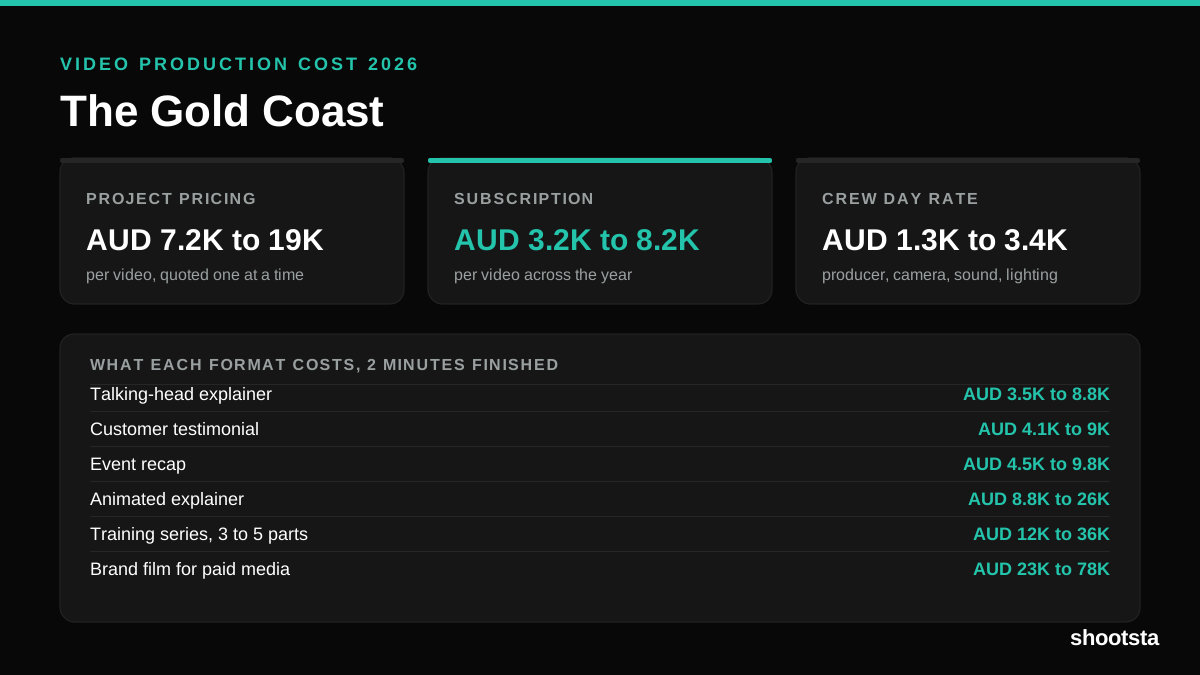
Video Production Cost on the Gold Coast 2026
Video production in the Gold Coast costs AUD 3,200 to AUD 8,200 per finished video on a subscription model, and AUD 7,200 to AUD 18,500 for one-off project work. Here is what you are paying for, and how the three pricing models compare.
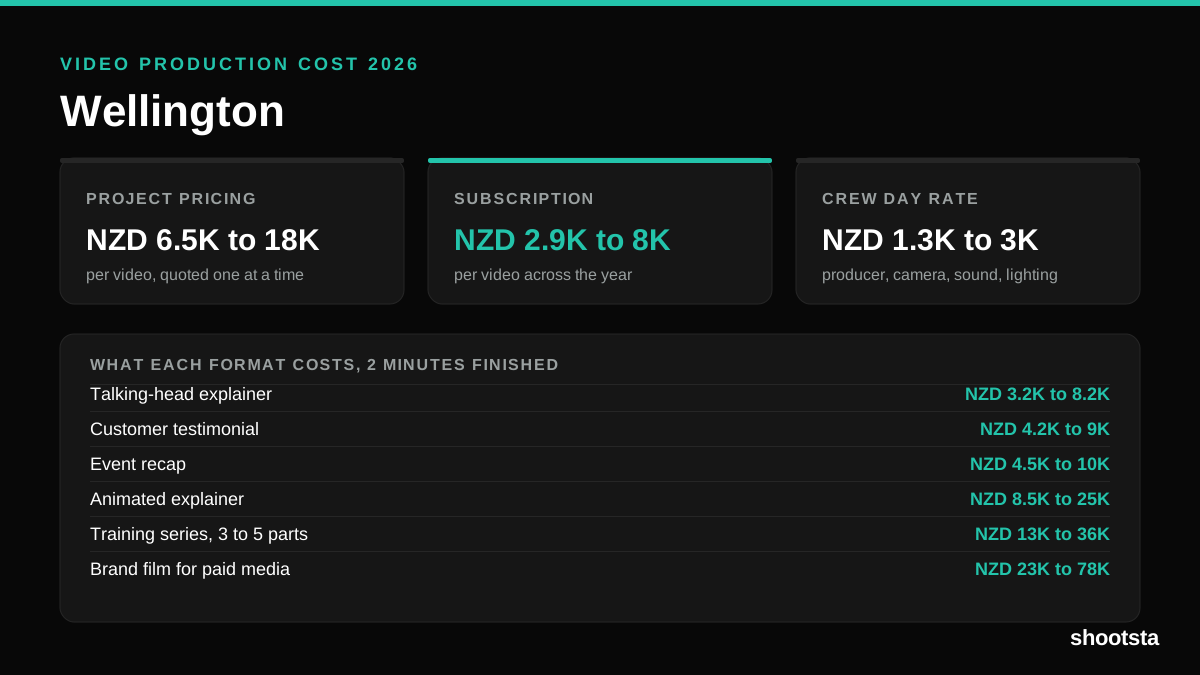
Video Production Cost in Wellington (2026)
Video production in Wellington costs NZD 2,900 to NZD 8,000 per finished video on a subscription model, and NZD 6,500 to NZD 18,000 for one-off project work. Here is what you are paying for, and how the three pricing models compare.
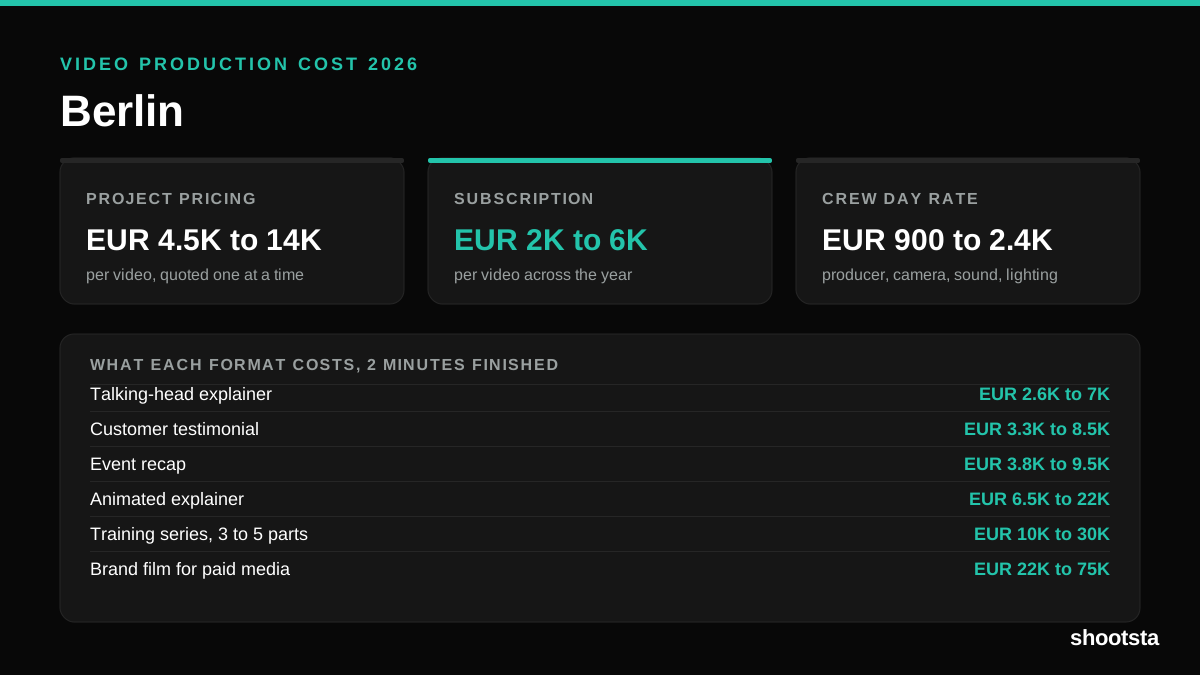
Video Production Cost in Berlin (2026)
Video production in Berlin costs EUR 2,000 to EUR 6,000 per finished video on a subscription model, and EUR 4,500 to EUR 13,500 for one-off project work. Here is what you are paying for, and how the three pricing models compare.