
Video Production Cost in the US (2026)
shootsta.
Video Production Cost in the US (2026)
By Shootsta · Published June 3, 2026 · Updated October 2026

Video production in the US costs USD 2,500 to USD 8,000 per finished video on a subscription model, and USD 6,000 to USD 25,000+ for one-off project work. Here is the full 2026 pricing breakdown for enterprise teams.
How much does video production cost in the US?
In 2026, corporate video production in the US typically costs between USD 2,500 and USD 8,000 per finished video on a subscription model, and between USD 6,000 and USD 25,000+ for one-off project work. Price depends on shoot complexity, video length, motion graphics, multi-region delivery, and how much pre-production planning is involved. Below is the full breakdown, the three pricing models in the market, city-by-city differences, and what to look at when comparing quotes.
What are you paying for in a US video production quote?
Most enterprise video quotes in the US include the same core line items, just bundled differently. The five real cost drivers are:
- Crew and equipment. Director or producer, camera operator, sound, lighting, sometimes a second camera or gimbal operator. US crew rates run USD 800 to USD 3,500 per day depending on level and city.
- Editing and post-production. Where most of the time goes. Editing typically takes 1.5 to 3 days for a standard 2 to 3 minute video. Multiply by an editor day rate of USD 700 to USD 1,800.
- Motion graphics and animation. Anything from simple lower thirds (small cost, often included) up to fully animated explainers (USD 3,500 to USD 15,000 per minute of finished animation).
- Pre-production. Scripting, storyboarding, scheduling, location scouting, talent briefing. Usually 1 to 3 days of producer time at USD 900 to USD 1,800 per day.
- Project management and revisions. The bit nobody quotes upfront but everybody pays for. One round of feedback usually included; subsequent rounds typically billed hourly at USD 100 to USD 220.
Before the detail, put your own volume against both models in the calculator below. It shows how the number of videos you make each year changes the total under each one.
Interactive estimator
What will your video program cost in the US?
Set your annual volume, how involved a typical video is, and how many language versions you need. The estimate returns the yearly cost of buying each video as a project against buying capacity on a subscription, in USD.
How involved is a typical video?
Pick the one most of your videos look like, not the biggest thing you make all year.
How many language versions?
Count the master. Subtitled versions cost less than full voiceover, so this is a midpoint.
Project pricing, per year
USD 273,600
About USD 11,400 a video, quoted one at a time.
Subscription, per year
USD 119,400
About USD 4,975 a video across the year.
You keep
USD 154,200
Roughly 56% off the per-video cost.
What sits behind the the US numbers
- Crew day rateProducer, camera, sound and lighting for a shoot day.USD 900 to USD 3,500
- Editor day rateA standard two to three minute video takes 1.5 to 3 days.USD 500 to USD 1,500
- Extra revision roundsWhat a third and fourth round of feedback adds across the year on project pricing. Subscriptions build the rounds into the workflow instead.USD 21,216
You are at the crossover
At 24 videos a year the two models are close, and the tie-break is not price. It is whether your volume is steady or lumpy. If most of the work lands around a launch, a results week or a conference, project pricing means queueing for crew exactly when everyone else wants them. Capacity you have already bought does not queue.
See how the pricing worksBudget guides for the US in 2026, not a quote. Ranges come from the same rate table the article quotes. Project pricing assumes each video is scoped and quoted on its own. Subscription pricing assumes brand templates and the approval chain are set up once and reused, which is what moves the per-video cost. Travel, talent buyouts and music licensing beyond a production library sit outside both.
The three pricing models for video production in the US
1. Project-based with a video production agency
You hire an agency for a specific video. Cost per video is highest because every project resets brand learning and project setup. Typical US enterprise project pricing for a 2 to 3 minute corporate video lands between USD 6,000 and USD 18,000. High-end branded films run USD 25,000 to USD 150,000+.
Best for: one-off campaigns, hero brand films, broadcast TVCs, or businesses producing fewer than 10 videos a year.
2. Agency retainer
You pay a monthly fee for a fixed allocation of agency time. Cost per video drops because setup time amortizes across more work. Typical retainers in the US are USD 8,000 to USD 30,000 per month, covering roughly 3 to 8 videos per month depending on complexity.
Best for: marketing teams with steady but moderate volume, often combined with design, copy, social, and paid media.
3. Subscription video production
You pay a monthly subscription that covers unlimited briefing, a set production capacity, and access to the editing team. Cost per finished video drops further because production infrastructure is shared and brand learning is locked into a workflow. Per-video costs typically land between USD 2,500 and USD 8,000 depending on complexity and volume tier.
Best for: comms, marketing, HR, and L&D teams producing 25+ videos a year, especially those needing burst capacity around launches, events, and quarterly comms.
Sample cost breakdown for a typical US corporate video
For a 2-minute corporate video filmed in one location in a major US city, with English captions and one round of revisions:
- Pre-production (scripting, scheduling, brief): USD 1,200 to USD 2,500
- Shoot day (crew + equipment, half day): USD 1,800 to USD 3,500
- Editing (2 days): USD 1,400 to USD 3,200
- Motion graphics, lower thirds, brand templates: USD 500 to USD 1,500
- Captions and quality check: USD 200 to USD 500
- Project management and one revision round: USD 500 to USD 1,000
Total project-based estimate: USD 5,600 to USD 12,200 per video.
Same video on a subscription model: typically USD 3,000 to USD 5,500 per video, because pre-production templating, brand setup, and project management amortize across other work.
City-by-city US video production pricing in 2026
US pricing varies significantly by city. New York and Los Angeles run highest, with San Francisco and Boston a tier below. Chicago, Atlanta, and Austin sit one more tier down. Smaller markets like San Diego, Nashville, Denver, and Portland are 25% to 40% cheaper than NYC or LA.
- New York City: This is a premium market, with crew day rates of USD 1,500 to USD 3,500. It has the deepest crew bench in the US. See the full New York cost breakdown.
- Los Angeles: This is a premium market, with crew day rates of USD 1,400 to USD 3,500. Its broadcast and entertainment talent is the strongest in the country. See the full Los Angeles cost breakdown.
- San Francisco / Bay Area: Crew day rates run USD 1,300 to USD 3,200, and crews here are strong in tech and SaaS work. See the full San Francisco cost breakdown.
- Boston: Crew day rates run USD 1,200 to USD 3,000. Local crews do a lot of education, life sciences and financial services work.
- Chicago: Crew day rates run USD 1,100 to USD 2,800. The city has strong CPG, B2B and broadcast crews.
- Atlanta: Crew day rates run USD 1,000 to USD 2,500, and Georgia offers production-friendly state credits.
- Austin: Crew day rates run USD 1,000 to USD 2,500, and the tech sector there keeps growing.
- San Diego: Crew day rates run USD 900 to USD 2,400. Crews here know biotech, defense and tourism work well. See the full San Diego cost breakdown.
- Nashville: Crew day rates run USD 900 to USD 2,400, and local crews are strong in music and healthcare.
- Denver / Portland: Crew day rates run USD 900 to USD 2,200. Both cities have a smaller crew base that is still growing.
Hidden costs that catch US teams out
Union vs non-union crews
US shoots involving IATSE or other union crew (more common in NYC and LA, less common elsewhere) come with specific work-rules, meal penalties, overtime, and pension/health contributions. Union day rates can be 20% to 40% higher than non-union equivalents, with non-negotiable overtime above 10-hour days. Build this into the brief if your project requires it.
Talent fees and SAG-AFTRA
SAG-AFTRA-covered talent has separate session fees, use fees by media (broadcast, social, OTT), residuals, and pension/health. A SAG-covered 30-second commercial with national broadcast and one-year online use can run USD 8,000 to USD 25,000+ in talent fees alone, depending on talent profile and usage. Non-union talent removes these layers but limits the talent pool.
Multi-city shoots and travel
A national brand shooting in three US cities pays USD 5,000 to USD 15,000 in crew travel, per diems, and equipment freight per multi-city campaign. A national partner with crews in each city removes most of this. Each travel day is also typically a half-rate billable day.
Revisions beyond the first round
Project agencies usually include one revision round. Anything after is billed hourly. A complex video with three rounds of stakeholder feedback can add USD 1,500 to USD 4,000 to the final bill.
How does video type change the cost in the US?
Different video formats have different cost profiles in 2026:
- Talking-head explainer (single camera, single location, 2 minutes): USD 3,000 to USD 9,000.
- Corporate event recap (full-day shoot, 1 to 2 cameras, 90 seconds delivered): USD 4,500 to USD 12,000.
- Customer testimonial (on location at client office, 2 minutes): USD 4,000 to USD 11,000.
- Animated explainer (2 minutes, custom style, no live action): USD 7,500 to USD 30,000.
- Internal training series (3 to 5 episodes of 4 to 7 minutes, shot in one block): USD 14,000 to USD 45,000 total.
- Brand film for paid media (60 seconds, multi-location, talent, motion graphics): USD 30,000 to USD 150,000+.
- Broadcast TVC (30 seconds, talent, paid network buy): USD 75,000 to USD 500,000+.
Why subscription often works out cheaper for US enterprise teams
The math is straightforward above a certain volume. The fixed costs of video production (pre-production templating, brand setup, project management, the time to learn your business) are roughly the same whether you produce 5 videos a year or 50. On a project basis, those fixed costs get charged again and again. On a subscription, they get absorbed once and amortized across everything produced after.
For a US enterprise comms or marketing team producing 30+ videos a year, a subscription model usually lands at 40% to 60% lower cost per video than equivalent project work, with the added benefit that brand consistency improves because the same team handles every project.
When subscription is the wrong model
If you produce fewer than 10 to 12 videos a year, subscription rarely pays back. The monthly fee assumes the capacity gets used. If you produce 4 videos in 12 months on a subscription that covers 24, you have paid for 20 you never made. Stick with project pricing.
The same goes for one-off hero brand films, broadcast TVCs needing a specific director, and SAG-covered ad campaigns. Those projects suit an agency better than a subscription.
Frequently asked questions
What is the cheapest way to produce business video in the US?
For very small businesses producing under 5 videos a year, freelance videographers in the US charge USD 500 to USD 2,500 per shoot day with editing extra. Quality varies widely. For enterprise teams, the cheapest per-video cost almost always comes from a subscription model once annual volume passes about 25 videos.
How long does it take to produce a video in the US?
Project agencies typically quote 4 to 8 weeks from brief to delivery for a standard corporate video. Subscription models usually deliver a first cut within 48 hours of brief and footage, with final delivery in 5 to 7 days after revisions. The difference is workflow design.
Do US video production prices include music licensing?
They should, but ask explicitly. Most reputable US agencies and subscription providers include commercial-use music licensing in the base price, drawn from production music libraries. Specific popular tracks are a separate licensing conversation and can add USD 500 to USD 200,000+ depending on artist and usage scope.
How do regulated industries (healthcare, FS, pharma) compare on cost?
Base production cost is the same. The added cost is compliance review time and version control overhead, which usually adds 10% to 25% on top of a standard quote. Subscription providers built for regulated industries include this in the workflow rather than charging it separately.
Why is video production in NYC and LA more expensive than other US cities?
Higher crew day rates, union prevalence, SAG-AFTRA depth, higher equipment rental costs, more expensive studio space, and more competition for senior crew during peak production seasons. The quality of work tends to match the cost - both cities have the deepest senior talent benches in the US.
Are there hidden costs in subscription video production?
The main thing to watch for is what happens when you exceed the included capacity. Most subscriptions are sized to a video volume and a complexity tier. Going significantly above either, or producing video types not covered by the tier, usually triggers an overage rate. Ask for that rate up front.
Where to go next
For the bigger picture beyond this market, read how video production costs break down by stage and model.
For US-specific service detail, see the New York hub, the Los Angeles hub, and our San Diego hub. For US tourism boards specifically, our multi-language destination video guide. For a scoped quote based on your actual volume, get in touch.
Take this article with you
Read the latest at shootsta.com/blog/video-production-cost-us
You might also like

How to Plan Video Team Capacity Around Leave
Your only editor just booked two weeks off, and you already know which projects will slip. Chad Lakin explains how to plan video team capacity so the work keeps moving when someone is away.
Corporate Video Editing Standards: Full Guide
A two-page editing standard does more for consistency than a forty-page brand book. Here is what it should cover, who owns each part, and how to enforce it with an in-house editor or an outside partner.
Quality Control in Outsourced Video Editing
When editing leaves the building, quality has to be checked by a system rather than by whoever happens to look. Here is the system: acceptance criteria, two QA gates, counted revision rounds and a quarterly audit.
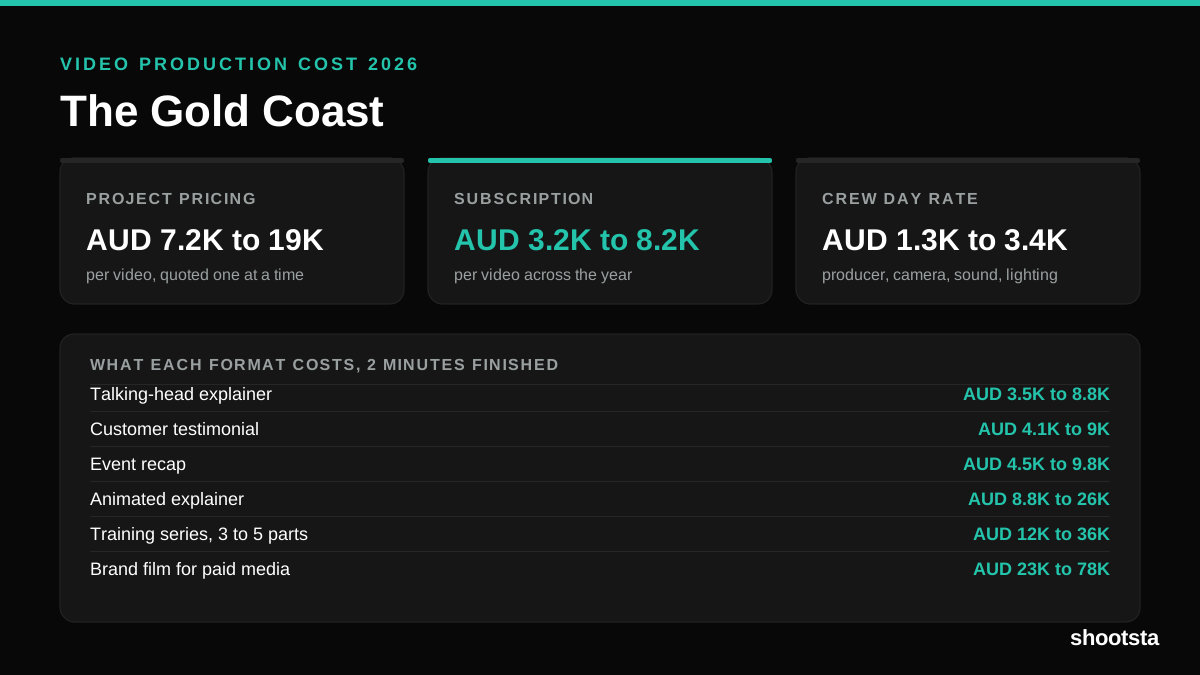
Video Production Cost on the Gold Coast 2026
Video production in the Gold Coast costs AUD 3,200 to AUD 8,200 per finished video on a subscription model, and AUD 7,200 to AUD 18,500 for one-off project work. Here is what you are paying for, and how the three pricing models compare.
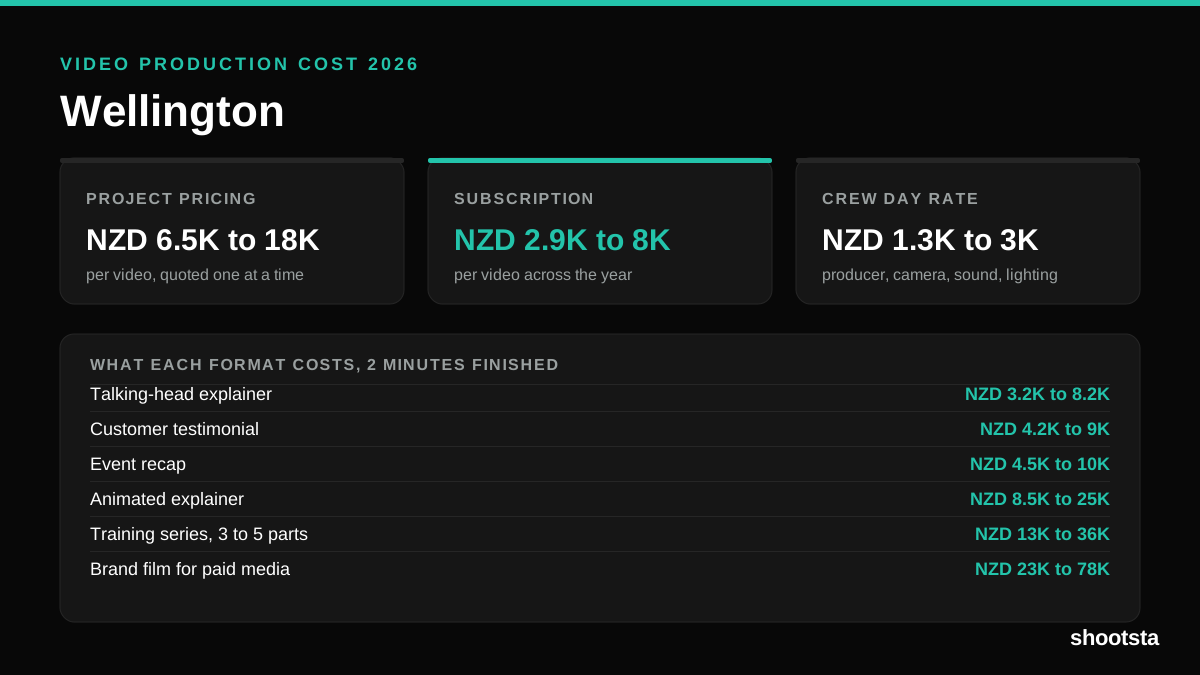
Video Production Cost in Wellington (2026)
Video production in Wellington costs NZD 2,900 to NZD 8,000 per finished video on a subscription model, and NZD 6,500 to NZD 18,000 for one-off project work. Here is what you are paying for, and how the three pricing models compare.
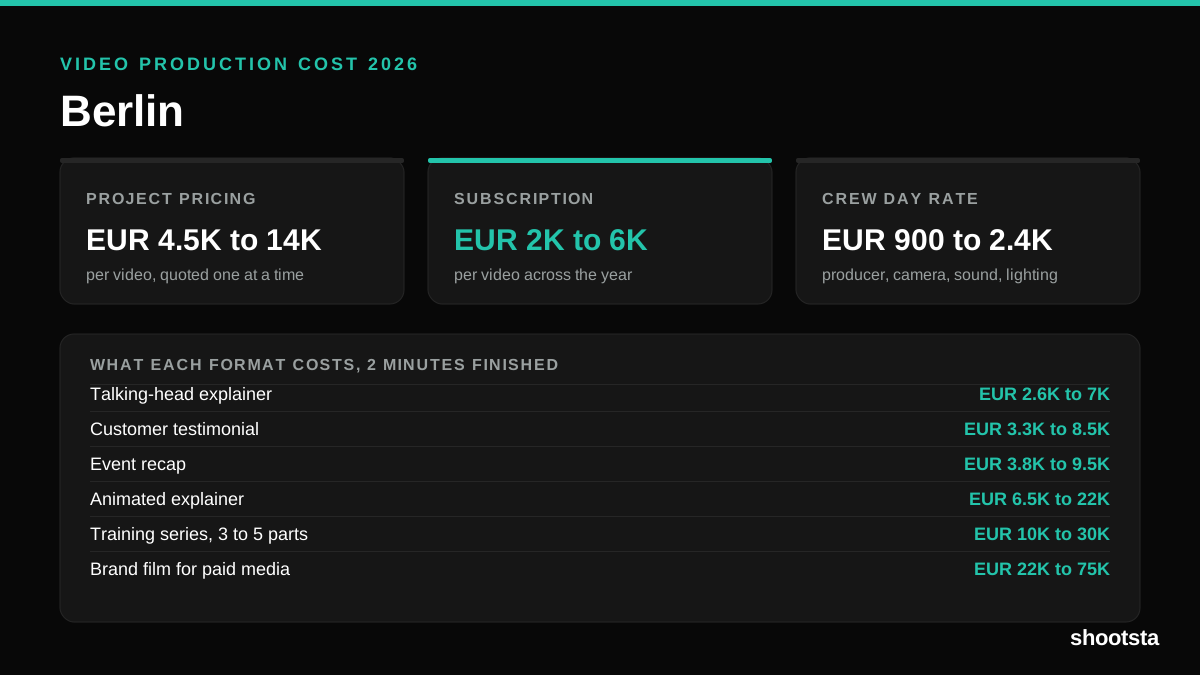
Video Production Cost in Berlin (2026)
Video production in Berlin costs EUR 2,000 to EUR 6,000 per finished video on a subscription model, and EUR 4,500 to EUR 13,500 for one-off project work. Here is what you are paying for, and how the three pricing models compare.