
Animated Video Production Cost in the US
shootsta.
Animated Video Production Cost in the US
By Shootsta · Published September 15, 2026 · Updated October 2026
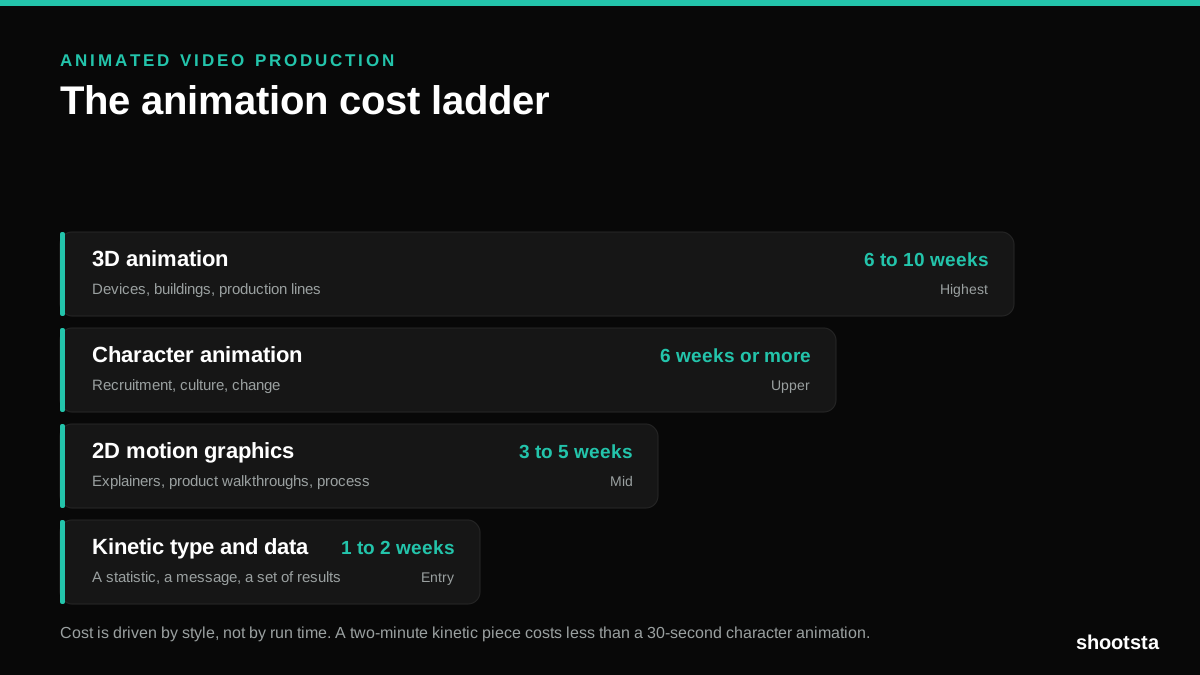
Animated video production costs move with style, not with length. Kinetic type, 2D motion, character and 3D sit on four rungs of a ladder. Here is what separates them.
Short answer. Animated video production cost is driven by style, not by run time. A 60-second kinetic type piece costs far less than a 60-second 3D piece. The four styles are kinetic type, 2D motion graphics, character animation and 3D, and they run from about one week to ten weeks. Pick the cheapest style that can carry the idea, then spend the difference on the script.
A 90-second explainer is the most common US request, and 2D motion graphics is almost always the right rung for it.
Animated video production is priced in a way that surprises many first-time buyers. Length barely matters, and the style you choose sets almost all of the price.
Ask three US studios for a 90-second animation and you will get three quotes that are nowhere near each other. The usual reason is that each one has assumed a different animation style, and the styles sit on a ladder where each rung costs several times the one below.
This guide sets out the four rungs, what each one costs relative to the others, how long each takes, and how to work out which one your project needs.
What is animated video production?
Animated video production is the making of video from drawn, designed or modelled frames rather than filmed footage. Nothing is shot on a camera, so everything on screen has to be built.
That is what makes it the right format when the subject cannot be filmed. Software interfaces, abstract processes, internal mechanisms, future states and data all fall into that category. It is also why animated video production scales differently to filming. Changing a fact means editing a file, with no reshoot to book.
What are the four animation styles?
Nearly all animated video production sits in one of four styles. They are listed here from lowest cost to highest.
Kinetic type and data motion
This style animates words, numbers and simple shapes in your brand fonts, with no illustration or characters. It works best for a statistic, a message or a set of results.
Typical turnaround is one to two weeks. This is the entry rung, and the fastest thing you can make.
2D motion graphics
Illustrated scenes, icons, interface elements and diagrams, animated in sequence. This is the workhorse style and it covers most explainers, product walkthroughs and process videos.
Typical turnaround is three to five weeks. If you are picturing an explainer video, you are picturing this rung. Most animated video production requests land here.
Character animation
Here, designed characters carry a story. The style is worth the money when the audience has to feel something rather than understand a process, which is why recruitment, culture and change communication videos often use it.
Design and rigging happen before any animation starts, so plan six weeks or more. Costs sit well above 2D motion graphics.
3D animation
3D uses modelled objects with real depth, lighting and camera movement. It earns its premium when form and scale carry the meaning, such as a device, a building or a manufacturing line.
Turnaround runs from six to ten weeks. Existing CAD or product files cut both the cost and the schedule, sometimes dramatically.
Which animation style fits your project?
Answer five questions on what the video has to explain, who watches it, what brand assets exist, the deadline and the budget band. The tool gives you a style and a typical turnaround.
Interactive
Which animation style fits the job?
Five questions on what the video has to explain, who watches it, what brand assets exist, the deadline and the budget band. You get a style and a typical turnaround.
Turnarounds are typical, not contractual. They assume a signed-off script and one review round. Style and budget move together: a longer deadline usually buys a rung up the ladder for the same money.
What drives animated video production cost?
Four things drive the cost, listed here in order of impact.
- Style. This is the biggest factor. Moving from kinetic type to 3D changes the cost more than any other decision you will make.
- Assets you already own. An existing illustration set, icon library or 3D product file removes days of design. A brand with only fonts and a palette starts from scratch.
- Script changes after animation starts. Editing a word at script stage is free. The same edit after frames are drawn means a re-render.
- Number of versions. Other languages, aspect ratios and market variants are each a finished asset. They are cheap if you plan them up front and expensive if you ask for them later.
Run time barely registers next to those four. A two-minute kinetic piece still costs less than a 30-second character animation, which is the opposite of what buyers often expect when they ask for a price by the minute.
What does animated video production look like?
An animated end-of-financial-year piece produced with Shootsta for Valencia. This is 2D motion graphics doing the job it is best at, which is turning a set of numbers and a message into something people will watch to the end.
How long does animated video production take?
It takes one to ten weeks, depending on the rung. Script approval swings the schedule more than the animation itself does.
A locked script costs nothing to change. An approved script that changes after frames are drawn costs a re-render and, more painfully, another review cycle. The teams that get animation delivered on time are the ones that spend an extra week on the script and then leave it alone.
Our guide to briefing an animation project covers the fields that keep this stage short.
Should you use an animated video production company or a subscription?
It depends on how much animated video production you expect to buy this year.
For one or two flagship pieces, a specialist animation studio is a reasonable buy. You are paying for concept development and craft on a small number of assets.
For a steady stream, which is where many enterprise teams end up once they start, per-project pricing gets expensive quickly. Animation is also the hardest skill to hire for in-house, which is why it is the most common gap we are asked to fill. A subscription that includes animation removes both the hiring problem and the quote step. Shootsta prices this as a fixed monthly fee covering a set number of video credits.
Can you animate without any brand assets?
Yes, and it is more common than you would think. Plenty of US teams arrive with a logo, a two-tone palette and nothing else.
What happens then is that the first animation project builds the asset library, which costs more than later projects and takes longer. The upside is that the second and third pieces are cheaper and faster, because the icons, characters and motion rules already exist. Treat the first project as an investment in a system rather than as a one-off.
How do you compare two animation quotes?
Put them on the same footing first, because two animated video production quotes are almost never scoped the same way.
Ask each studio to state four things in writing: the style they have assumed, how many revision rounds are included, whether you receive the working project files or only the export, and what a second language version would cost. Those four turn a pair of unlike numbers into a comparison.
The source files matter more in animation than in filmed video, because animated pieces get updated rather than replaced. A price change, a new logo or a revised statistic is a small edit if you hold the files and a new project if you do not.
Watch for a quote that is cheaper because it assumed a simpler style than the one you described. That is the most common reason an animated video production budget doubles in week three.
Is animation cheaper than filming?
Animation is usually cheaper, though not always, and the fair comparison is over a year rather than per video.
A single filmed video with a small crew often costs less than a single character animation. Over twelve months the picture inverts, because animation has no travel, no talent availability and no reshoots. Changing a fact means editing a file.
The strongest programs use both. They film the human moments, where a real face carries more than a drawn one. They animate the mechanism, the process and anything a camera cannot reach.
How does animation video production in the US compare with Australia, the UK and Singapore?
This post is the US member of a set. The Australia, London and Singapore posts cover the same four styles, and the differences between markets are about what teams buy rather than how animation is made.
US teams tend to buy the post-production and animation service rather than a filming kit, because the gear already exists in-house. The common requests are animated explainers for healthcare, medical devices and pharma, product walkthroughs for software, and training and enablement modules, with professional voiceover as part of the job. Australian teams more often start from a kit and training, Singapore teams build one master animation and localize it across APAC languages, and UK teams lean on animation to keep a large library current across functions.
Animation video production in the US is the largest of the four clusters by search volume, and the one where the gap between a studio quote and a subscription is widest. Production for US clients runs from Shootsta's San Diego office, with animators and editors in Sydney, London and Singapore picking up work across time zones, so a brief sent at the end of a US day has a first version back in about 48 hours.
Animation video production FAQs
How do you choose between animation video production companies in the US?
Compare them on four things. First, check which of the four styles each one produces in-house rather than subcontracts. Then ask whether the brand assets are set up once as templates or rebuilt on every job, and whether you receive the source project files. Last, see whether the price is a quote per project or a fixed monthly fee with a set number of credits. A studio and a subscription can both make good animation. They behave differently once you need the fifth piece.
What do video animation companies charge in the US?
For an animated explainer, the working range is about US$7,500 to US$30,000 per video on a per-project basis, with the style deciding where in that band a quote lands. That range comes from the same rate table as our video production cost guide for the US. On a subscription, the same explainer is priced inside a monthly fee covering a set number of video credits, with no per-project fees, which is what moves the per-video cost down once the brand templates exist.
Do animation video production services in the US include the script and voiceover?
At Shootsta, yes. Scripting, storyboarding, professional voiceover, animation and captions are part of the service, so a US team can send a brief or an existing document and receive a finished animation. Ask any provider this question directly, because a quote that excludes the script and the voiceover can look cheaper by a third.
We have a designer in-house. Why use an animation video production service?
Motion design is a separate skill from graphic design, and it is the hardest video skill to hire for. Your designer keeps the brand calls and the direction. The animation hours flex with the calendar instead of with headcount, and the first project builds templates your designer then owns. The split is set out in how a video partner extends your in-house team.
Where to go next
To see the service itself, visit our animation video production page. For a closer look at the pricing of the most requested format, read what an animated explainer video costs in 2026.
If you are ready to brief, our guide to writing an animation brief sets out what a studio needs from you. To model animation alongside your other video spend, use the cost calculator.
To talk through a specific animated video production project, book a free consultation.
About Shootsta
Shootsta is a global video production service that helps enterprises create on-brand videos at scale and operationalize video production across every business touch-point. We have produced 70,000+ videos for 920+ brands since 2014, with a first cut in about 48 hours and 4.9 / 5 customer satisfaction across post-delivery surveys. Editors work from offices in Sydney, London, Singapore and San Diego.
Last updated 6 October 2026.
Take this article with you
Read the latest at shootsta.com/blog/animated-video-production-us-cost
You might also like
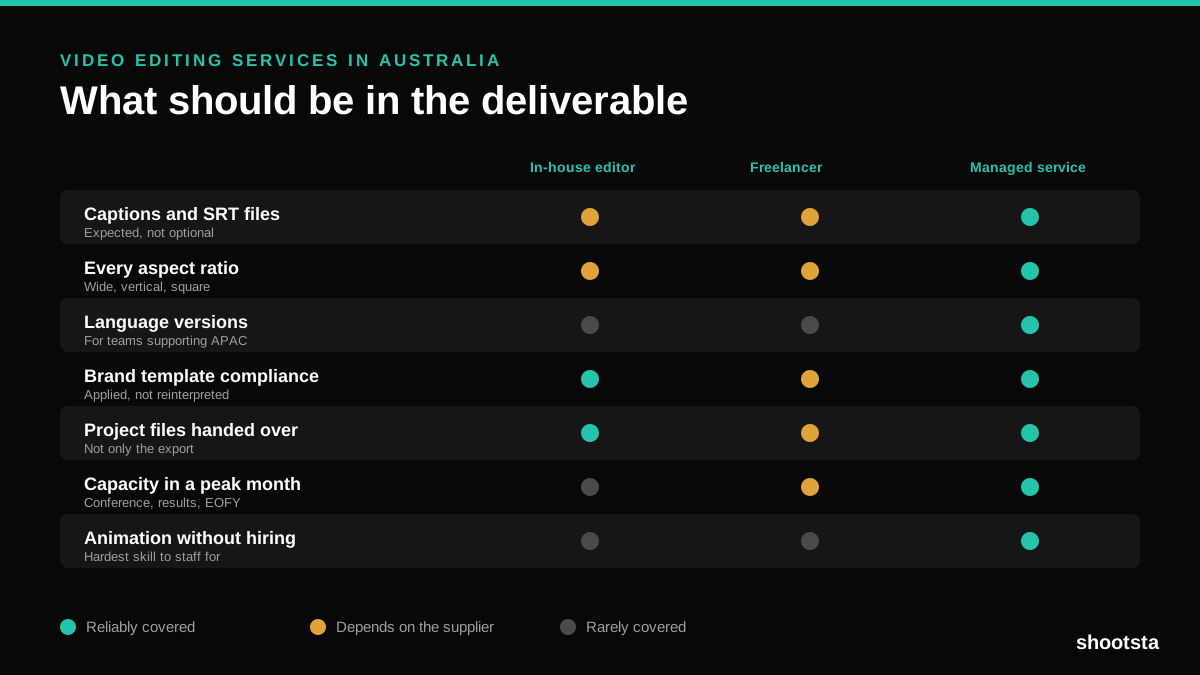
Video Editing Services in Australia
Australian teams are spread across time zones and offices, so the editing queue matters more than the editing. Here is what to expect on cost and turnaround.
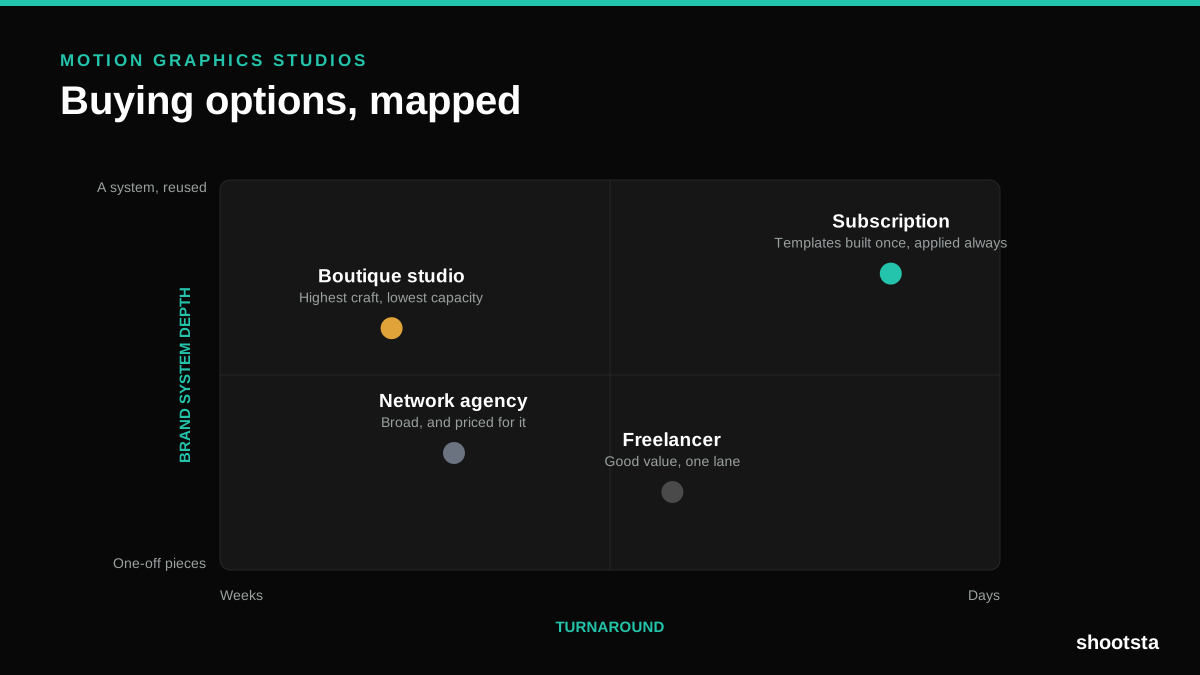
How to Choose Between Motion Graphics Studios
Every motion graphics studio has a good reel. The reel is the one thing that will not tell you how the fifth project goes. These ten criteria will.
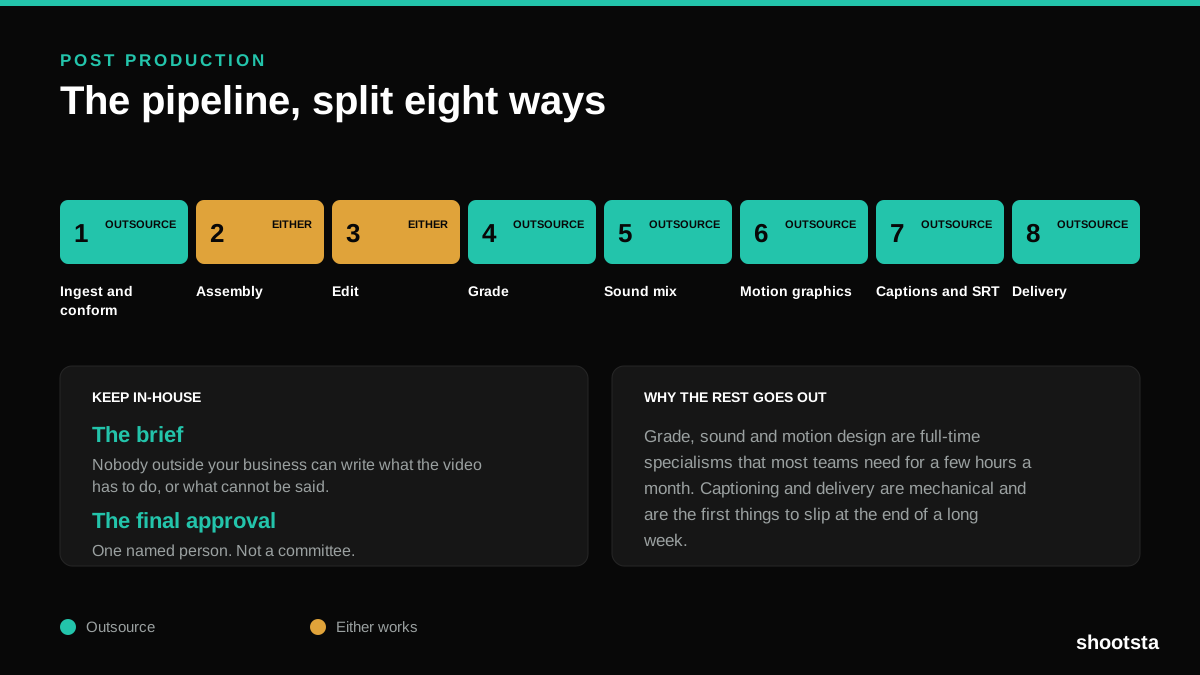
Post Production Agency or In-House Team?
Post production is eight stages, not one. Some of them need context only your team has. The rest are mechanical and are the first things worth handing over.
How to Commission Medical Training Animation
Commissioning a medical training animation is mostly decisions you make before anyone animates a frame. The brief fields that matter, what to ask a studio, how much expert time to budget, and the contract terms that stop a rebuild in two years.
How to Write an Animation Brief
How to Write an Animation Brief
Most animation briefs cause delays because they over-specify the visual style and under-specify the outcome. Here are the nine fields an animation production team needs to quote accurately and start without rework.
How to Localize Animated Video at Scale
How to Localize Animated Video at Scale
Animated video is the easiest format to localize because text and audio live in editable layers. Here is how to scale it across languages cleanly.