
Medical Training Animation: A Complete Guide
shootsta.
Medical Training Animation: A Complete Guide
By Shootsta · Published August 18, 2026 · Updated October 2026
A medical training animation teaches a procedure, a device workflow, or a mechanism the camera cannot reach. Here is how one gets made, what it costs, and how to keep medical review from eating the schedule.
A medical training animation is a short animated video that teaches a clinical procedure, a device workflow, or how a treatment works inside the body. It is built from a script and illustrated frames instead of filmed footage. That makes it the right format when the subject sits inside the body, inside a machine, or inside a protocol that no camera can follow.
This guide covers what a medical training animation does, how one gets made, what it costs, and how to clear medical review without losing a month to it. For the wider format picture first, read our overview of animation use cases for healthcare and pharma.
What is a medical training animation?
A medical training animation is an animated learning asset made for a clinical or regulated audience. It teaches one thing at a time: how a drug acts on a receptor, how a surgeon loads an implant, or how a nurse escalates a deteriorating patient.
Three things separate a medical training animation from a standard explainer video. A subject matter expert checks the content against a named source. The visuals have to be anatomically accurate rather than merely attractive. Most of this work also passes a medical, legal and regulatory review before a single learner watches it.
When does animation beat filming?
Animation wins whenever the camera cannot get there. You cannot film a molecule binding to a receptor, and you cannot film blood moving through a stent. Filming inside a joint during real surgery means arranging access and patient consent. Even then you may not get the angle the learner needs to see.
Animation also wins when the content has to change, because a protocol update means a script edit and a re-render. A filmed procedure means arranging another shoot, another clinician and another consent process.
Keep the camera for the human proof. Clinician interviews, patient stories and leadership messages all land better with a real face on screen. Use a medical training animation for the mechanism and the method.
What types of medical training animation are there?
Six formats cover almost every medical training animation request we see.
- Mechanism of action. How a drug or therapy works at cell level, usually built to train field teams, medical science liaisons and clinicians.
- Surgical procedure. A step-by-step walkthrough of a technique, generally produced for surgeon onboarding or a device launch.
- Device handling. Setup, calibration, cleaning and fault-finding for equipment. This is the highest-volume format inside medical device companies.
- Clinical protocol and SOP. Escalation pathways, infection control and hand-off procedures drawn as a clear sequence rather than written as a policy.
- Anatomy and physiology. Foundation modules for new starters and for the non-clinical staff who support clinical teams.
- Safety and compliance. Adverse event reporting, sharps handling and the privacy rules that govern health records.
Start with one format and expand from there. Device handling and clinical protocol libraries tend to grow fastest, because the source material already exists in written form and only needs translating into pictures.
How is a medical training animation made?
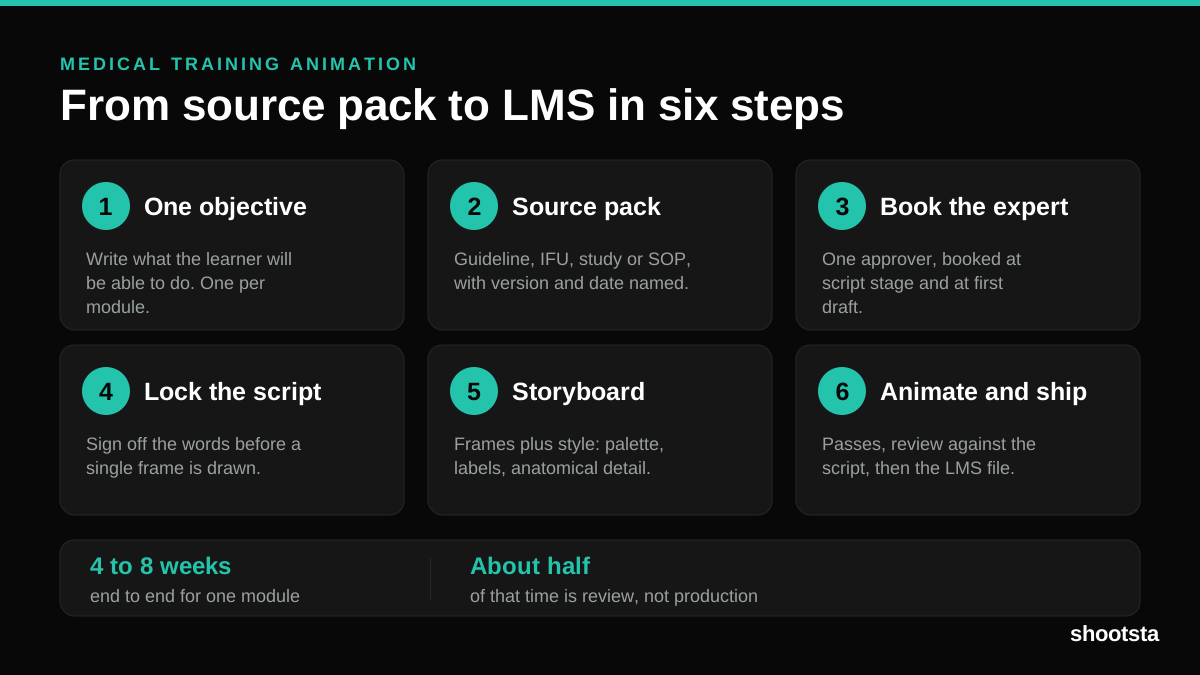
Six steps take you from brief to LMS. A single module usually takes four to eight weeks end to end.
1. Set one learning objective
Write the sentence that says what the learner will be able to do afterwards. Give each module one objective, and if you have two objectives, make two modules. This single decision does more for completion rates than any visual choice made later in production.
2. Assemble the source pack
Gather the instructions for use, the clinical guideline, the published study or the internal SOP that the animation will follow. Name the version and the date. Every claim on screen has to trace back to something in that pack.
3. Book the expert early
Pick one subject matter expert with authority to approve. Book their time at script stage and again at the first animation draft. Late expert input is the most common reason a medical training animation runs over schedule.
4. Lock the script
The script carries the accuracy, so sign it off before any frame is drawn. Changing a word costs nothing at script stage, while the same change after animation has started costs a re-render.
5. Storyboard and style frames
The storyboard maps each line of script to a frame. Style frames set the look: palette, label style and how much anatomical detail you want. Approving both together is how you avoid an unpleasant surprise at the first version. Our guide to writing an animation brief covers the fields that keep this stage short.
6. Animate, review, deliver
Animation runs in passes, moving from rough motion to detail and then to audio and captions. Review happens against the locked script rather than against personal taste. Delivery includes the LMS file, the captions and the source project for future edits.
What does healthcare video production look like?
A video produced with Shootsta for Elekta, a medical technology company. Animation and live action usually sit side by side in a medical program, with the camera carrying the human moments:
Should you use 2D or 3D?
3D earns its cost when form and depth carry the meaning. Anatomy, device assembly and anything a learner has to see from several angles all justify the premium.
Most medical training animation is 2D, because protocols, pathways, decision trees and data are ideas rather than physical objects. 2D draws ideas faster, costs less, and is far easier to update when a clinical guideline changes.
Mixing the two is common and often sensible. A 2D protocol module with one 3D shot, placed where the learner needs to see the device, gives you the economy of 2D and the clarity of 3D. The full trade-off is in our comparison of 2D and 3D animation for business.
What does a medical training animation cost?
The range is wide, because the label covers very different work. Simple 2D protocol modules built from an existing style kit sit in the low thousands. Custom 2D medical animation for a 60 to 90 second module usually lands in the mid four to low five figures. Detailed 3D anatomy or surgical work runs well into five figures. Four things move the number more than length does.
- Anatomical detail. A simplified cross-section costs a fraction of a photoreal organ model built to withstand close inspection.
- Custom versus reused assets. The first module carries the setup cost, and every module built from the same style kit afterwards gets cheaper.
- Review rounds. Open-ended review is where medical budgets quietly blow out, so defined rounds at named stages keep the number predictable.
- Language versions. Animation is cheap to re-voice, because the picture never changes and only the audio and the on-screen text have to swap.
For a fuller breakdown of the tiers, see our guide to animated explainer video cost.
How does medical review fit the schedule?
A medical training animation ships faster when review is planned in from the start rather than bolted on at the end. Two checkpoints work well: the expert signs the script, and the reviewers sign the near-final animation.
Give reviewers the source pack alongside the draft, so that they check against the guideline rather than against memory. Keep a record of who approved what and when. In regulated settings that record matters as much as the finished video. The full review chain is covered in how to produce video for healthcare and pharma.
How do you deliver it to an LMS?
Ask for the LMS package at brief stage rather than after delivery. Most learning platforms want a SCORM or xAPI package if you need completion tracking, and a plain MP4 file if you do not.
Three delivery items are easy to forget. Captions are an accessibility requirement for most health employers under WCAG. Chapter markers let a learner jump straight back to one step. A transcript makes the module searchable and helps second-language staff follow along.
If the program runs across several markets, plan the language versions before the first module is built. Our guide to animated video in multiple languages explains the file structure that keeps this cheap.
Frequently asked questions
How long does a medical training animation take to produce?
Four to eight weeks for a single module, from brief through to delivery. About half of that is review rather than production. Teams with a locked source pack and one named approver land at the fast end of that range.
Who checks the medical accuracy?
A named subject matter expert checks it against the source pack. The animation team owns the clarity of the picture. The expert owns whether the picture is right, and both sign-offs matter.
Can one animation serve clinicians and patients?
Rarely as it stands, but the underlying assets carry over well. The same models and motion can be re-cut with a simpler script for patients, which costs far less than commissioning a second build from scratch.
How often should a medical training animation be updated?
Whenever the guideline, the product label or the device instruction changes. Keep the source project files, so an update is an edit rather than a rebuild. That is a good reason to ask for those files in the contract.
Does animation make regulatory review easier?
Yes, in one specific way. Every word and every frame is fixed before production, so reviewers approve exactly what ships. There is no improvised delivery to re-check after the edit.
Where to start
Pick the procedure your team explains most often and build that medical training animation first. It gives you the style kit, the review rhythm and a real completion figure to argue with when you ask for the rest of the program. To scope one, explore our animation production services or read animation use cases for L&D teams.
Take this article with you
Read the latest at shootsta.com/blog/medical-training-animation
You might also like
Medical Training Animation Best Practices
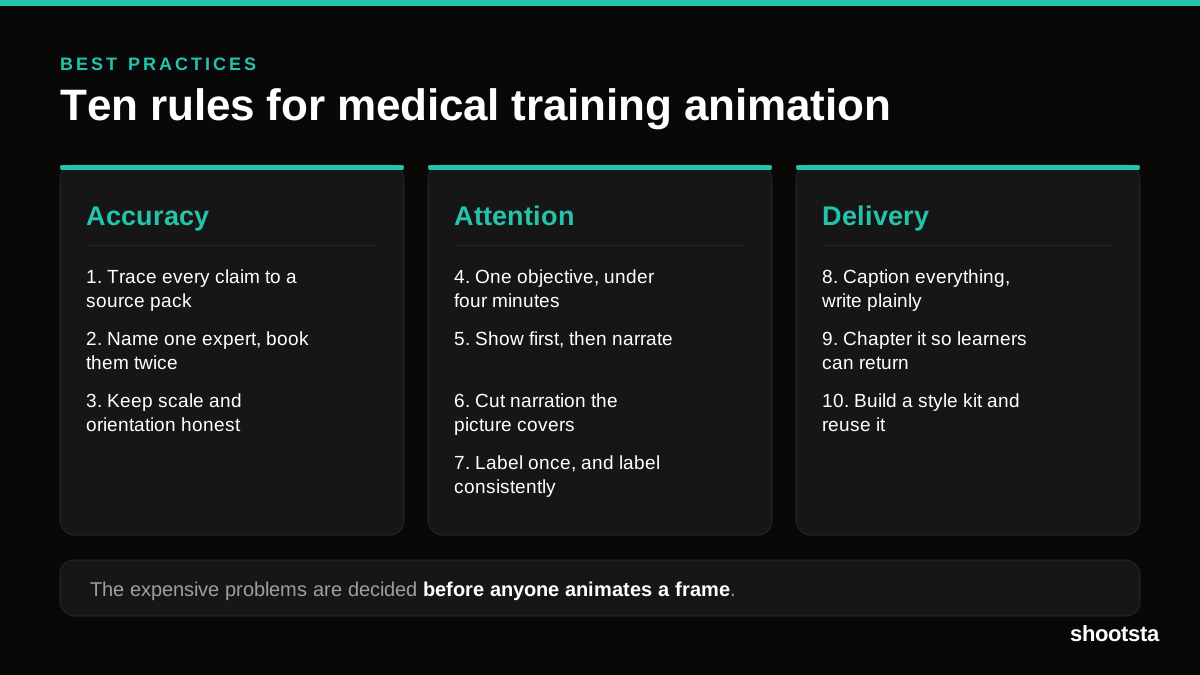
Ten rules that hold up across device training, clinical protocol work and mechanism of action modules. Most medical animation fails for dull reasons: too many objectives, narration that repeats the picture, and review that arrives too late to change anything.
What Delayed Training Videos Cost L&D Teams
What Delayed Training Videos Cost L&D Teams
When training video ships late, employees work without the knowledge for longer. For a distributed enterprise, that backlog has a large, measurable cost.
Australian Corporate Training Video Production
Australian Corporate Training Video Production
A practical guide to corporate training video production for Australian teams: compliance and WHS modules, LMS-ready formats, AEST turnaround, and what a training library costs to build.
What Makes a Great Learning Video
What Makes a Great Learning Video
A great learning video changes what someone can do after watching it. Here is how the best ones are built, the mistakes that lose learners, and how the panel scores them.
Animation Use Cases for L&D Teams
Animation Use Cases for L&D Teams
Learning and development teams get more out of animation than almost any other function. Here are the places it works hardest, and where you should still reach for a camera.
FSI Onboarding: Build a Training Video Library
FSI Onboarding: Build a Training Video Library
Farmers is onboarding 1,700 new agents in 2026. Progressive is hiring 12,000 staff. Northwestern Mutual is moving 2,000 employees into a new campus. None of that scales without a video library.