
Australian Corporate Training Video Production
shootsta.
Australian Corporate Training Video Production
By Shootsta · Published June 24, 2026 · Updated October 2026
A practical guide to corporate training video production for Australian teams: compliance and WHS modules, LMS-ready formats, AEST turnaround, and what a training library costs to build.
What is corporate training video production for Australian teams?
Corporate training video production is the process of turning your onboarding, compliance, and upskilling content into reusable video modules that an Australian workforce can watch on demand through your LMS or intranet. In many AU enterprises it takes the place of the repeated live workshop. There, a different facilitator delivers slightly different material to each new cohort. A video module gives every employee the same version.
The Australian angle matters for two reasons. Compliance content has to map to local obligations like Work Health and Safety, Fair Work, and industry-specific safety codes. Edit turnaround and support also work better when they run inside AEST business hours rather than overnight from an overseas studio. Shootsta is headquartered in Sydney and has produced corporate training video for Australian enterprises since 2014.
Why do Australian teams move from workshops to training video?
The short answer is consistency and reach. A live workshop has to be repeated every time a new cohort joins, and the quality drifts depending on who is running the room that day. A training video is recorded once and watched by 10 people or 10,000 people at no extra cost, which is what regulators and auditors look for when they ask whether every employee received the same message.
Video also fits the way people learn on the job. Employees can pause, rewind, and rewatch a step until it lands, on their own schedule and across time zones if your team spans the east coast, Perth, and trans-Tasman sites. For the broader internal-comms picture, see our guide to internal communications video for Australian companies.
What types of training video do Australian companies produce most?
Compliance and WHS
Compliance is where most programs start. Work Health and Safety inductions, code-of-conduct and Fair Work modules, and industry-specific safety training all need the same message delivered the same way to every employee. Scenario-based video handles this far better than a slide deck repeated by a different presenter each quarter. We go deeper in compliance training videos that work.
Onboarding
Onboarding video gives new hires a consistent introduction to the company, its values, systems and ways of working. Everyone gets the same start whether they join in Sydney, Melbourne, or a remote site. Onboarding video also takes repetitive first-week explaining off your people leaders.
Product and systems training
These are short, repeatable walkthroughs of internal tools, customer-facing products or process changes. They date quickly, so the ability to re-record one module without rebuilding the whole library is what keeps the content current.
Microlearning
Microlearning videos run two to four minutes, reinforce a single idea and fit into a daily workflow. They suit refreshers and just-in-time learning more than long-form modules.
Does training video work with the LMS platforms Australian teams use?
Yes. The practical requirement is LMS-ready MP4 with H.264 encoding, professionally edited captions, separate caption files for accessibility re-use, and transcripts. That loads into any major LMS that Australian organizations run. When your platform needs tracked completions on the video itself rather than on a wrapping module, the file is packaged as SCORM.
Accessibility is part of this for many AU employers. Standard captions and transcripts are baseline, and full WCAG 2.1 AA delivery with audio description is available where compliance or public-sector procurement requires it. To see how a full program comes together, read how Shootsta works for learning and development teams.
How fast can training video be produced?
With a subscription model, your team briefs and films a module, uploads the footage, and receives a first cut in about 48 hours. Because Shootsta edits inside AEST business hours, an Australian L&D team gets revisions turned around during the working day rather than waiting overnight. Brand templates, intros, lower thirds, and music are applied to every edit automatically, so quality stays consistent as the library grows.
There is no fixed cap on volume. You can run onboarding, compliance and product training modules from a single platform. Output then follows your training calendar rather than a production crew's availability.
What does corporate training video production cost in Australia?
Pricing follows volume and packaging rather than a flat per-video rate. Ad-hoc production for a one-off module is the most expensive way to buy it. Subscription packages start to win once a team is producing more than five videos a year, because the per-module cost falls sharply and the workflow overhead drops. For a fully worked breakdown of per-video and annual pricing across the AU market, see our Sydney video production cost guide.
The in-house comparison is worth running too. A fully loaded in-house video producer in Australia is a large salary line, and one person can only finish so many modules. The same budget on a subscription package usually covers more output across a wider range of formats. That is why L&D teams with a steady stream of training content often keep their in-house people and hand the editing to a partner.
Should an Australian L&D team produce training video in-house or outsource it?
It depends on volume and format mix. For programs running fewer than five modules a month, in-house with a tool like Camtasia or Vyond is usually the better economics. For programs running 10 or more modules a month with mixed formats, live action plus screen capture plus animation, an outsourced editing service scales better and takes the production-throughput burden off L&D staff. The full side-by-side, including LMS compatibility and accessibility, is on the corporate training video production service page.
How do you start a training video program?
Pick one high-value, repeatable topic and build it first. For many Australian teams that is a WHS induction or a code-of-conduct module, because the compliance benefit is immediate and the content is stable enough to reuse for a year or more. Produce it, load it into your LMS, and measure completion before expanding into onboarding and product training.
A small start also lowers the risk in your business case. One module proves the workflow, the turnaround, and the on-brand output before you commit to a larger package. To map out where video fits across your learning surfaces, talk to our team through the Sydney video production hub or book a free consultation.
Take this article with you
Read the latest at shootsta.com/blog/corporate-training-video-production-australia
You might also like
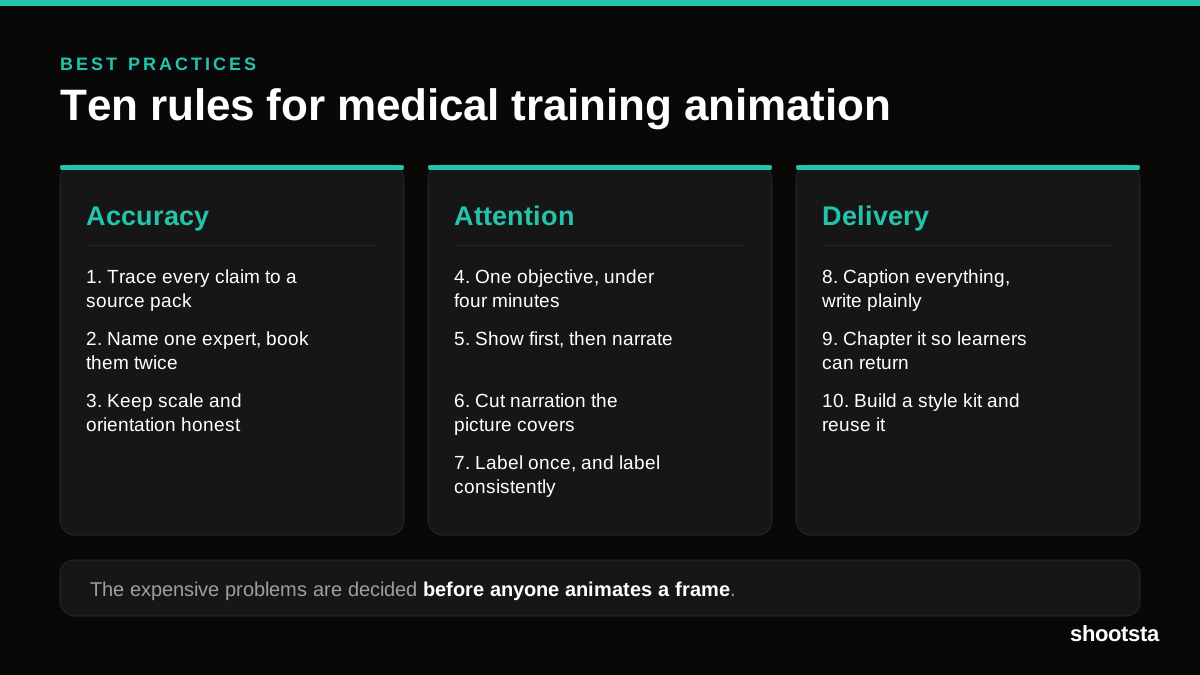
Medical Training Animation Best Practices
Ten rules that hold up across device training, clinical protocol work and mechanism of action modules. Most medical animation fails for dull reasons: too many objectives, narration that repeats the picture, and review that arrives too late to change anything.
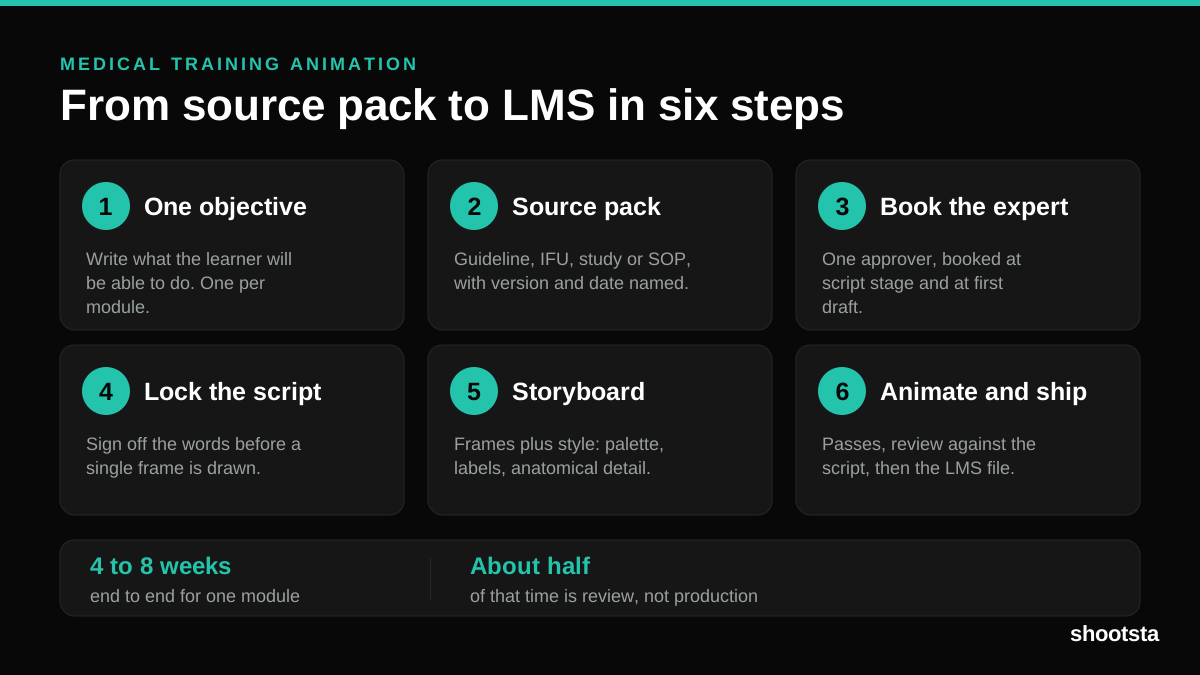
Medical Training Animation: A Complete Guide
A medical training animation teaches a procedure, a device workflow, or a mechanism the camera cannot reach. Here is how one gets made, what it costs, and how to keep medical review from eating the schedule.
What Delayed Training Videos Cost L&D Teams
What Delayed Training Videos Cost L&D Teams
When training video ships late, employees work without the knowledge for longer. For a distributed enterprise, that backlog has a large, measurable cost.
What Makes a Great Learning Video
What Makes a Great Learning Video
A great learning video changes what someone can do after watching it. Here is how the best ones are built, the mistakes that lose learners, and how the panel scores them.
Animation Use Cases for L&D Teams
Animation Use Cases for L&D Teams
Learning and development teams get more out of animation than almost any other function. Here are the places it works hardest, and where you should still reach for a camera.
FSI Onboarding: Build a Training Video Library
FSI Onboarding: Build a Training Video Library
Farmers is onboarding 1,700 new agents in 2026. Progressive is hiring 12,000 staff. Northwestern Mutual is moving 2,000 employees into a new campus. None of that scales without a video library.