
Medical Training Animation Best Practices
shootsta.
Medical Training Animation Best Practices
By Shootsta · Published August 22, 2026 · Updated October 2026
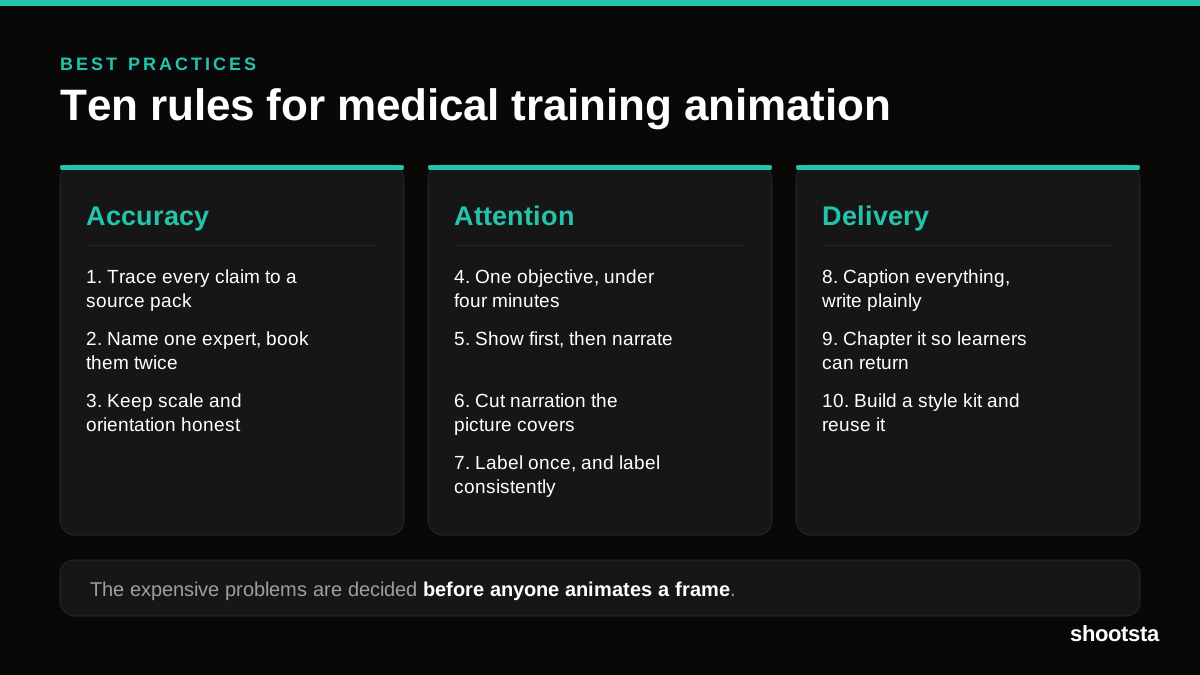
Ten rules that hold up across device training, clinical protocol work and mechanism of action modules. Most medical animation fails for dull reasons: too many objectives, narration that repeats the picture, and review that arrives too late to change anything.
Medical training animation best practices come down to a single idea: the learner should finish the module able to do the thing. Accuracy serves that, pacing serves that, and so does the format you deliver the finished file in.
Most modules that fail do so for fairly dull reasons. They stack too many objectives into one video, the narration repeats what the picture already shows, and the review process arrives too late to change anything. These ten medical training animation best practices fix all three. If you have not built one before, start with our guide to medical training animation and come back to this list at brief stage.
What makes a medical training animation effective?
An effective medical training animation does three jobs at once. It is accurate, which a subject matter expert has confirmed against a documented source. It is watchable, which means short and paced to the picture rather than to the script. It also has to be usable inside the learning platform your staff already open every week. If you miss any one of those, the module gets skipped or quietly ignored.
Medical training animation best practices for accuracy
1. Trace every claim to a source pack
Before scripting begins, collect the guideline, the instructions for use, the study or the SOP that the module will follow, and note the version and date of each. Anything that appears on screen and cannot be traced back to that pack does not go in. This single habit is what keeps regulated review short.
2. Name one expert and book them twice
Use one subject matter expert with authority to approve, booked at script stage and again at the first animation version. Two short reviews beat one long one. An expert seeing the module for the first time at the final version will ask for changes that cost a full re-render.
3. Keep scale and orientation honest
Medical training animation gets tempting to simplify, so resist it wherever simplifying changes the meaning. If the device sits at a specific angle, draw that angle, and if a cell is not that size relative to the vessel, say so on screen. Learners carry the picture into practice, and a misleading proportion teaches the wrong thing.
Medical training animation best practices for attention
4. One objective per module, under four minutes
Write the objective as a sentence about what the learner will be able to do, and if you need two sentences you need two modules. Four minutes is a practical ceiling for a single procedure, because longer modules get paused and never resumed.
5. Show the step, then name it
Let the picture arrive a beat before the narration explains it, because learners process the visual first. Narration that runs ahead of the animation splits their attention, and the step itself is the part they need to remember.
6. Cut narration to what the picture cannot say
If the animation shows the clamp closing, the voiceover does not need to say that the clamp closes. Use the audio for the reason, the risk or the exception instead. This one edit often shortens the script a good deal, and a tighter script is easier to remember.
7. Label once, and label consistently
Introduce each anatomical or device label the first time it appears, then leave it alone, because repeated labels crowd the frame. Inconsistent labels across a module library are worse still, since staff end up learning two names for the same thing.
Medical training animation best practices for delivery
8. Caption everything and write for second-language staff
Captions are part of meeting WCAG accessibility standards, and they also carry the module for staff watching without sound. Keep sentences short in the script itself, because plain wording helps every learner reading English as a second language.
9. Chapter the module so learners can return to one step
Staff will not rewatch a full procedure module just to check step four. Chapter markers, a transcript and a clear step title on screen turn the video into a reference people come back to. That repeat use drives more of the value than the first viewing does.
10. Build a style kit on module one and reuse it
Decide the palette, the label style, the level of anatomical detail and the motion rules once. Every module after that gets assembled from approved parts instead of designed from scratch. It is what keeps a large library of medical training animation modules looking like one program, and it is why later modules cost far less to produce than the first.
What are the most common mistakes?
We see four mistakes again and again. Here they are in roughly the order they turn up.
- Stacked objectives. A single module trying to teach the anatomy, the device and the protocol together, when it should have been split into three.
- Review as a final gate. Sending the finished animation to medical and legal for the first time, at the point where every change is expensive.
- Over-specified visuals, under-specified outcome. Briefs that describe the render style in detail and never say what the learner should be able to do afterwards.
- No source files at handover. When the guideline changes a year or two later, you end up rebuilding the module instead of editing it.
All four share the same root cause: the expensive problems in medical training animation are decided long before anyone animates a frame.
Frequently asked questions
How long should a medical training animation be?
Aim for two to four minutes for a single procedure or protocol. Mechanism of action modules can run slightly longer, because the learner is following a chain of events. Anything past five minutes should probably have been two modules.
Does a medical training animation need a voiceover?
It usually does, though not always. Device handling and protocol modules work well with on-screen text alone, which also makes language versions cheaper to produce. Mechanism of action work benefits from narration, because the sequence needs explaining as it unfolds.
How do you measure whether a module worked?
Completion rate tells you whether the length and the pacing were right, and a short knowledge check tells you whether the teaching worked. Track both, and treat a low completion rate as a production problem rather than a learner problem.
Can existing training slides be turned into animation?
They often can, and a deck is a good starting point. A slide deck that a trainer already delivers has usually been through some review. The source pack and the sequence both exist, so the script work becomes editing rather than writing.
Who should own the module library?
Give the library one owner in L&D or clinical education, with a named medical reviewer attached to it. Shared ownership across departments is how a set of modules drifts out of date. See animation use cases for L&D teams for how this sits alongside the rest of a learning program.
Where to start
Take the module your team gets the most questions about and rebuild it against these ten rules, then keep the style kit it produces. To scope a wider program, read how to commission a medical training animation or explore our training video production services.
Take this article with you
Read the latest at shootsta.com/blog/medical-training-animation-best-practices
You might also like
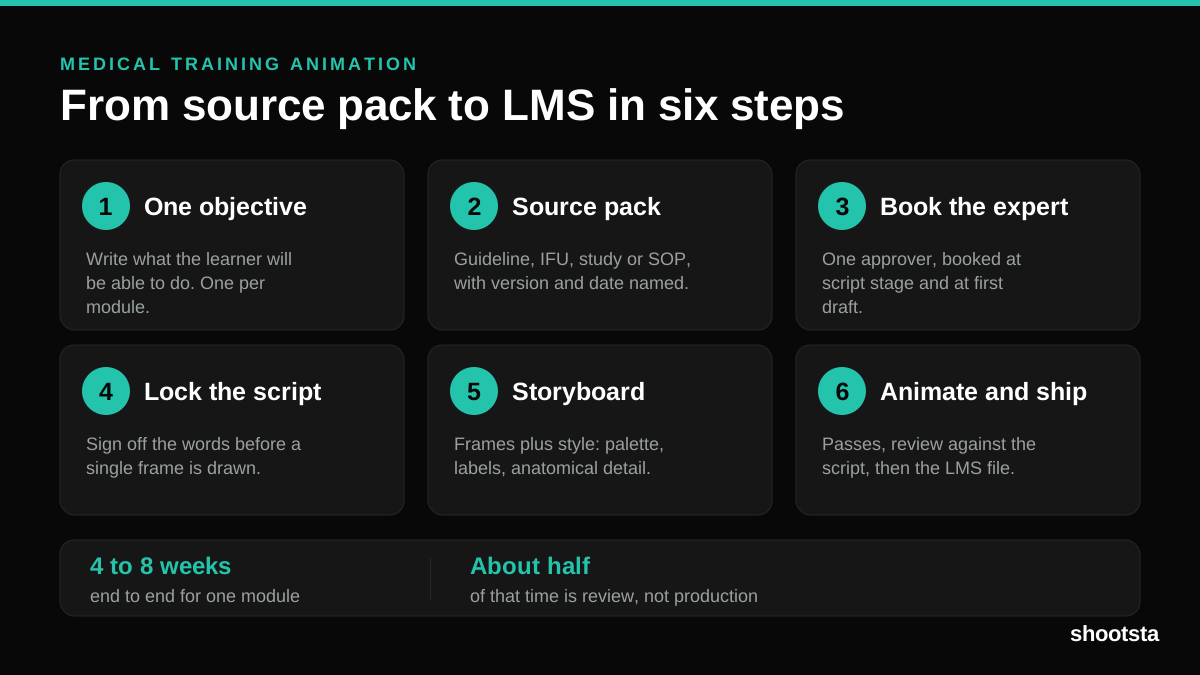
Medical Training Animation: A Complete Guide
A medical training animation teaches a procedure, a device workflow, or a mechanism the camera cannot reach. Here is how one gets made, what it costs, and how to keep medical review from eating the schedule.
What Delayed Training Videos Cost L&D Teams
What Delayed Training Videos Cost L&D Teams
When training video ships late, employees work without the knowledge for longer. For a distributed enterprise, that backlog has a large, measurable cost.
Australian Corporate Training Video Production
Australian Corporate Training Video Production
A practical guide to corporate training video production for Australian teams: compliance and WHS modules, LMS-ready formats, AEST turnaround, and what a training library costs to build.
What Makes a Great Learning Video
What Makes a Great Learning Video
A great learning video changes what someone can do after watching it. Here is how the best ones are built, the mistakes that lose learners, and how the panel scores them.
Animation Use Cases for L&D Teams
Animation Use Cases for L&D Teams
Learning and development teams get more out of animation than almost any other function. Here are the places it works hardest, and where you should still reach for a camera.
FSI Onboarding: Build a Training Video Library
FSI Onboarding: Build a Training Video Library
Farmers is onboarding 1,700 new agents in 2026. Progressive is hiring 12,000 staff. Northwestern Mutual is moving 2,000 employees into a new campus. None of that scales without a video library.