
How to Choose a Singapore Video Partner
shootsta.
How to Choose a Singapore Video Partner
By Shootsta · Published May 23, 2026 · Updated October 2026
Most procurement processes for video production in Singapore optimize for the wrong thing. Here is the decision framework enterprise marketing and comms teams should use instead in 2026.
How do you choose a video production partner in Singapore?
Many Singapore enterprise procurement processes for video production optimize for the wrong thing. They compare three quotes on a single hero project and pick the lowest. The team then lives with brand drift and slow turnaround, and runs the whole procurement exercise again within the year. A better framework judges the operating model across a full year rather than the cost of one video. Below is an 8-criteria decision framework for enterprise marketing, comms, HR, and L&D teams in Singapore in 2026.
What does a Singapore video production partner need to deliver?
For a typical enterprise team in Singapore, the job is bigger than producing one video. Over a year, the partner has to:
- Produce 20 to 80+ finished videos a year across multiple use cases (marketing, comms, HR, L&D, events).
- Keep them on-brand without re-explaining the brand every project.
- Deliver them fast enough to match the news cycle, the campaign calendar, and the comms moment.
- Handle multilingual versions for ASEAN where needed.
- Stay compliant where the content is regulated (MAS, HSA, internal HR).
- Scale up around launches, events, and quarterly comms without an entire new procurement cycle.
The 8-criteria framework below tests whether a partner can carry that whole year of work.
The 8-criteria framework for choosing a Singapore video production partner
1. Operating model fit
Your volume should decide the operating model. Below 6 to 8 videos a year, project pricing usually makes the most sense, and between 8 and 20 a year a project or light retainer works. Once you pass 20 a year, especially across several formats and languages, subscription production tends to win on per-video cost and turnaround. Start with an honest forecast of annual volume, then match the operating model to it. Procurement processes often skip both steps.
2. Turnaround capacity
Ask for the partner's standard turnaround from brief approval to first cut. Anything over 7 days points to a project shop rather than a production workflow. Enterprise comms teams should expect 48 to 72 hours. If turnaround is not a hard contractual commitment, it will not happen.
3. Brand setup and templating
Templated brand setup (lower thirds, captions, fonts, sting, intro outro, grading) has a large effect on per-video cost over time. A partner who sets brand templates up once and reuses them spends less time on each video at 20+ video volume than a partner who rebuilds the brand setup each project. Ask each candidate directly how they handle brand setup across projects.
4. Multilingual capacity for SEA
If your content is going across Mandarin, Bahasa, Vietnamese, or Thai versions, multilingual capacity is non-negotiable. Ask who handles translation, voiceover, on-screen text, and compliance review for each language. If the answer is "we outsource it", you will pay an uplift on every project. Subscription providers built for APAC usually include this, while boutique houses often have to bring in outside help.
5. Compliance workflow (if regulated)
For MAS-regulated FS, HSA-regulated pharma, or government work, look for a compliance workflow that names approvers as default fields in the project, versions every edit, and stores audit trail with the approved master. Treat this as a yes-or-no filter, because a partner without it cannot take regulated work. We covered this in depth on the MAS-compliant video production in Singapore piece.
6. Account team continuity
Ask who you will be working with day to day, which usually means an account manager, a producer and a lead editor. Then ask how long each has been at the company. High turnover in the account team is a common cause of brand consistency problems. A partner with a stable named team gives you 12+ months of accumulated brand learning. A partner with a rotating team resets that learning every project.
7. Pricing transparency and overage rates
Get the overage rate in writing. On a subscription, find out what it costs when you exceed the included capacity. On project work, ask the price of a third revision round, a same-week turnaround and a multilingual version. Surprise charges on invoices sour video partnerships quickly, so surface them during evaluation before they reach your second month's bill.
8. Industry experience and references
Ask for client references in your industry, ideally in Singapore or APAC, ideally producing similar formats at similar volume. A partner who has produced dozens of videos for Singapore banks will handle your bank workflow better than one who has done a single project. The same holds for pharma, tech and training. Generic "we work with enterprise" references are weaker than specific industry depth.
The decision matrix
For an enterprise team in Singapore comparing 3 video production partners, score each on the 8 criteria from 1 to 5, weighted by your priorities. A typical weighting for a 50-video-a-year FS marketing team looks like:
- Operating model fit: 20%
- Compliance workflow: 20%
- Brand setup and templating: 15%
- Turnaround capacity: 15%
- Multilingual capacity for SEA: 10%
- Account team continuity: 10%
- Pricing transparency: 5%
- Industry experience: 5%
Note that headline price is not in the framework. Per-video cost comes out of the operating model and brand setup choices rather than the rate card. Two providers can have identical rate cards and still end up far apart on actual per-video cost after a year.
Red flags in Singapore video production partner evaluation
- Quotes that do not specify the number of revision rounds included.
- "It depends" answers on turnaround commitment.
- No named compliance workflow when the content is regulated.
- No reference clients in your industry or at your scale.
- Brand setup billed separately on every project.
- Raw footage retained by the agency by default.
- Multilingual work outsourced to a third party without naming them.
- Account team that has been at the company less than 6 months.
Green flags worth weighting heavily
- Subscription model option, even if you choose project work, because it indicates production discipline.
- Templated brand setup process explained in detail.
- Audit trail and version control built into the standard delivery.
- Multilingual SEA capacity in-house with named voice and edit team.
- Reference clients you can phone yourself who have worked with the partner for 12+ months.
- Pricing model that gets cheaper per video as volume grows.
- Named account team with 12+ months tenure.
The 30-minute conversation that should come before any RFP
The most useful evaluation step comes before the RFP. It is a 30-minute scoping conversation with each candidate partner that covers four things:
- What is your honest annual video volume and format mix?
- Where are the timing pressure points (campaigns, events, regulatory cycles)?
- What is the in-house team capable of producing themselves?
- Where are the language and compliance constraints?
If a candidate partner cannot turn that conversation into a clear proposed operating model and a transparent pricing approach, they are unlikely to deliver against the 8 criteria. If they can, the formal RFP usually validates what the conversation already established.
How does Shootsta fit this framework?
Shootsta is positioned for criteria 1 (subscription operating model for 20+ video annual volumes), 2 (48-hour first cut as standard), 3 (templated brand setup once per account), 4 (multilingual SEA in-house), and 5 (MAS-compliant workflow for FS clients). For a one-off hero brand film with a large crew and budget, a boutique production house is usually a better fit, and we say so in scoping conversations. For the regular volume around those films, the Shootsta operating model is built for the job. The Singapore hub covers the service range.
Frequently asked questions
What is the most important criterion when choosing a video production partner in Singapore?
Operating model fit. The right operating model for the volume drives every other cost and quality outcome. For 20+ videos a year across multiple formats, subscription production almost always beats project pricing on per-video cost, turnaround, and brand consistency. Below 8 videos a year, project work is usually cheaper.
How do you compare quotes from different Singapore video production companies?
Do not compare quotes on a single video. Compare the full-year per-video cost across realistic projected volume, including brand setup, revisions, multilingual versions, and the typical mix of formats. Two providers with similar rate cards can come in far apart on actual annual cost.
Should an enterprise marketing team in Singapore use a retainer or a subscription model?
Retainer if the team is buying a bundle of creative services (design, copy, paid, video) from one partner. Subscription if video is the primary service and volume is 20+ a year. Subscription wins on per-video cost at higher volume because production infrastructure is shared, while retainers tend to be sized to people-hours.
Do I need a Singapore-based video production partner if my videos go across SEA?
Not always, but usually yes. A Singapore-based partner gives proximity to your APAC HQ stakeholders, native English-language production, and the deepest multilingual SEA voice and edit talent pool in the region. For programs purely targeting Greater China, Hong Kong is the better base.
How long should a Singapore video production partner evaluation take?
4 to 8 weeks from scoping to signed agreement. Less than 4 weeks usually means corners cut on operating model fit and reference checks. More than 8 weeks usually means stakeholder misalignment that will surface again post-signing.
Where to go next
For the full Singapore service offering, see the Singapore video production hub. For pricing context to inform the evaluation, see the Singapore video production cost guide. To book a scoping conversation, get in touch and we will start with the 30-minute call before any RFP.
Take this article with you
Read the latest at shootsta.com/blog/how-to-choose-singapore-video-partner
You might also like
How to Plan Video Team Capacity Around Leave
Your only editor just booked two weeks off, and you already know which projects will slip. Chad Lakin explains how to plan video team capacity so the work keeps moving when someone is away.
Corporate Video Editing Standards: Full Guide
A two-page editing standard does more for consistency than a forty-page brand book. Here is what it should cover, who owns each part, and how to enforce it with an in-house editor or an outside partner.
Quality Control in Outsourced Video Editing
When editing leaves the building, quality has to be checked by a system rather than by whoever happens to look. Here is the system: acceptance criteria, two QA gates, counted revision rounds and a quarterly audit.
Video Production Cost on the Gold Coast 2026
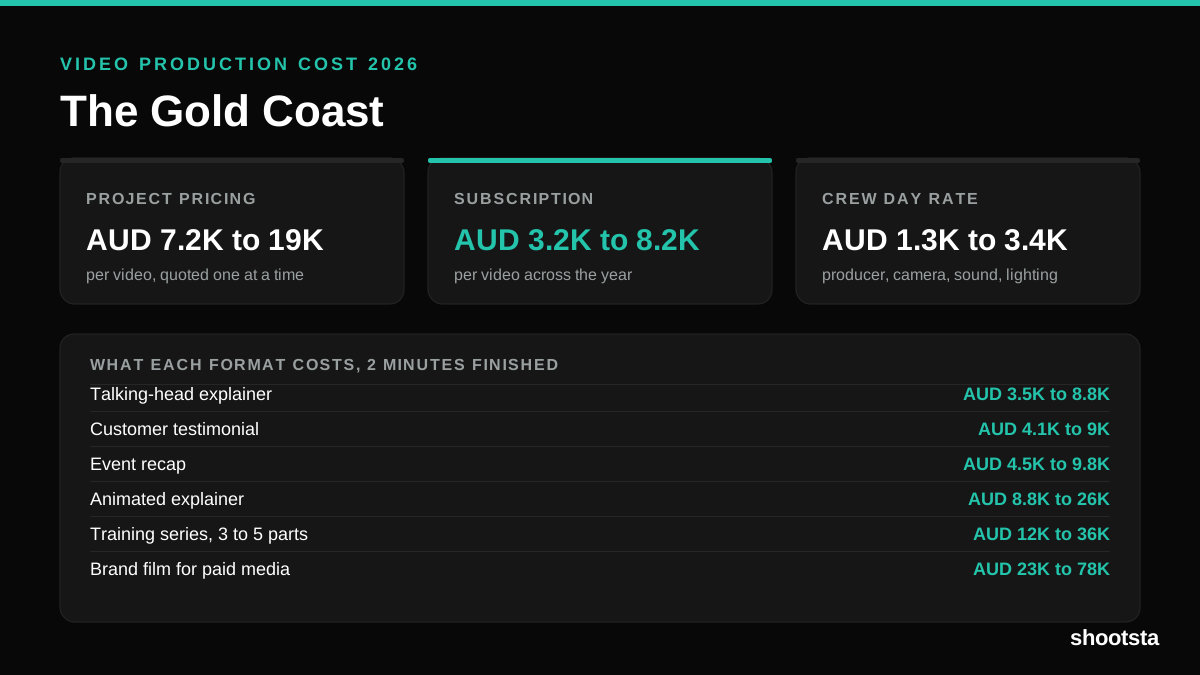
Video production in the Gold Coast costs AUD 3,200 to AUD 8,200 per finished video on a subscription model, and AUD 7,200 to AUD 18,500 for one-off project work. Here is what you are paying for, and how the three pricing models compare.
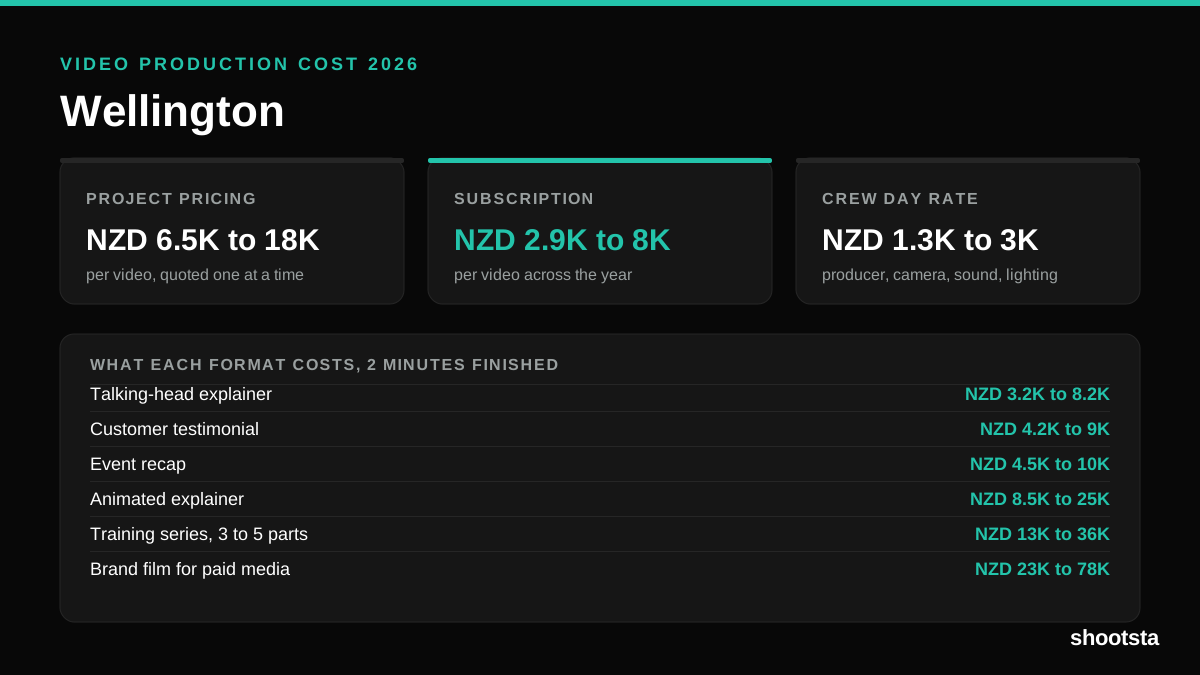
Video Production Cost in Wellington (2026)
Video production in Wellington costs NZD 2,900 to NZD 8,000 per finished video on a subscription model, and NZD 6,500 to NZD 18,000 for one-off project work. Here is what you are paying for, and how the three pricing models compare.
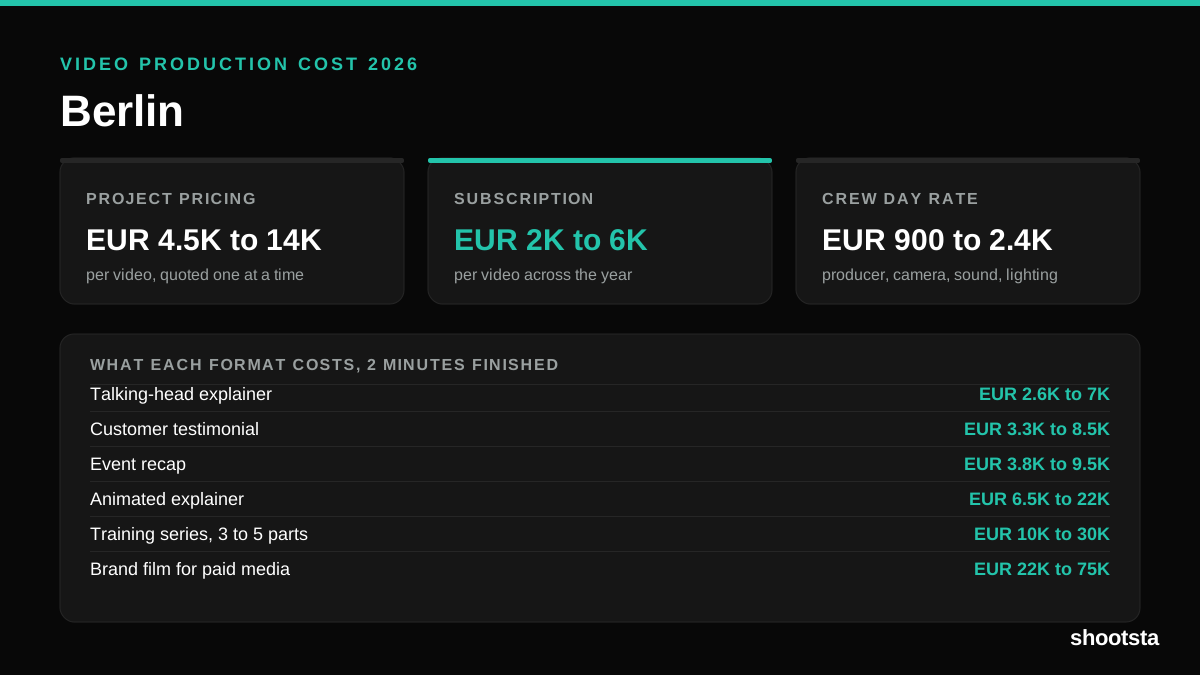
Video Production Cost in Berlin (2026)
Video production in Berlin costs EUR 2,000 to EUR 6,000 per finished video on a subscription model, and EUR 4,500 to EUR 13,500 for one-off project work. Here is what you are paying for, and how the three pricing models compare.