
Selling Video Production to Your CFO
shootsta.
Selling Video Production to Your CFO
By Shootsta · Published March 23, 2026 · Updated October 2026
Your CFO does not care about engagement rates or brand awareness. They care about revenue, cost, and risk. Here is how to build a business case for video production that speaks their language.
Why do video business cases fail?
A video business case usually fails because it is written for marketers rather than for finance. It leads with engagement metrics, brand awareness and creative examples. A CFO reads this and sees soft benefits with no clear connection to revenue or cost savings.
A business case that gets approved speaks the CFO's language: return on investment, payback period, cost per unit, and risk mitigation. It answers the question every finance leader asks: "What do we get for what we spend, and how confident are we in that number?"
What does a CFO want to see?
Strip away the marketing language and a CFO evaluates any investment against four criteria.
Revenue impact
The CFO wants to know whether the spend creates new revenue or protects existing revenue. For video, that means connecting video to pipeline. If your video-influenced pipeline is a meaningful share of total pipeline, the revenue argument is easy to make. Show the math: X videos > Y leads > Z pipeline > W closed revenue.
Cost reduction
The next question is whether video replaces something more expensive. Take your current agency cost per video and set it against the per-video cost of a subscription model. Shootsta customers typically see 50-60% lower per-video cost vs. agencies, and multiplying the gap by your yearly volume makes the savings plain.
Payback period
Your CFO will ask how long the spend takes to pay for itself. If the pipeline you can attribute to video in the first 6 months is larger than the annual cost, you can show payback inside that window. Finance teams like an investment that pays back within 12 months.
Risk
The last question is what happens if video does not work. For a video subscription, the risk is lower than the alternatives, because you are not adding headcount or building anything. Set a review point so you know when you can change course. Compare that with hiring a full-time videographer or building an internal studio.
How do you build the cost comparison?
Put the numbers side by side, because a CFO judges a cost against the alternatives rather than on its own.
Agency model: use the per-video quotes from your last few projects and multiply them by the number of videos you need in a year. Each extra video adds the same cost again. Agencies usually take several weeks per video, so add the timeline to the comparison too.
In-house team: count the salary for a videographer, then add equipment, editing software and management time. One person can only edit so many videos a month, and the cost stays the same whatever they produce.
Subscription model (like Shootsta): the monthly cost depends on volume, so ask for a quote at the number of videos you plan to make. Divide it by that number to get your cost per video. The first cut comes back in about 48 hours.
The subscription model usually wins on unit economics and flexibility. You pay for what you use and can scale up or down, without carrying the overhead of more full-time staff and equipment.
How do you quantify the revenue side?
This is where business cases tend to get vague, so hold yours to numbers. Use real figures from your own data where possible, and industry benchmarks where you don't have data yet.
Direct attribution
If you already produce video, pull the data. Count the leads that came from video, the pipeline it touched and the win rate on video-influenced deals. Even rough numbers are better than "video improves engagement." If you don't have attribution data yet, building it is part of the proposal.
Comparable channel economics
Compare video's expected performance to channels your CFO already understands. If organic search (helped by video on your pages) brings leads in at a lower cost than paid search, video brings down your blended cost per lead. If video-influenced deals close faster than the rest, that is a measurable gain in pipeline velocity.
Conservative modeling
Always present three scenarios. The conservative case assumes low adoption and little pipeline impact, while the expected case assumes moderate adoption and a measurable pipeline contribution. The best case has full adoption across teams and a large effect on pipeline and revenue.
CFOs respect conservative estimates more than optimistic ones. If even the conservative scenario shows positive ROI, the decision is easier. In practice, enterprise video programs tend to beat their conservative projections once several departments start making videos.
What objections will the CFO raise?
"We already have an agency"
Keep the agency for the work it does best, such as your annual brand film. A subscription model covers the everyday videos that do not need agency-level production: leadership updates, training modules, social clips and product demos. At agency rates, that volume gets expensive and slow.
"Can't our marketing team just do this?"
Your team can film, and the subscription model adds editing capacity so they can keep up with volume. That leaves your marketing team's time for strategy, distribution and measurement instead of hours in Adobe Premiere.
"How do we know it will work?"
Propose a 3-month pilot with one department making 10-20 videos. Measure the time saved, the cost per video and the business impact, and expand if it works. If it does not, you have spent one quarter of budget learning that video is not the right investment right now, which is a small downside.
"What about AI video tools?"
AI tools help with scriptwriting, captioning, and repurposing. They do not replace professional editing or on-camera talent for brand-sensitive content. Read our practical guide to AI video in the enterprise for a realistic breakdown of where AI helps and where it doesn't.
The one-page business case format
When you present to the CFO, keep it to one page and use this structure.
Problem: we need X videos per month but our current model produces Y at $Z per video.
Solution: a video production subscription that enables teams to film on their own devices with professional editing at a fixed monthly cost.
Cost: $X/month (vs $Y/month current spend for the same output).
Expected return: X leads/quarter from video content, $X pipeline influenced, $X revenue attributed at Y% win rate.
Payback: under X months.
Risk: a set review point, with the option to change course if there are no results within 6 months.
Next step: 3-month pilot with [department], measuring [specific metrics].
If you want help building the numbers, talk to our team. We can walk you through results from companies in your industry and help you model the ROI for your situation.
Take this article with you
Read the latest at shootsta.com/blog/selling-video-production-to-your-cfo
You might also like

How to Plan Video Team Capacity Around Leave
Your only editor just booked two weeks off, and you already know which projects will slip. Chad Lakin explains how to plan video team capacity so the work keeps moving when someone is away.
Corporate Video Editing Standards: Full Guide
A two-page editing standard does more for consistency than a forty-page brand book. Here is what it should cover, who owns each part, and how to enforce it with an in-house editor or an outside partner.
Quality Control in Outsourced Video Editing
When editing leaves the building, quality has to be checked by a system rather than by whoever happens to look. Here is the system: acceptance criteria, two QA gates, counted revision rounds and a quarterly audit.
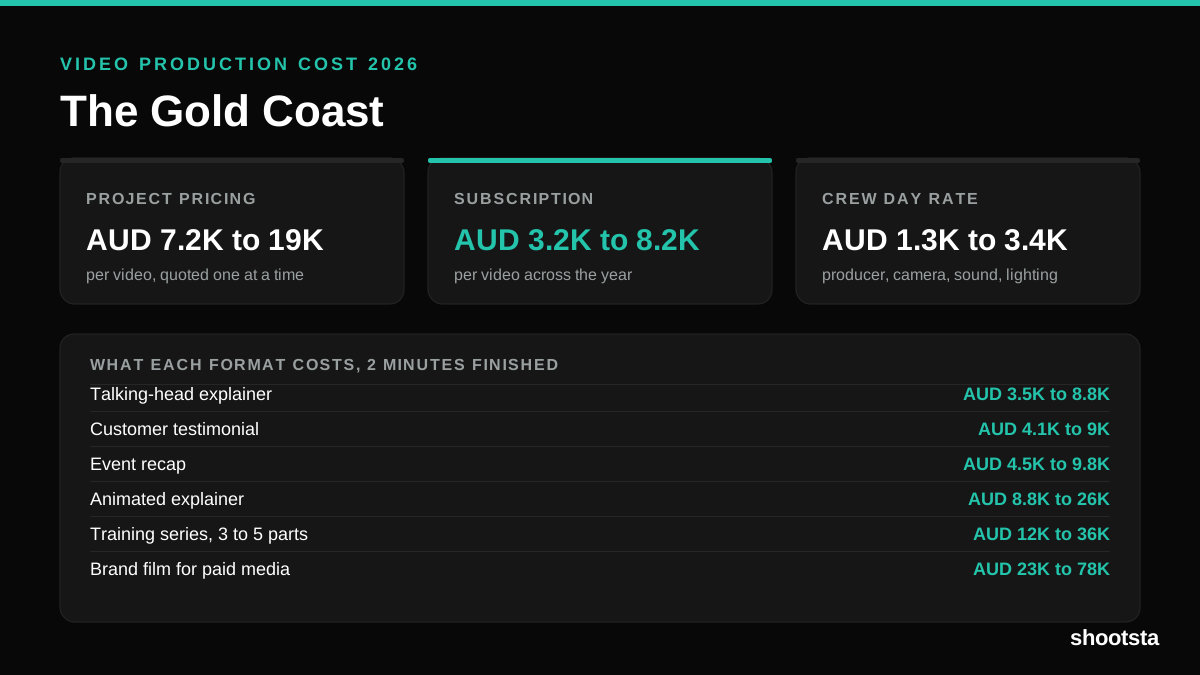
Video Production Cost on the Gold Coast 2026
Video production in the Gold Coast costs AUD 3,200 to AUD 8,200 per finished video on a subscription model, and AUD 7,200 to AUD 18,500 for one-off project work. Here is what you are paying for, and how the three pricing models compare.
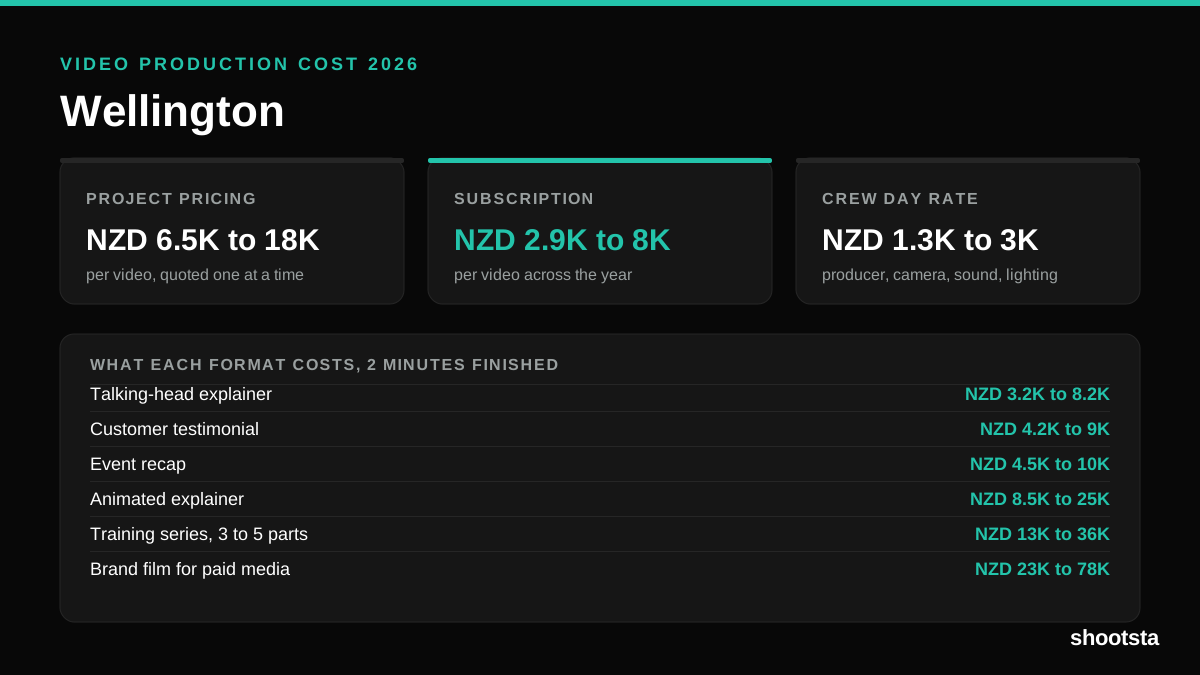
Video Production Cost in Wellington (2026)
Video production in Wellington costs NZD 2,900 to NZD 8,000 per finished video on a subscription model, and NZD 6,500 to NZD 18,000 for one-off project work. Here is what you are paying for, and how the three pricing models compare.
Video Production Cost in Berlin (2026)
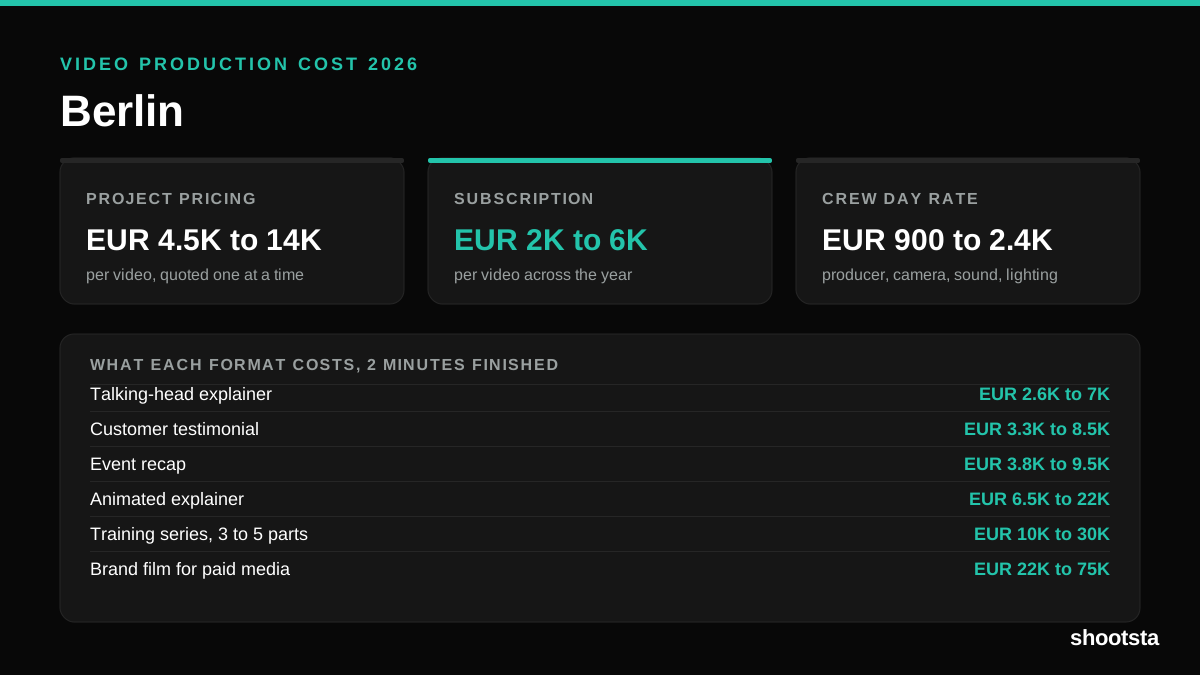
Video production in Berlin costs EUR 2,000 to EUR 6,000 per finished video on a subscription model, and EUR 4,500 to EUR 13,500 for one-off project work. Here is what you are paying for, and how the three pricing models compare.