
12 Branded Content Examples That Worked
shootsta.
12 Branded Content Examples That Worked
By Shootsta · Published September 22, 2026 · Updated October 2026
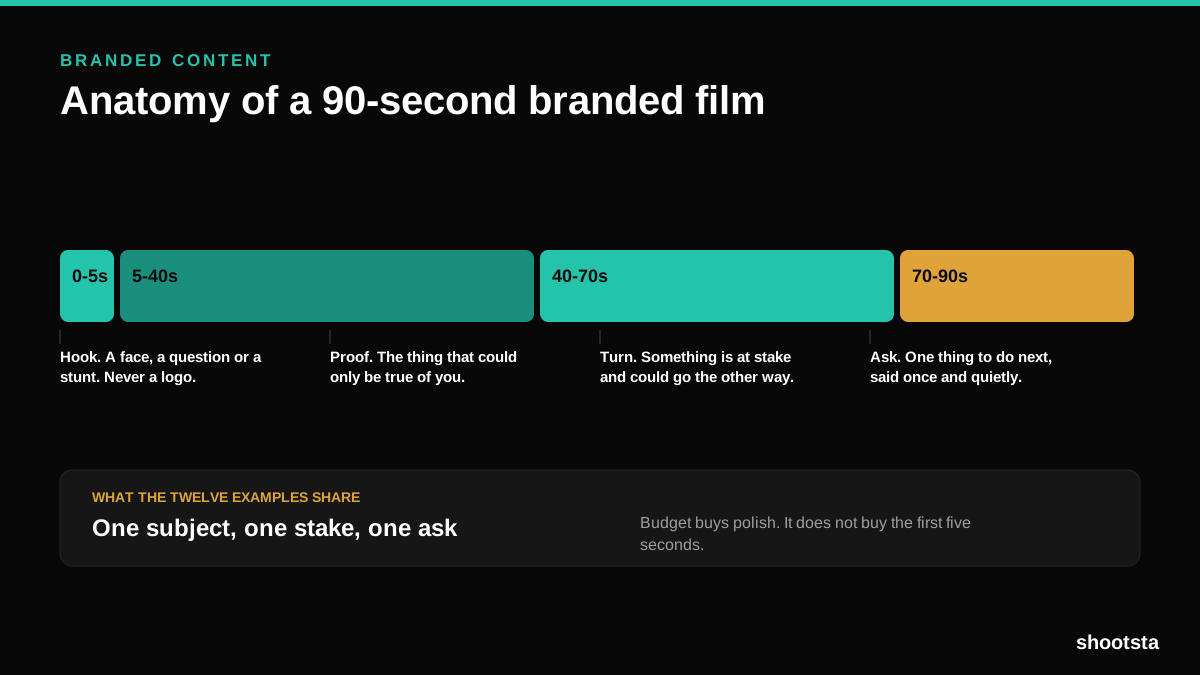
Twelve pieces of branded content that people chose to watch, what each one got right, and the structure underneath all of them.
Short answer. Branded content is video people choose to watch rather than sit through. The twelve branded content examples below span consumer and business brands, and they share four beats: a hook in the first five seconds, one clear subject, a real person or a real stake, and a single quiet ask at the end. The budget is not what separates them. Volvo Trucks and Slack solved the same problem with wildly different money.
Branded content is video that earns attention instead of purchasing it, which means the audience chooses to press play and then chooses to keep watching.
That is a considerably higher bar than an advertisement, which is why most branded content examples that appear in presentations are either famous, expensive, or both. The useful ones are the pieces you can learn a structure from. All twelve below are real, published work you can watch, and each one is here for a specific reason.
What is branded content?
Branded content is video made by a brand where the value to the viewer comes first and the commercial message comes second, or sometimes not at all. It sells by being worth watching.
The difference between branded content and advertising is not budget or length. It is the trade. An ad interrupts something the viewer wanted and asks for thirty seconds. Branded content is the thing the viewer wanted.
Twelve branded content examples worth studying
They are ordered roughly by how famous they are rather than by how good they are. The branded content examples further down the list are arguably the more instructive ones.
1. Volvo Trucks, The Epic Split (2013)
The Epic Split is a 75-second single take of Jean-Claude Van Damme balanced between two reversing trucks, made to demonstrate dynamic steering. It is a product feature demonstration that people watched tens of millions of times by choice.
Why it works: the stunt is the proof. Take the trucks away and there is no film.
2. Dove, Real Beauty Sketches (2013)
Real Beauty Sketches filmed women describing themselves to a forensic artist who could not see them, then compared those sketches to descriptions from strangers. It won the Titanium Grand Prix at Cannes.
Why it works: the format is an experiment, so nobody knows the outcome in advance. Not even Dove controls what the women say.
3. Slack, So Yeah, We Tried Slack (2014)
So Yeah, We Tried Slack is a mockumentary in which the video studio Sandwich explains that they did not want to use Slack, then did. It is a product demo pretending to be a joke about product demos.
Why it works: it opens by agreeing with the sceptic. That buys the next ninety seconds of attention from an audience that had already decided not to care.
4. Zendesk, Zendesk Alternative (2014)
Zendesk noticed people searching for alternatives to their own product, so they built Zendesk Alternative, a fictional indie band with a website, a record or two and a grudge about the name. Buyers searching for a competitor found a joke instead of a comparison chart.
Why it works: the distribution is the idea. The content was built to occupy a search result rather than to be shared.
5. Mailchimp Presents, Second Act (2019)
Second Act is a documentary series about people who changed careers to start a business, co-produced with Vice. The product appears nowhere in the films.
Why it works: the audience for the show and the audience for the product are the same people. That alignment is doing all the work.
6. Intel and Toshiba, The Beauty Inside (2012)
The Beauty Inside was a social film about a man who wakes up in a different body every day, with viewers cast as the lead through an open audition. It took three Grand Prix at Cannes.
Why it works: the product truth and the story are the same idea. What is inside matters more than the case.
7. Always, #LikeAGirl (2014)
#LikeAGirl asked adults and young girls to run and throw "like a girl", and let the difference between the two speak. Documentary maker Lauren Greenfield directed it.
Why it works: the film argues with a phrase rather than with a competitor. That leaves nothing for a viewer to push back on.
8. Blendtec, Will It Blend? (2006)
Will It Blend? is the founder of a blender company putting phones, marbles and rake handles into his own product on camera. It has run for the best part of two decades.
Why it works: it is a repeatable format rather than a campaign. One good idea that can be made again next week is worth more than one perfect film.
9. Red Bull, Stratos (2012)
Stratos was a live jump from the stratosphere, watched by millions in real time. Red Bull did not make content about an event. They made the event.
Why it works: the brand funded something that would have been newsworthy without them, then simply owned the footage.
10. Patagonia, DamNation (2014)
DamNation is a feature documentary about dam removal in the United States, produced by Patagonia. It argues a position the company holds rather than selling a jacket.
Why it works: it is long, slow and about rivers. It also tells you exactly what the company believes, and that belief is what the brand is selling.
11. Chipotle, Back to the Start (2011)
Back to the Start is a two-minute stop-motion film about a farmer industrialising his farm and then reversing it, scored by Willie Nelson covering Coldplay. It ran in cinemas.
Why it works: animation lets a company make an argument about farming without a single shot of a real farm to argue with.
12. Nike, Nothing Beats a Londoner (2018)
Nothing Beats a Londoner follows young Londoners competing over whose day was harder, with 258 real kids and cameos from athletes. It took the Social and Influencer Grand Prix at Cannes.
Why it works: it was released scene by scene through the participants' own accounts, so the distribution was built into the casting.
What do these branded content examples have in common?
Four beats recur across all twelve, and they appear regardless of whether the production budget was enormous or almost nonexistent.
- Something happens in the first five seconds. A face, a question, a stunt. Never a logo and a music sting.
- It is about one thing. You can describe every piece on this list in one sentence with no "and" in it.
- There is a real person or a real stake. Something could have gone the other way.
- The ask is quiet and singular. Most of these barely ask at all, which is precisely why they get shared.
How does your last brand video score?
Eight criteria drawn from what these twelve branded content examples have in common, scored against your own most recent piece.
Interactive scorecard
Rate your last brand video
Eight things the examples above have in common. Score your most recent brand video against them. The result names the two weakest so you know what to change on the next one.
1. Something happens in the first five seconds
A face, a question, a moment. Not a logo and a music sting.
2. It is about one thing
You can say what the video is about in a single sentence, without an 'and'.
3. A real person carries it
A named human on screen, not a voiceover over stock footage.
4. There is something at stake
A problem, a risk or a change. Something that could have gone the other way.
5. The detail is specific to you
Details a competitor could not put their logo on and reuse unchanged.
6. It works with the sound off
Captions or on-screen text carry the meaning for the majority who scroll muted.
7. The ask is clear and singular
One thing to do next, said plainly, once.
8. The length matches the platform
Cut for where it actually runs, rather than one master pushed everywhere.
Score the video you actually published, not the cut you wanted to publish. The eight criteria come from what the twelve examples in this post share, and every one of them is a decision made before the edit rather than during it.
What does branded content look like at a normal budget?
A brand film produced with Shootsta for Mitsubishi. It was never meant for Cannes, and it does not need to be. It opens on a person and stays on one topic, and it was made on a schedule a marketing team can repeat every quarter.
Do you need a big budget for branded content?
No, and half of these branded content examples demonstrate it. Slack made a mockumentary with a single studio, Blendtec pointed a camera at a blender, and Zendesk built a website and a joke.
What each of them had was a real idea and a willingness to publish something that did not look like an ad. Budget buys polish. It does not buy the first five seconds.
How often should you publish branded content?
Often enough that a single piece of branded content failing to land is an experiment rather than a disaster.
The trap in studying famous branded content examples is treating each one as a single bet. Blendtec has published hundreds of videos. Mailchimp runs a slate. Publishing on a rhythm means you learn what your audience responds to, rather than guessing once a year with everything riding on it.
Publishing branded content on a rhythm is a production question rather than a creative one, and production is usually where the plan stalls. A team that can make one video a quarter cannot run a format. A team that can turn a first cut around in about 48 hours can.
Where to go next
If you are working out which format fits what you need to say, the video quiz takes a minute and gives you a straight answer. For examples in a different register, see our collection of public service announcement video examples.
For the buying side, read agency or subscription, which covers how each model behaves once you publish regularly. For the business audience specifically, see B2B video production costs and buying models.
To talk through a branded content idea and whether it can be made repeatable, book a free consultation.
Sources
Every example above links to a primary or trade source: the brand's own page, the producing studio, or the awards body that gave it a prize. Campaign facts, dates and awards were verified in September 2026. No results or view counts are quoted here beyond what those sources state.
About Shootsta
Shootsta is a global video production service that helps enterprises create on-brand videos at scale and operationalize video production across every business touch-point. We have produced 70,000+ videos for 920+ brands since 2014, with a first cut in about 48 hours and 4.9 / 5 customer satisfaction across post-delivery surveys. Editors work from offices in Sydney, London, Singapore and San Diego.
Last updated 22 September 2026.
Take this article with you
Read the latest at shootsta.com/blog/branded-content-examples
You might also like
Commercial Videography: Cost and Scope
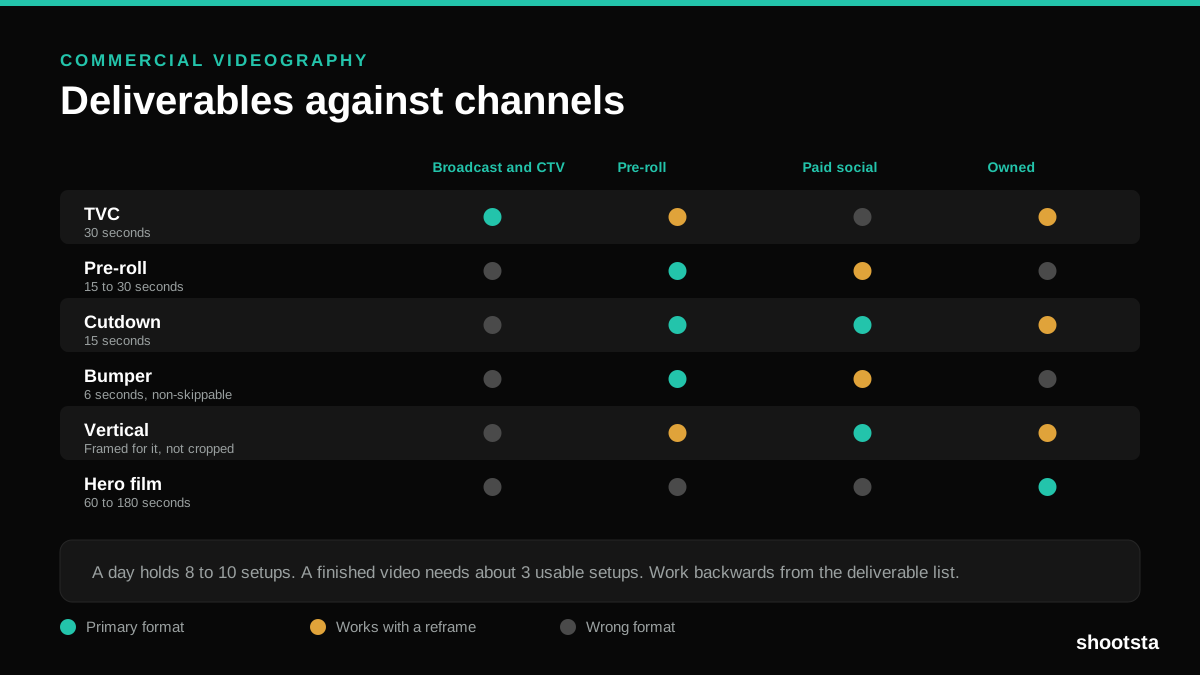
Commercial videography is priced by the day and judged by the deliverable. Most projects go wrong because those two numbers were never reconciled.
Promotional Video Production: Cost and Time
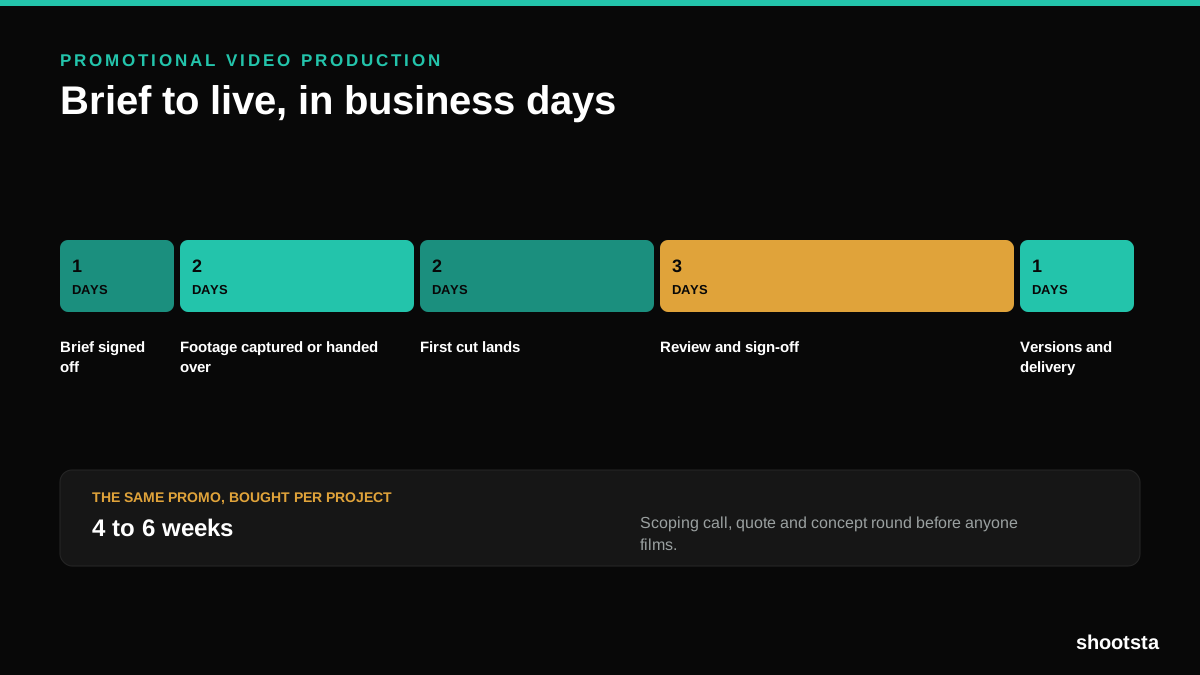
Most promotional video production schedules are not slow because of the edit. They are slow because of the approval chain. Here is where the days go.
Video Marketing Agency or Subscription?
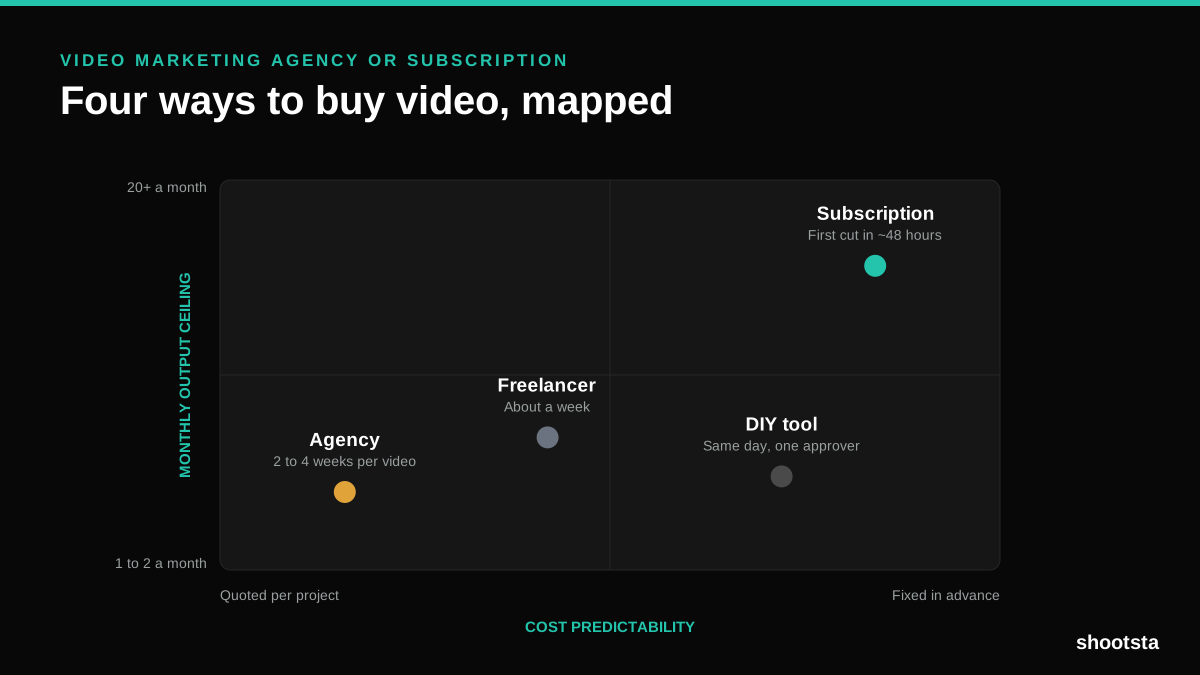
A video marketing agency prices per project and works in weeks. A subscription prices the year and works in days. Which one fits depends on how often you publish, not on which is better.

B2B Video Production: Costs and Buying Models
There are five ways to buy B2B video production. Each one works well up to a point and then breaks, usually at a volume nobody planned for. Here is what each costs and where the ceiling sits.
How to Measure Video Speed-to-Market
How to Measure Video Speed-to-Market
Speed-to-market is the lag between needing a video and publishing it. For marketing teams it is a revenue metric. Here is how to measure and improve it.
Animation for Wealth Management & Advice
Animation for Wealth Management & Advice
Wealth and advice firms have to explain complex strategies and build trust at scale, under regulation. Animation does both without putting an adviser in front of a camera every time.