
Why Uncanny AI Ads Happen and How to Fix Them
shootsta.
Why Uncanny AI Ads Happen and How to Fix Them
By Shootsta · Published October 27, 2026 · Updated November 2026
AI video ads look uncanny when faces, hands, motion, lip-sync, voice and light are almost right. This is what triggers the uncanny valley, what it does to brand trust, and the edits that turn a generated draft into an ad you can publish.
You can now make a 30-second ad in an afternoon with Sora, Veo, Runway or Kling, and the first cut often looks great on a laptop screen. Then a colleague watches it, says it feels a bit off, and struggles to explain why.
That feeling is the uncanny valley, and it is the reason so many AI video ads look uncanny even when each frame seems fine. This post explains what triggers it, what uncanny AI ads do to brand trust, and the finishing work that turns a generated draft into an ad you are happy to put your logo on.
The short answer: uncanny AI ads come from small errors in faces, hands, motion, lip-sync, voice and light that viewers sense before they can name them. A global DoubleVerify study found that 42% of consumers say low-quality or "uncanny" AI ads would hurt their opinion of a brand. A human edit that fixes those errors is the cheapest way out of the valley.
What is the uncanny valley in AI video ads?
The idea comes from the robotics professor Masahiro Mori, who described it in 1970. As a robot looks more human, people warm to it, until it gets very close to human and small flaws start to feel creepy. The warmth drops into a "valley", and IEEE Spectrum published the first official English translation of his essay in 2012.
Generated video now sits right on the edge of that valley. A cartoon never falls in, because viewers do not expect it to be real. A photoreal presenter in an ad is different, because your viewer's brain reads the clip as real footage and then catches details that real footage would never have.
Why do AI video ads look uncanny?
The models are good at single frames and weaker at what happens between frames. They also learn from millions of clips, so they drift toward an average face, an average light and an average voice. Each tell below is small, but together they make uncanny AI ads easy to spot, even for viewers who could not name them.
Faces and eyes
Eyes are the first place people look, so faces are often where uncanny AI ads first give themselves away. Look for a gaze that does not quite land on the lens, blinks at odd intervals, and teeth or ears that change shape between shots. Skin is often too smooth, with no pores.
Hands and objects
Hands still give generated clips away, because fingers merge, a ring moves to another finger or a cup passes through a palm. Products can change shape between shots as well, which matters a lot in an ad where the product is the hero.
Motion and physics
Real things have weight. In generated clips, hair floats, fabric moves without wind, and people walk as if they are gliding across the floor. Backgrounds can also "breathe", with walls and signs that shift slightly as the camera moves. Motion errors are hard to spot in a still frame, which is why uncanny AI ads can pass a storyboard review and then fail on playback.
Lip-sync and voice
A lip-sync error of a few frames is enough to make a presenter feel dubbed. Synthetic voices add a second problem, which is prosody: the stress lands on the wrong word, every sentence rises and falls the same way, and there are no breaths.
Light that is too perfect
Generated scenes often look like a stock photo shoot, with soft light from every side, nothing in shadow and the same glossy finish on every surface. Real rooms have a window on one side, a mixed light source and a bit of mess. When the light has no clear source, the scene feels staged in a way viewers pick up on. It is one of the quieter causes of uncanny AI ads, and one of the easiest to fix with a grade.
Text, logos and brand details
Signs, packaging and screen text often come out as near-letters, and a logo may be close to yours without being right. For a brand this tell does the most damage, because it makes the ad look careless as well as artificial.
Do uncanny AI ads hurt brand trust?
Yes, and there is now good data on how uncanny AI ads land with viewers. DoubleVerify surveyed 22,000 consumers and 2,020 marketers for a global study released on 29 July 2026. It found that 42% of consumers say a brand's use of low-quality or "uncanny" AI ads would hurt their opinion of that brand, and eMarketer's write-up of the same study reports the figure as 43%.
The UK numbers show where the line sits. About 49% of UK consumers react badly to low-quality AI ads, but only 29% react negatively when AI ads look polished and professional. The study also found that 56% of people say they cannot reliably tell when content is AI-generated. That gap between uncanny AI ads and polished ones is the whole case for finishing work, because your audience is reacting to AI that looks unfinished rather than to AI as such.
Why do AI UGC avatar ads feel off?
AI UGC ads use a generated "creator" talking to camera in a casual, phone-shot style, and demand for them has grown fast. Fiverr's 2026 Business Trends Index reported a 265% rise in searches for AI UGC video ads between November 2025 and April 2026.
The format has a built-in risk, and it produces some of the most obvious uncanny AI ads. UGC works because it feels like a real person sharing a real opinion, so an avatar with a slightly flat voice breaks that promise faster than a studio ad would. It also raises a legal question in the US, where the FTC's rule on fake reviews has been in force since October 2024. The rule bars testimonials from people who do not exist, including AI-generated ones that pose as real customers.
Should you disclose AI in ads?
Check the platform rules before you post. YouTube asks creators to disclose realistic content that is altered or synthetic, and TikTok asks users to label AI-generated content that shows realistic scenes. A clear label costs less trust than a viewer working it out on their own, which is what happens with uncanny AI ads, and a finish that looks deliberate makes the ad read as a choice rather than a shortcut.
Shootsta Snap founding intake
Get your AI video cleaned up by an editor
Shootsta editors fix the hands, text, lip-sync and voice that give AI video away. The first intake has 20 founding places, and each one comes with a free audit of one video.
How do you fix uncanny AI ads before they run?
You rarely need to start again. Most uncanny AI ads can be pulled out of the valley in the edit. These are the fixes an editor works through, roughly in order of impact.
- Cut around the flaws. Trim each shot before a hand or face breaks, so the viewer has less time to study the errors.
- Replace the weakest shots. Swap in real product footage, a screen recording, stock or a fresh generation, because one real shot of your product steadies the whole ad.
- Re-voice the script. A human voiceover with natural stress and breaths fixes most prosody problems, and the editor re-syncs or cuts away when the mouth is on screen.
- Rebuild the sound. Generated clips often have thin room tone, so the editor adds ambience, foley and a mix that sits the voice above the music.
- Grade for one look. A consistent grade with a defined light direction pulls clips from different prompts into one world.
- Fix every brand element. Replace garbled text, add your real logo, set on-screen copy in your brand fonts and add accurate captions.
- Cut the versions you need. Reframe for 9:16, 1:1 and 16:9 so nothing important falls off the edge of the frame.
Our guide on how to fix AI-generated video goes through each step in more detail. For a quick pass or fail list your team can run before anything goes live, use the AI video quality checklist.
Can your team fix uncanny AI ads in-house?
Your in-house team can fix a lot of it, and they know your brand best. The catch is time, because clean-up work is slow and fiddly and it lands on whoever has editing software open that week. Freelancer.com's CEO told The Guardian that preparing AI work for commercial use can be "incredibly time-consuming". Listings for fixing AI output on that platform rose 87% to 10,760 between August 2025 and June 2026, with video editing among the top categories.
If your team would rather spend that week on the next campaign, hand the clean-up queue to a human editor. You can see how Shootsta Snap fixes AI video: you send the generated ad, an editor fixes what makes it read as AI, and you get back a publishable, on-brand cut. To weigh your options, read our breakdown of AI video clean-up cost or the guide to when to hire an editor to fix AI video.
What does a finished AI ad look like?
A finished ad does not need to hide that AI helped make it. What sets it apart from uncanny AI ads is that it looks like someone made choices. Before you publish, watch it at full size and on a phone with the sound on, and check that it passes these tests.
- No shot shows a face, hand or product that changes shape.
- The voice stresses the right words and takes breaths.
- The light, grade and sound match from shot to shot.
- Every logo, product name and line of text is correct.
- Any AI disclosure the platform needs is in place.
If you are working out where generated video belongs in a wider program, our post on how brands stay human as AI gets more capable covers the bigger picture. For a plain-English definition of the wider problem, see what AI slop video is.
Frequently asked questions
Do uncanny AI ads hurt sales?
The best current data is on brand opinion rather than sales. DoubleVerify's 2026 global study found that 42% of consumers say low-quality or uncanny AI ads would hurt their view of the brand. In the UK the share was about 49%, compared with 29% for AI ads that look polished.
Can an editor fix uncanny AI ads without a reshoot?
In most cases, yes. An editor can cut around flaws, replace weak shots, re-voice the script, rebuild the sound, grade the clips to one look and fix brand text. A full reshoot is only needed when the core idea or the main presenter does not work.
How much does it cost to fix uncanny AI ads?
It depends on the length and how much needs rebuilding. Shootsta Snap's founding prices start at US$99 per video for a clean-up of up to 60 seconds and US$249 for a rebuild of up to 3 minutes, and every quote is confirmed before work starts. You can register for the AI video clean-up intake at no cost.
Sources
- DoubleVerify, Global Study: Poor-Quality AI Content Puts Brand Trust at Risk (press release, 29 July 2026)
- Advanced Television, Study: AI slop poses growing risk to brand trust (UK figures)
- eMarketer, Quality of AI outputs in creative can influence trust
- IEEE Spectrum, The Uncanny Valley by Masahiro Mori
- AI Magazine, Fiverr Business Trends Index 2026 release
- Search Engine Journal, AI slop clean-up job listings report (Freelancer.com data first reported by The Guardian)
- US Federal Trade Commission, final rule banning fake reviews and testimonials
- YouTube Help, disclosing altered or synthetic content
- TikTok Support, AI-generated content labels
Take this article with you
Read the latest at shootsta.com/blog/why-ai-video-ads-look-uncanny
You might also like
25 Marketing Video Ideas That Drive Pipeline
25 Marketing Video Ideas That Drive Pipeline
25 marketing video ideas built around the formats that move pipeline for B2B teams - explainers, customer stories, thought leadership, ABM, webinar repurposing, and more.
LinkedIn Video Length: How Long Should Your Videos Be?
LinkedIn Video Length: How Long Should Your Videos Be?
The right LinkedIn video length depends on format and goal. Data-backed breakdown of optimal duration for feed videos, ads, thought leadership, and LinkedIn Live.
LinkedIn Video Best Practices for B2B Teams
LinkedIn Video Best Practices for B2B Teams
What works for B2B video on LinkedIn in 2026. Formats, lengths, captions, hooks, and posting patterns from teams producing 10+ videos per month.
Video Marketing Agency: What It Does and Costs
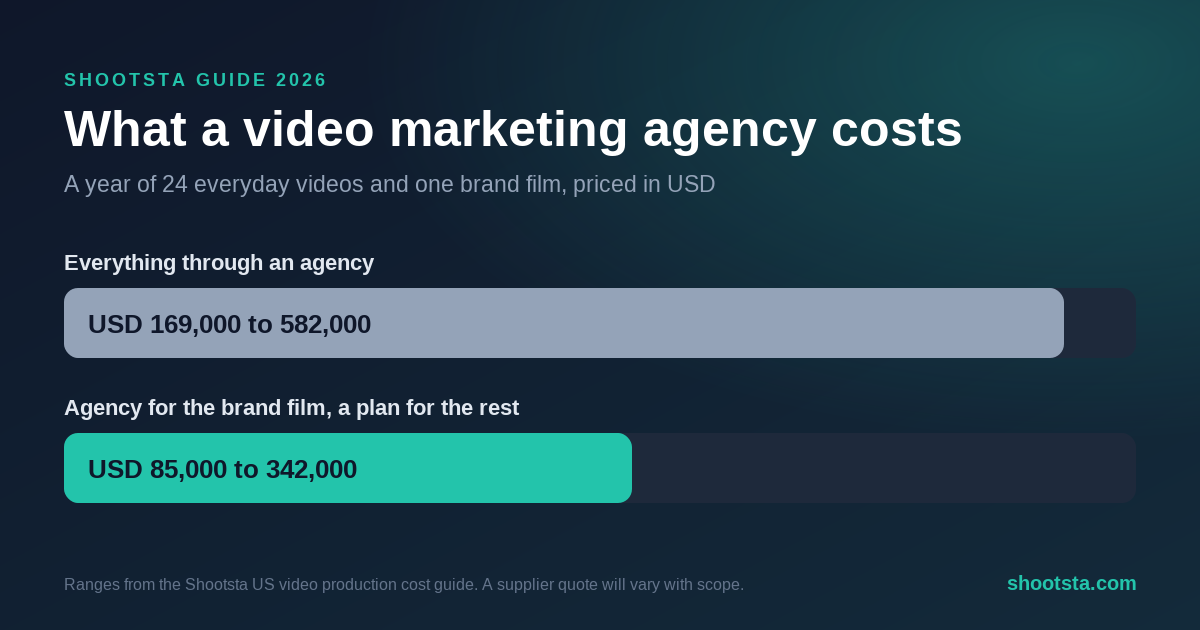
What a video marketing agency does, the four kinds you will meet, what they cost in the US, Australia and the UK, and when a managed video partner is the better buy.
How Creative Directors Keep Brand Consistency
How Creative Directors Keep Brand Consistency
Brand guides were written for things that sit still. This is how creative directors maintain brand consistency in video: the decisions they own on pace, music and the look, where they step into a production, and how their taste holds up when output grows.
Video Marketing Services: What's Included
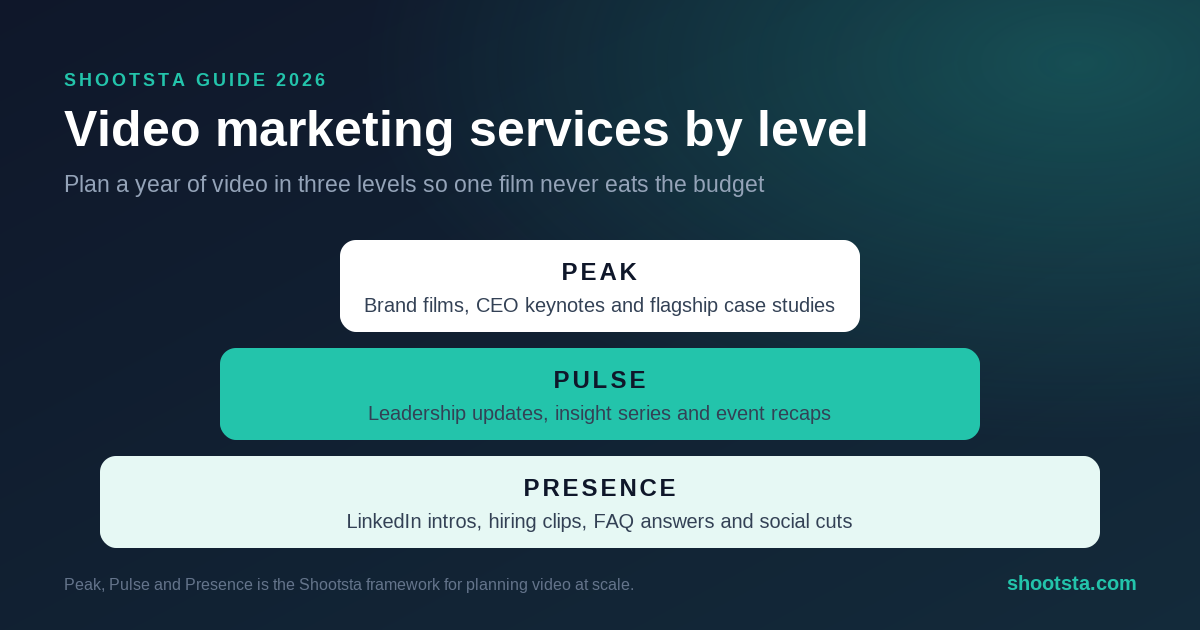
The video marketing services that make up a year of video, what each one includes, 2026 costs by video type and a builder that counts the videos you need.