
shootsta.
How to Write a Video Sales Letter Script
By Shootsta · Published April 12, 2026 · Updated October 2026
The 7-part script formula B2B teams use to write video sales letters that book meetings - with fill-in-the-blank templates for cold outbound, ABM, and proposal walkthroughs.
Most video sales letters fail in the first eight seconds. Not because the offer is wrong, but because the script is. Either the rep buries the hook, or the message reads like a written email someone decided to film.
This guide gives you the script formula B2B sales teams use in outbound, plus three fill-in-the-blank templates you can adapt today. If you want a service that scripts, films, and edits these for you, see our video sales letter production service. If you want the broader strategy first, start with how to make video sales letters the star of your sales strategy.
What is a video sales letter script?
A video sales letter (VSL) script is the written outline a rep follows when recording a short on-camera sales video. It opens with a hook, names the buyer's problem, presents the solution, surfaces proof, and ends with a clear next step. Good VSL scripts are usually 100 to 220 words for a 60-90 second cold outbound video, and 250 to 500 words for a 2-3 minute proposal walkthrough.
Scripts matter more on video than in email. Buyers can skim text. They cannot skim a face on screen, so every sentence has to earn its seconds.
The 7-part video sales letter script formula
Every VSL that performs well in B2B follows the same arc. Skip a step and the video stalls.
1. Pattern interrupt (0-5 seconds)
Open with something the prospect did not expect. Use their name, their company, a specific detail you noticed about their stack, their hiring page, or a recent post. The goal is to stop the autoplay-thumb.
Bad: "Hi, my name is Sarah from Acme."
Good: "Hi Daniel, saw your team just posted three new BDR roles on LinkedIn - that's exactly why I shot this."
2. Name the problem (5-15 seconds)
State the painful, specific outcome the prospect is dealing with right now. Name the symptom they feel, because the abstract category will not register. If they do not nod by the 15-second mark, they will close the tab.
3. Earn permission (15-25 seconds)
Give one sentence on why you are credible to talk about this problem, and keep the company pitch out of it. Use either a relevant customer ("we just helped Stripe's BDR team do X") or a specific result ("our customers see Y"). Keep it short. Buyers can sense when you are auditioning.
4. Tease the solution (25-50 seconds)
Describe what your solution does in one breath. Avoid feature lists. Use the one-sentence shape: "We help [ICP] do [outcome] without [common pain]." If the buyer cannot repeat your value prop after one watch, the script is not done.
5. Show, do not tell (50-70 seconds)
Cut to a screen recording, a customer logo wall, or a quick before-and-after. Visual proof carries more weight than another spoken claim. This is where VSLs beat written email - the buyer can see it work.
6. Soft CTA (70-85 seconds)
Make the next step low-friction. "Worth a 15-minute call next week?" beats "click here to book a demo." Reply rates climb when the ask reads like a question you would put to a colleague.
7. Sign off with a name (85-90 seconds)
End with your name, a smile, and a short signoff. Buyers reply to humans, not to brands. Avoid "Looking forward to hearing from you" - it sounds like the bottom of a templated email.
Cold outbound VSL script template
Use this for first-touch cold video on email or LinkedIn. Target length: 60-75 seconds, 130-180 words.
"Hi [Prospect First Name], saw [specific trigger about their company]. Most [their role] I talk to at companies like [their company] are dealing with [specific pain]. We just helped [comparable customer] [specific outcome] in [timeframe]. The way it works is [one-sentence solution]. I shot this because [reason this is relevant to them right now]. Worth a 15-minute call next [day]? Either way, no pressure. Cheers, [Your name]."
Two things to test: the opening trigger (rotate between hiring posts, funding news, product launches, role changes), and the ask (a specific day name beats "let me know").
Free PDF Guide
Get the VSL Script Template
The full fill-in-the-blanks video sales letter script plus a swipe file of lines you can steal.
ABM and tier-one account VSL script template
Use this for named accounts where you can do 10 minutes of research before recording. Target length: 90-120 seconds, 200-280 words.
"Hi [Prospect First Name], shot this just for [their company]. I noticed [specific account-level signal - product launch, exec hire, market move]. From what I can see, your team is [hypothesis about their priority]. The reason that matters: [why your space helps with that priority]. We have done this with [two comparable named accounts] - in both cases we [specific outcome with numbers]. Here is what working with us would look like for [their company]: [one-sentence custom plan]. I am not asking for a meeting today. I am asking if I have read [their company]'s priorities right - and if so, whether it is worth a 20-minute conversation with [name a relevant exec on your side other than yourself]. Either way, would value the read. Cheers, [Your name]."
Proposal and re-engagement VSL script template
Use this when sending a proposal or reviving a stalled deal. Target length: 2-3 minutes, 350-500 words.
"Hi [Champion First Name], shot this to walk through the proposal so you can share it internally without scheduling another call. Three things to flag. First, what is in scope and what is not - [one-sentence summary]. Second, the price and what drives it - [one-sentence summary]. Third, the next step and the timeline - [one-sentence summary]. The reason I am sending video instead of writing this in email: I want your CFO and your CTO to be able to watch this in five minutes and have the same context you have. Specific things they will probably ask: [list two or three likely objections and answer each in one line]. If you want to push back on anything in here, reply to this email and I will re-record. Otherwise, the path forward is [specific next step with date]. Thanks for the time on this, [Your name]."
How long should a video sales letter script be?
Target word count by use case:
- Cold outbound: 130-180 words (60-75 seconds)
- LinkedIn DM: 90-130 words (45-60 seconds)
- ABM and tier-one account: 200-280 words (90-120 seconds)
- Proposal walkthrough: 350-500 words (2-3 minutes)
- Long-form landing page VSL: 1,200-2,500 words (8-15 minutes)
If your script runs long, cut anything that does not move the buyer toward the next step. Reps consistently overestimate how long they have. Watch-through drops sharply after 90 seconds in outbound and after 3 minutes in proposals.
Should you use AI to write video sales letter scripts?
Use AI for the first draft, never for the final version. Tools like ChatGPT, Claude, and the script tools built into modern sales platforms can produce a workable VSL outline in 30 seconds. The problem is the same one AI has elsewhere: the language sounds like everyone else's. Buyers can hear it.
The workflow that works: feed AI your offer, the prospect's company, and the trigger. Let it draft the structure. Then rewrite in your own words, especially the opening five seconds and the CTA. Those two parts decide whether the video gets watched.
Video sales letter script FAQs
How do you write a video sales letter script for cold email?
Follow the 7-part formula but compress it. Cold email VSLs work best at 60-75 seconds and 130-180 words. Lead with a personal trigger about the prospect's company, name the specific pain, drop one piece of credibility, describe the solution in one sentence, and end with a low-friction ask. Avoid generic openers like "Hope this email finds you well."
What is the best length for a B2B video sales letter script?
For B2B cold outbound, 130-180 words for a 60-75 second video. For ABM and named accounts, 200-280 words for a 90-120 second video. For proposal walkthroughs, 350-500 words for a 2-3 minute video. Long-form landing-page VSLs can run 1,200-2,500 words but they are a different format with different rules.
Do video sales letter scripts need to be word-for-word?
No. The strongest performers use the script as a structure and keep the teleprompter off. Reps write the seven beats as bullet points, rehearse twice, then record looking at the camera. Word-for-word reads land flat - buyers can tell when someone is reading. The exception is the opening hook and the CTA, which should be locked.
How long does it take to write a video sales letter script?
A skilled rep using a template should produce a personalized cold outbound script in 5-8 minutes. ABM scripts take 15-25 minutes because of the research. Proposal scripts take 30-45 minutes because they are longer and need to anticipate buying-committee objections. AI tools can cut all of these by 30-50% on the first draft.
What is the difference between a video sales letter script and a sales call script?
A VSL script is one-way - the buyer cannot interrupt or ask questions, so every objection has to be anticipated and answered in the script. A sales call script is two-way and leaves room for discovery. VSL scripts are tighter, more visual, and end with a single specific ask. Call scripts are more conversational and have multiple branches.
Production at sales velocity
The hardest part of running VSLs at scale is producing the videos fast enough that the deal does not go cold. Writing the script is the easy half. Shootsta turns around edited VSLs in 48 hours, on-brand by default, at a unit cost that lets you run outbound video across a whole sales team. See the full video sales letter production service, or talk to our sales team for a quote based on your team size and target output.
Take this article with you
Read the latest at shootsta.com/blog/video-sales-letter-script-template
You might also like
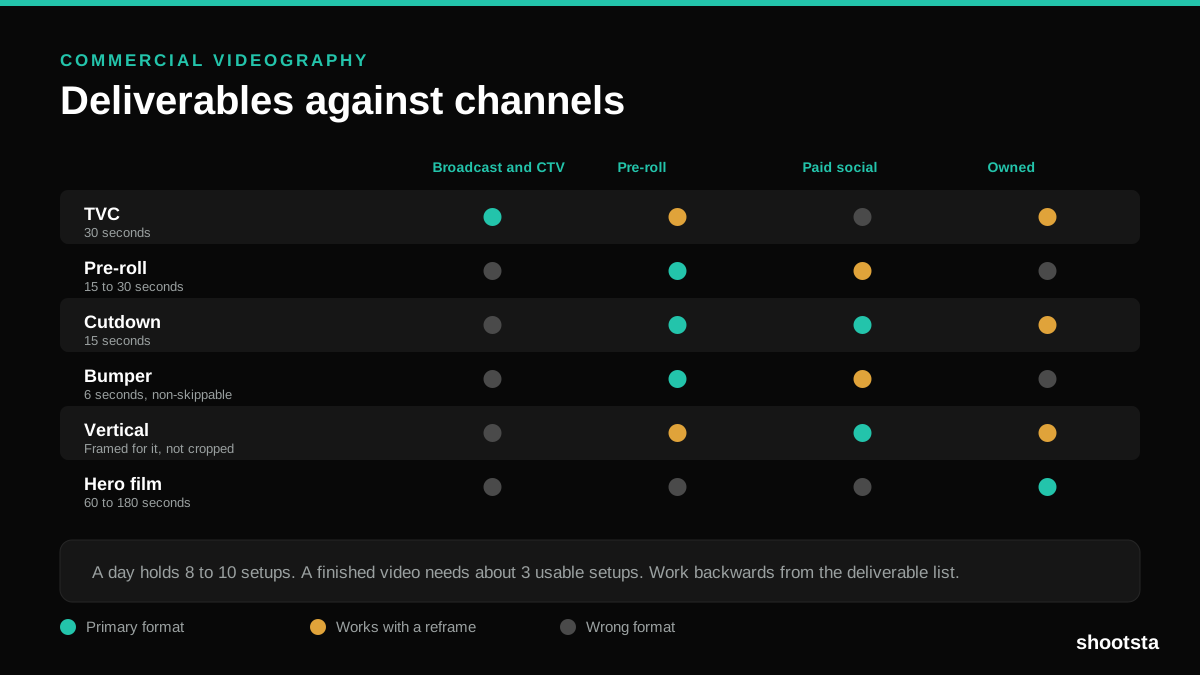
Commercial Videography: Cost and Scope
Commercial videography is priced by the day and judged by the deliverable. Most projects go wrong because those two numbers were never reconciled.
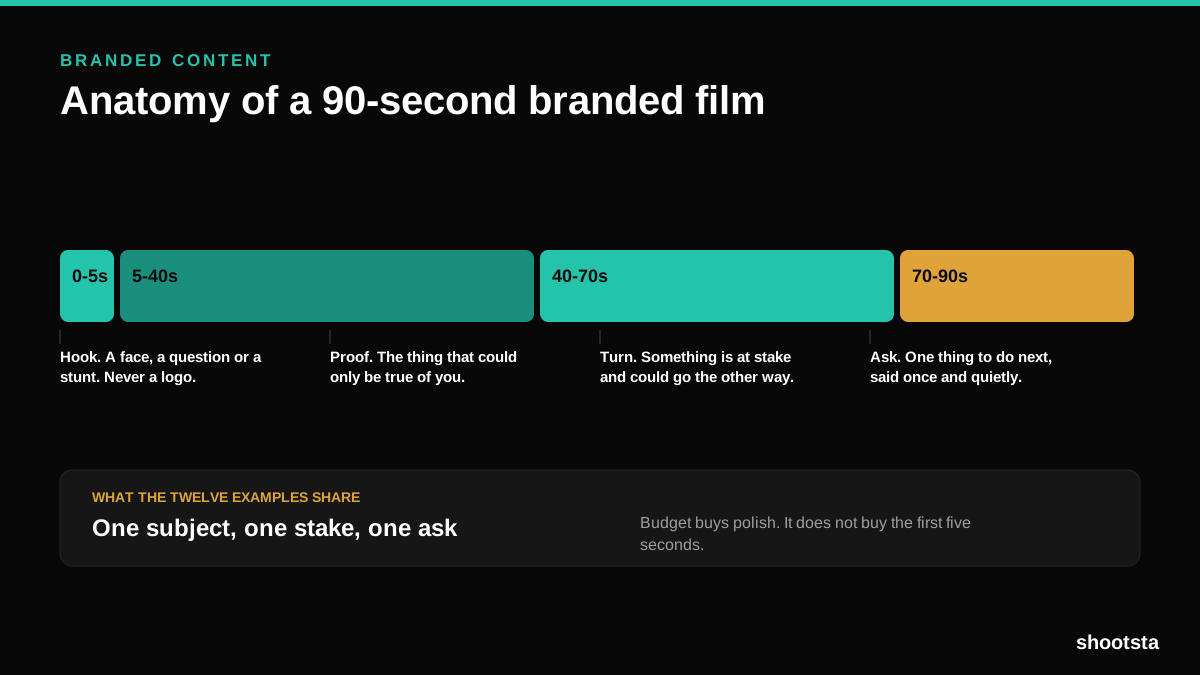
12 Branded Content Examples That Worked
Twelve pieces of branded content that people chose to watch, what each one got right, and the structure underneath all of them.
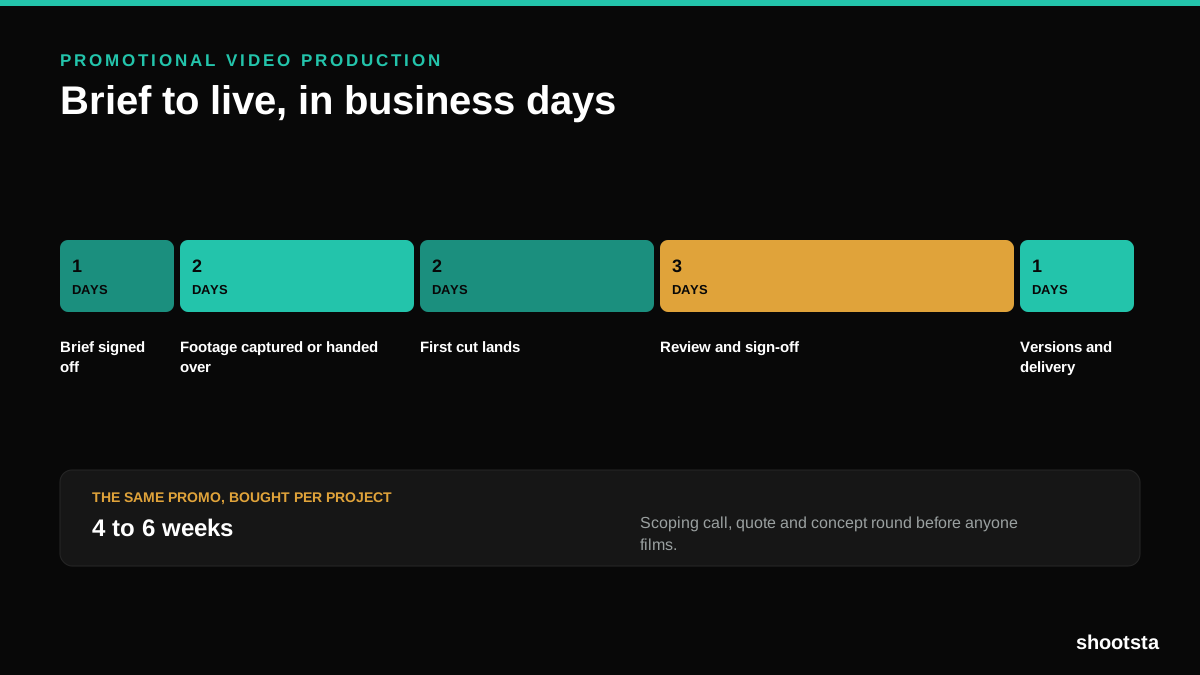
Promotional Video Production: Cost and Time
Most promotional video production schedules are not slow because of the edit. They are slow because of the approval chain. Here is where the days go.
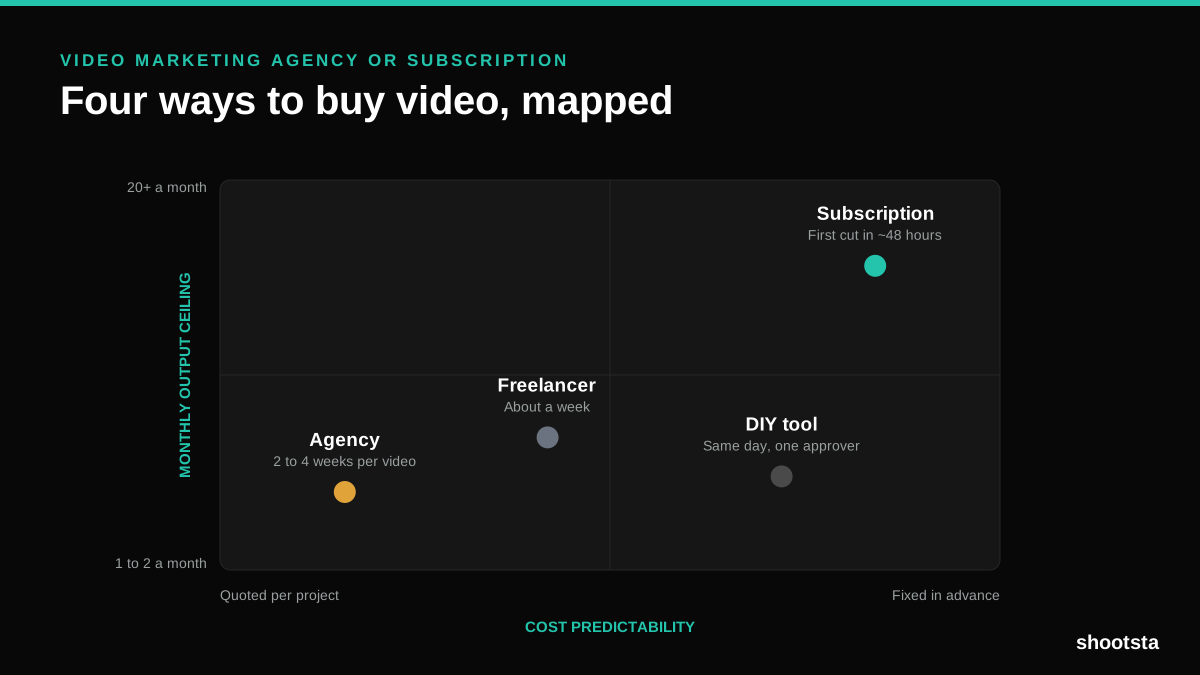
Video Marketing Agency or Subscription?
A video marketing agency prices per project and works in weeks. A subscription prices the year and works in days. Which one fits depends on how often you publish, not on which is better.

B2B Video Production: Costs and Buying Models
There are five ways to buy B2B video production. Each one works well up to a point and then breaks, usually at a volume nobody planned for. Here is what each costs and where the ceiling sits.
How to Measure Video Speed-to-Market
How to Measure Video Speed-to-Market
Speed-to-market is the lag between needing a video and publishing it. For marketing teams it is a revenue metric. Here is how to measure and improve it.