
shootsta.
10 AI Video Nightmares That Hit Bigger Brands
By Shootsta · Published November 25, 2026 · Updated November 2026
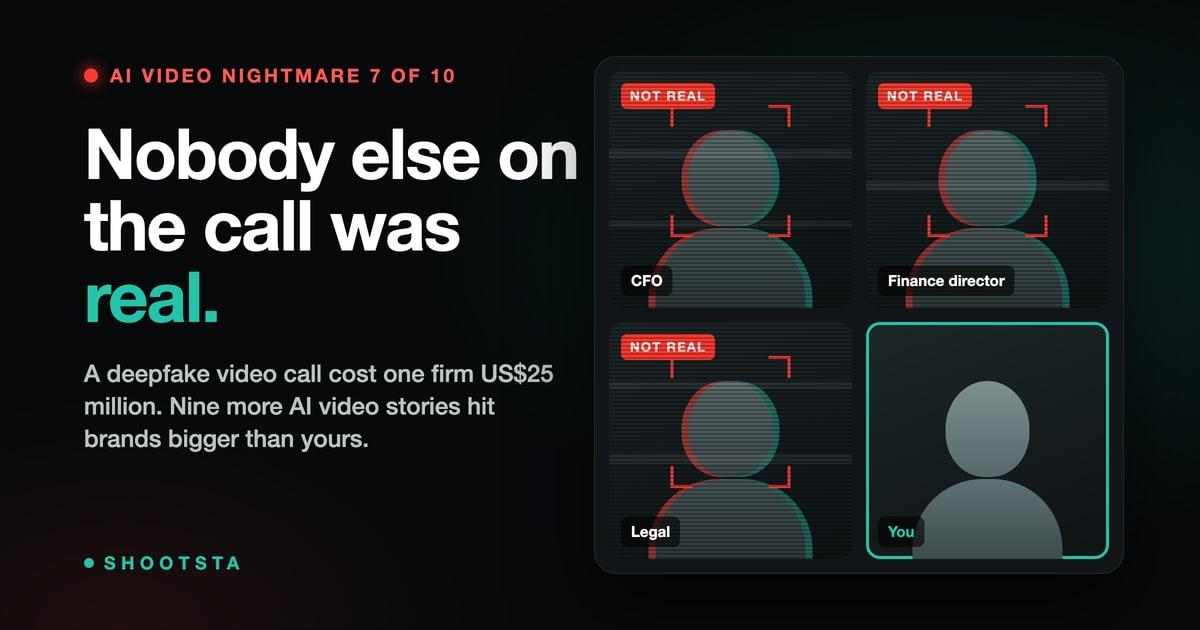
Ten AI video nightmares from 2024 to 2026, from a Christmas ad pulled in three days to a US$25 million deepfake call. Each one happened to a real company, and each one came down to a check that nobody made.
A finance worker in Hong Kong joined a video call with his chief financial officer and a few colleagues. He knew every face on the screen, so he sent HK$200 million to five bank accounts. It later turned out that nobody else on the call was real.
That story is number seven of the 10 AI video nightmares below. The other nine cost less money and caused more public embarrassment. All ten happened to real companies since 2024, and most of those companies have bigger budgets than yours.
One number explains why they keep happening. In the IAB's 2026 study of AI in advertising, 82% of ad executives said young consumers feel positive about AI-generated ads, while only 45% of those consumers agreed. That gap was 32 points in 2024 and has grown to 37, which means the people who approve AI video are grading their own homework.
What counts as an AI video nightmare?
An AI video nightmare is a generated or AI-altered video that damages the brand that published it. The damage can be a pulled campaign, a wave of mockery, lost money or a legal problem. The ten below start with the public flops and end with the quieter risks that sit with your legal and finance teams.
1. McDonald's pulled its AI Christmas ad after three days
McDonald's Netherlands launched a fully AI-generated Christmas ad on 6 December 2025 and removed it three days later. Viewers called it creepy, and the company turned off comments before making the video private.
The head of the production company said her team "hardly slept" for seven weeks and generated thousands of takes, according to eWeek's report on the pulled ad. Seven weeks of work bought three days on air, which is a poor trade for a tool that is sold as the cheap option.
2. Coca-Cola got roasted for its AI holiday ad, then made another
Coca-Cola remade its "Holidays Are Coming" ad with AI in 2024, and viewers called the result soulless. The company came back in 2025 with more AI holiday ads, even after a full year of that criticism. A behind-the-scenes film said five specialists generated over 70,000 clips in 30 days, and critics still spotted a fireplace with no chimney opening.
When it takes 70,000 clips to finish one campaign, the tool is working like a slot machine and someone still has to watch every pull. The campaign tagline is "Real Magic", which did not help the reviews.
3. Meta swapped a menswear ad for an AI granny
True Classic sells clothes to men aged 30 to 45. In October 2025, Meta's Advantage+ tools replaced the brand's best ad, a man in a fleece set, with an AI-generated grandmother in an armchair. The image ran for three days, and customers noticed before the marketing team did.
In 2026, REI ended up with an Instagram ad showing a bike with two handlebars after Meta auto-enrolled it in an AI feature. Meta told reporters that AI can make mistakes and that advertisers are responsible for reviewing the output. The granny was a still image, and the lesson carries straight over to video: the brand check is your job, and the platform will publish without waiting for you to do it.
4. Toys R Us brought its late founder back with Sora
In June 2024, Toys R Us showed a brand film at Cannes Lions that was made with OpenAI's Sora video tool. It showed the company's late founder as a boy, dreaming up the store. Social posts about the brand went from 13.5% negative to 53.4% negative after release, according to sentiment figures reported by Marketing-Interactive.
Toys R Us called the film a success. Viewers saw a brand built on children playing release a film with no real children in it.
5. Svedka's AI Super Bowl ad sent the brief back to humans
Svedka's 2026 Super Bowl ad was billed as the first national spot in the game made mostly with AI. Adweek asked creative leaders to review it, and their verdict was that the ad still needed an idea.
For 2027, Svedka is asking its drinkers to make the ad instead. The prize is US$500,000, and entries do not need to use AI. One year after the robots took the Super Bowl, the creative work went back to people.
Free Consultation
Want a hand with your next video?
Talk to a Shootsta producer about your goals, timeline, and budget. There is no pitch, just advice you can use.
6. Will Smith's tour video showed a crowd with extra fingers
In August 2025, Will Smith posted a tour video full of cheering fans. Viewers spotted blurred faces and extra hands in the crowd. TechCrunch looked closer and concluded that his team had animated real crowd photos with AI and cut them in with real footage.
The fans were probably real, and it made no difference to the reaction. Once viewers found one fake shot, they stopped trusting every other shot in the video, including the honest ones.
7. A deepfake video call cost Arup $25 million
In January 2024, a finance worker at Arup's Hong Kong office was invited to a video call with the CFO and other colleagues. All of them were deepfakes built from public video and audio of the real people. He made 15 transfers worth about US$25.6 million to five bank accounts before anyone noticed.
Arup is the engineering firm behind the Sydney Opera House, and it employs very smart people. Every executive who has appeared on camera has already supplied the raw material for a fake. A familiar face on a call no longer proves who is speaking, so payment requests need a second check by phone.
8. You may not own your fully AI-generated video
On 2 March 2026, the US Supreme Court declined to hear Thaler v. Perlmutter. That left a lower court ruling in place, so work made purely by AI gets no copyright protection in the US. Work with enough human authorship can still be registered, although the American Bar Association notes that nobody has drawn the line precisely.
The risk runs the other way too. Disney and Universal sued Midjourney in June 2025, called it a "bottomless pit of plagiarism" and named its video service in the complaint. A fully generated brand film might be free for a rival to reuse, and it might also contain someone else's property. This is general information, and your legal team should decide which of your videos it covers.
9. OpenAI shut down Sora six months after launch
OpenAI launched the Sora app in September 2025, and on 24 March 2026 it announced that the app and the API were both shutting down. A Disney deal tied to Sora, reported at US$1 billion, ended with it.
Any team that rebuilt its video workflow around Sora had to rebuild it again within months. A video tool is a supplier like any other, and suppliers can leave the market with little warning.
10. Quip made a real ad and viewers called it AI
In March 2026, the toothbrush brand Quip released a 15-second ad made with miniatures and a human actor on a physical set. Commenters accused it of being AI anyway. Quip moved its behind-the-scenes footage forward by about a month and posted it with the caption "No AI, just us".
This is where the other nine stories lead. Audiences now assume the worst about any polished video, so brands that do the real work have to prove it.
What do these AI video nightmares have in common?
Each story broke at a point where nobody was checking. A team shipped a fireplace that nobody had looked at closely, and an ad platform published an image that nobody had previewed. A finance worker trusted a call that nobody had verified, and brands built on tools whose terms nobody had read.
In every case the AI did roughly what it was asked to do. The missing piece was a person with the eye and the authority to send the work back before anyone outside the company saw it.
AI has a place in video production, and it saves time on drafts. Publishing its output unchecked under your logo is a gamble with your brand. Our AI video quality checklist covers what to look for before you publish, and our guide to what AI slop video is explains why viewers spot it so fast.
How Shootsta helps when AI video goes wrong
At Shootsta, we work on human edited video. Our editors work inside your brand templates, and your team reviews each cut on the timeline before anything ships. That review step is the one the ten brands above skipped.
If you already have an AI video that is not working, Shootsta Snap AI video clean-up puts a human editor on it. We work to a first cut in about 48 hours, and anything faster is quoted separately. You can read how to fix AI generated video shot by shot first, or compare what AI video clean-up costs.
Frequently asked questions
What is the biggest risk of using AI video in marketing?
The biggest risk is publishing something nobody on your team has checked closely. Most of the public failures above came from a skipped review, and the tools themselves worked as designed. A named person should approve every AI video against your brand rules before it goes out.
Do consumers dislike AI-generated ads?
Many do, and marketers tend to underrate it. The IAB's 2026 study found that 45% of Gen Z and Millennial consumers feel positive about AI-generated ads, while 82% of ad executives assumed they did. Among Gen Z, 39% said they feel negative about them.
Can you copyright an AI-generated video?
In the US, work made purely by AI cannot be registered for copyright. Work with enough human authorship can be, and the line between the two has not been set precisely. Rules differ by country, so check with your legal team.
Can a bad AI video be fixed?
Often it can, because an editor can replace the worst shots, repair warped hands and faces, and regrade the footage so it matches your brand. Some videos are cheaper to remake, and a good editor will tell you which kind you have. We explain the usual causes in why AI video ads look uncanny.
Sources and further reading
- IAB and Sonata Insights, The AI Ad Gap Widens (January 2026), the source for the 82% and 45% figures and the Gen Z numbers.
- eWeek and Fox Business on the McDonald's Netherlands Christmas ad, December 2025.
- NBC News and Euronews on Coca-Cola's 2024 and 2025 AI holiday ads.
- Business Insider and TNW on Meta's Advantage+ AI ad tools, True Classic and REI.
- NBC News and Marketing-Interactive on the Toys R Us Sora film, June 2024.
- TechCrunch, Adweek and Marketing Brew on Svedka's 2026 Super Bowl ad and its 2027 plans.
- NME and TechCrunch on the Will Smith tour video, August 2025.
- Fortune on the Arup deepfake fraud in Hong Kong, 2024.
- The American Bar Association on the Thaler copyright case, and Reuters on the Disney and Universal lawsuit against Midjourney.
- Axios and PetaPixel on the Sora shutdown, March 2026.
- Modern Retail on Quip's practical-effects ad, April 2026.
Take this article with you
Read the latest at shootsta.com/blog/ai-video-nightmares
You might also like
AI Video Quality Checklist Before You Publish
A pre-publish AI video quality checklist covering visuals, text and logos, audio, brand, legal and disclosure, and platform specs, with a table of who should sign off each part.
AI Slop Video: What It Is and How to Spot It
AI slop is video that viewers can tell was machine-made, from warped hands to garbled logos and drifting lip-sync. Here are the tells, what they cost a brand and how to check your own video before it goes out.
Brand Consistency Across Localized Video
Brand Consistency Across Localized Video
Brand consistency across localized video comes from governance and shared templates, not from hoping regional teams stay on brand by themselves.
What Your In-House Video Person Should Hand Off
When every video request runs through one or two people, the queue only grows. Chad Lakin explains how brands split the work between the in-house team and a partner without adding headcount.
Video Marketing Agency: What It Does and Costs
What a video marketing agency does, the four kinds you will meet, what they cost in the US, Australia and the UK, and when a managed video partner is the better buy.
How Creative Directors Keep Brand Consistency
How Creative Directors Keep Brand Consistency
Brand guides were written for things that sit still. This is how creative directors maintain brand consistency in video: the decisions they own on pace, music and the look, where they step into a production, and how their taste holds up when output grows.